PVC Pipe Slope Calculator
Check pipe fall, slope percent, fall per foot, partial-flow Manning velocity, and the minimum velocity target before trenching a PVC drain run.
Use one consistent elevation datum for the inlet and outlet. The calculator treats positive fall as flow from the start elevation down to the end elevation, then checks the selected flow depth with the Manning equation.
Outlet elevation is too high for gravity flow. Recheck grade, bedding, and outlet depth before setting pipe.
Useful for larger storm or yard drains when cover depth is tight and the pipe still has positive fall.
Often the practical range for small PVC gravity drains, with 1/8 to 1/4 inch of fall per foot.
Good for moving water quickly, but sanitary drains may need code checks to avoid solids separation.
Pipe Slope Results
Your calculated grade and velocity will appear here.
| Calculation | Formula | Imperial example | Metric example |
|---|---|---|---|
| Total fall | start elevation - end elevation | 100.00 ft - 99.20 ft = 0.80 ft | 30.00 m - 29.76 m = 0.24 m |
| Slope percent | (fall / run) × 100 | (0.80 / 80) × 100 = 1.00% | (0.24 / 24) × 100 = 1.00% |
| Fall per foot | slope decimal × 12 | 0.010 × 12 = 0.12 in/ft | 0.010 × 1000 = 10 mm/m |
| Target fall | run × target slope / 100 | 80 ft × 1% = 0.80 ft | 24 m × 1% = 0.24 m |
| Item | Formula or value | What it means | Calculator use |
|---|---|---|---|
| Manning velocity | V = (1.486 / n) R^(2/3) S^(1/2) | Imperial open-channel velocity in ft/s | Uses actual positive slope, or target slope if actual slope is flat. |
| Metric form | V = (1 / n) R^(2/3) S^(1/2) | Metric open-channel velocity in m/s | Inputs convert internally so both unit modes agree. |
| Hydraulic radius | R = area / wetted perimeter | Partial pipe geometry changes with flow depth | Flow depth percent sets area and wetted perimeter. |
| Minimum velocity | Often checked near 2 ft/s | Helps keep solids moving in gravity drains | Card 3 compares Manning velocity to your entered minimum. |
| Nominal PVC | Common slope check | Fall per foot | Typical use |
|---|---|---|---|
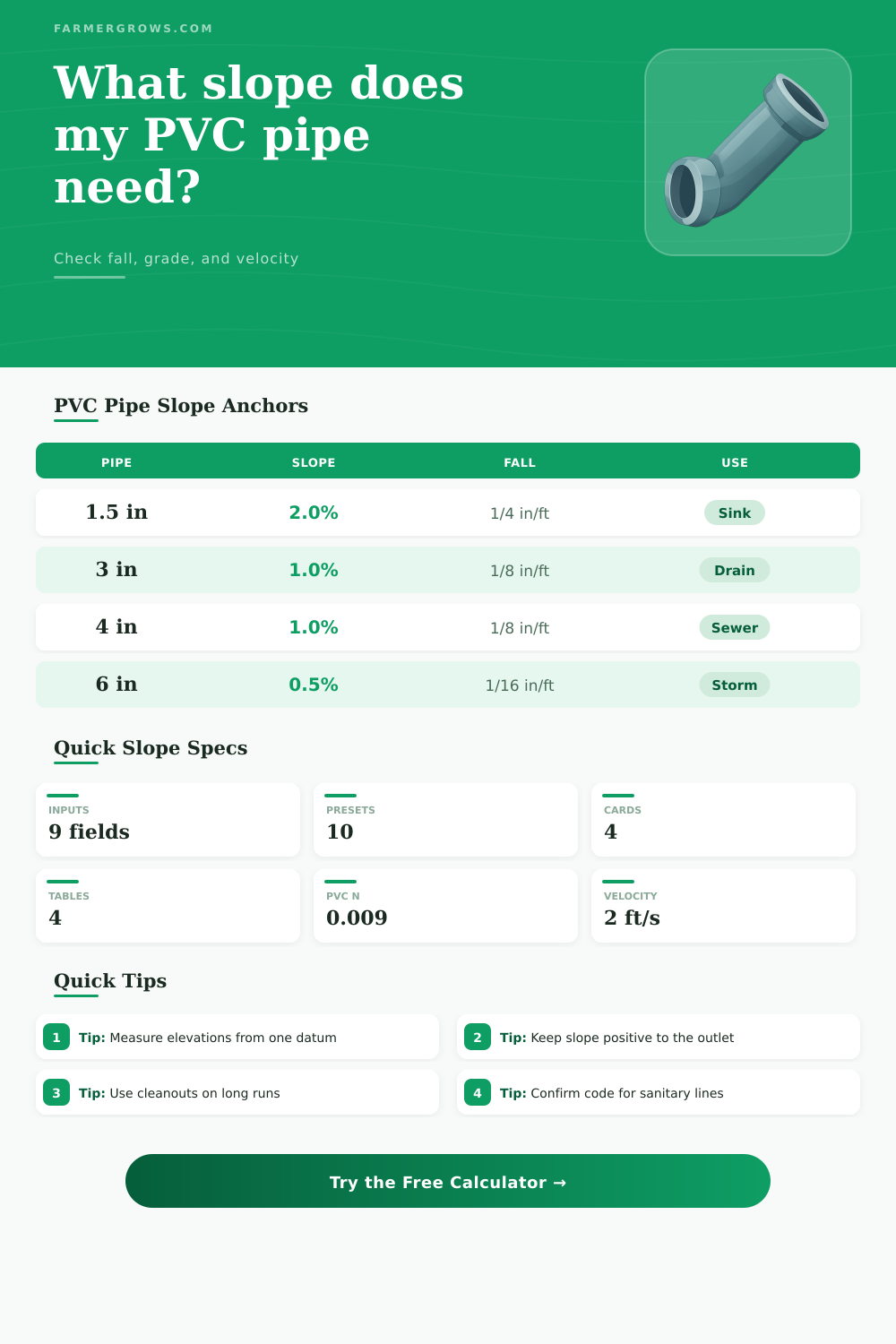
| 1.5 in | 2.0% | 1/4 in per ft | Fixture branch or small condensate-style gravity runs. |
| 2 in | 2.0% | 1/4 in per ft | Small floor drains and short utility drain branches. |
| 3 in | 1.0% to 2.0% | 1/8 to 1/4 in per ft | Building drains and longer gravity runs where cover matters. |
| 4 in | 1.0% | 1/8 in per ft | Building sewer, storm drain, and farm utility drainage checks. |
| 6 in | 0.5% to 1.0% | 1/16 to 1/8 in per ft | Larger storm or yard drainage where flow depth varies widely. |
| Surface or preset | Manning n | Target slope | Notes |
|---|---|---|---|
| New smooth PVC | 0.009 | Use design grade | Best-fit value for clean, smooth plastic pipe. |
| Aged PVC | 0.010 to 0.011 | Use design grade | Reasonable check when pipe is not perfectly clean. |
| Perforated PVC in gravel | 0.011 to 0.013 | 0.5% to 1.0% | Good for yard drains, but envelope material controls performance. |
| Sanitary gravity run | 0.009 to 0.011 | 1.0% to 2.0% | Always compare final layout against local plumbing requirements. |
Set both elevation readings from the same benchmark. A laser level, transit, or water level gives a cleaner slope than measuring trench depth from uneven soil.
Do the math before fittings are glued. A short flat section, raised outlet, or sag between bedding points can erase the slope shown on the overall run.
The calculator combines elevation grade, target fall, partial-pipe geometry, and Manning velocity so you can compare the planned PVC slope against practical drainage performance.
A slope calculator is an tool that will allow you to determine the proper grade that your PVC pipe should have to ensure that the water correctly drain through the pipe. If the grade or slope of the PVC pipe is incorrect, the water will remain in the trench and the PVC pipe will eventualy become clogged with the solid waste that pass through the pipe. A slope calculator will take the measurements of your PVC pipe that you have and convert that into the numbers that will indicate the slope of the PVC pipe and the velocity at which the water will travels through that pipe.
To use a slope calculator for your PVC pipe, you will need to provide several different inputs to the calculator. The various parameters that you will need to input include the length of the run of your PVC pipe, the elevation difference between the start and the end of the pipe, the diameter of the PVC pipe, and the depth at which the water will falls within the PVC pipe. Each of these parameter is important for determining the slope that your PVC pipe should have in order for it to function as expected.
How to Use a PVC Pipe Slope Calculator
Based on the inputs that you provide to the slope calculator, the calculator will provide you with several different results. The results will include the actual slope that your PVC pipe should create, the fall that the pipe will have per foot of that pipe, the total fall that the pipe will experience, and the Manning velocity of the pipe. The Manning velocity will allow you to ensure that the velocity of the water through the PVC pipe is sufficient to allow for self-cleansing of that pipe; the self-cleansing threshold for most PVC pipes is around 2 feet per second.
If the velocity is too low, the slope calculator will allow you to determine whether increasing the fall or the flow depth will help increase that velocity; however, you must ensure that there is enough depth within the trench to make such an adjustment. The different types of PVC pipes will have different required slopes. For instance, a four-inch diameter pipe that you will use to allow for building sewer systems may have a one percent slope as its requirement, but a six-inch diameter pipe that will be used for storm systems may have a steeper slope at a one percent slope if it is only half-full of water.
Additionally, a yard drain may require a different slope then a sink drain due to the different amounts of waste that may pass through each pipe. The slope calculator will allow you to test each of these scenarios to determine which slope will provide the best results for your pipe. In addition to the parameters that you input into the calculator, there are a few external factors that may impact how well your PVC pipe drain.
For instance, if the soil in which the PVC pipe is installed is not even in its settling, that could impact the slope of the pipe. Additionally, tree roots may lift the outlet of the PVC pipe. Use the cleanouts that are provided in the PVC pipe to allow for maintenance of the system and to ensure that the elevation of the PVC pipe is correctly set; the slope calculator will not warn you of these potential issue, but it will give you a baseline from which to recognize such problems.
The roughness of the interior of the PVC pipe will also impact the velocity of the water through that pipe. If the pipe is relatively new, the roughness of the pipe is likely to be approximately 0.009; however, if the PVC pipe is older and has accumulated sediment within it’s interior, the roughness may be closer to 0.011. The velocity will be reduced if the pipe is relatively old and features a higher coefficient of roughness.
The slope calculator will allow you to input each of these different coefficients to determine if a steeper slope will be required for old PVC pipe. Finally, there may be code requirements for your area that relate to the velocity of the water through your PVC pipe. For instance, there may be a minimum recommended velocity for sewage systems to avoid issues like blockages, but there may be a maximum recommended velocity for those same systems to avoid erosion of the pipe.
The slope calculator will not replace the local code tables in your area, but the slope calculator will allow you to determine if your chosen slope will meet the velocity requirements of the local code. Additionally, dont simply choose the slope for your PVC pipe based off the slope that you used on a previous project. Assuming that the velocity that the slope calculator calculates is too low for your projects requirements, there are several options for correcting that issue.
One solution is to increase the total fall of the PVC pipe; however, only if there is enough depth within the trench to allow for such an adjustment. Additionally, reducing the diameter of the PVC pipe will increase the velocity of the water through that pipe. Finally, another option is to increase the flow depth of the water when there is heavy rain falling; however, this would mean accepting that the velocity will be slower during periods of light rain.
The best way to use a slope calculator for your PVC pipe is to run the numbers through the calculator at least twice. First, run the numbers to determine the slope that your PVC pipe should have based on your plans for the site. However, run the numbers a second time in which you incorporate the potential effects of the outlet of the pipe (which may be higher than you had originally planned); this will allow you to determine the safety margin of your pipe design.
A large safety margin will be beneficial; it will provide you with some time to make mistakes when laying your pipe. Thus, a slope calculator will allow you to convert your measurements to useful numbers that will allow you to design your PVC pipe in such a way as to ensure that the water correctly moves through it.