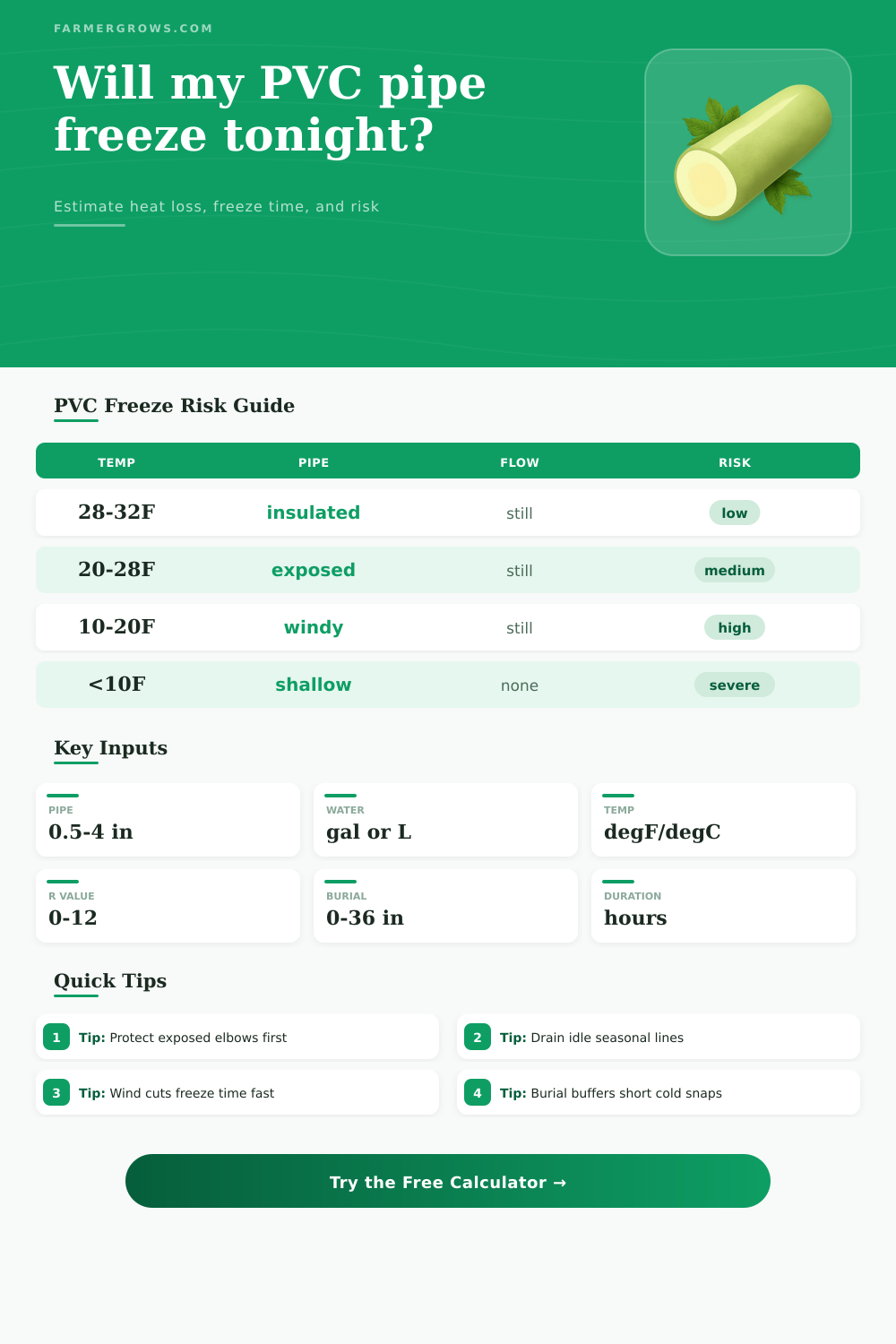
PVC Pipe Freeze Calculator
Estimate water volume, heat loss, time to first ice, and full freeze risk for PVC pipe using pipe size, water temperature, ambient temperature, insulation R value, burial depth, wind exposure, flow status, and exposure duration.
This calculator treats the pipe as a water-filled cylinder losing heat to cold air or soil. It estimates the time to reach 32°F, the added time to freeze the water, and the risk during the entered cold exposure.
Freeze Risk Estimate
Results update after calculation.
Compare the current line against common freeze-protection changes. The same pipe, water temperature, ambient temperature, wind, flow, and duration are used for each card.
| Nominal PVC Size | Inside Diameter | Gallons per 100 ft | Liters per 30 m |
|---|---|---|---|
| 1/2 in Schedule 40 | 0.622 in | 1.58 gal | 5.88 L |
| 3/4 in Schedule 40 | 0.824 in | 2.77 gal | 10.31 L |
| 1 in Schedule 40 | 1.049 in | 4.49 gal | 16.72 L |
| 1-1/2 in Schedule 40 | 1.610 in | 10.58 gal | 39.38 L |
| 2 in Schedule 40 | 2.067 in | 17.45 gal | 64.96 L |
| 4 in Schedule 40 | 4.026 in | 66.12 gal | 246.16 L |
| Air Temperature | Typical Concern | Exposed PVC Note | Buried PVC Note |
|---|---|---|---|
| 30 to 32°F | Low for short nights | Watch thin lines and metal valves | Usually buffered by soil |
| 24 to 30°F | Moderate after several hours | Insulate elbows and hose bibs | Shallow cover may still be safe |
| 15 to 24°F | High for idle water | Drain or add heat where possible | Depth and soil moisture matter |
| Below 15°F | Severe for small exposed pipe | Protect, drain, or keep controlled flow | Local frost depth should be checked |
| Condition | Calculator Treatment | Practical Meaning | Common Farm Example |
|---|---|---|---|
| Sheltered still air | Lower heat transfer | Pipe cools slower | Inside pump house or protected bay |
| Open windy area | Higher heat transfer | Pipe loses heat faster | Riser on a fence line or field edge |
| Slow drip | Small heat credit | Delay, not guaranteed protection | Hose bib drip during frost night |
| Continuous flow | Larger heat credit | Warmer upstream water can dominate | Active livestock or greenhouse line |
| Protection Detail | Typical R Input | Best Use | Limit to Remember |
|---|---|---|---|
| Bare PVC | 0 | Short mild frost only | Wind and fittings remain vulnerable |
| Thin foam sleeve | 1 to 2 | Protected sheds and crawlspaces | Gaps at tees reduce performance |
| Thicker pipe wrap | 3 to 5 | Exposed risers and hose bib branches | Keep wrap dry and continuous |
| Boxed pipe plus wrap | 6 to 10 | Windy outdoor runs | Still needs sealed ends |
This is a planning estimate for water-filled PVC, not a guarantee against pipe damage. Local frost depth, soil moisture, pipe joints, fittings, and actual wind exposure can change the result.
When you manage PVC pipe in cold weather, you must determine if the water inside the PVC pipes will freeze. The air temperature is one factor that determine whether the water will freeze, but it isnt the only factor. The water in the PVC pipes will expand if it turn to ice, and this expansion will cause the PVC pipes to break.
The risk of the PVC pipes breaking from expanding ice occur when the air is still and the heat leaves the PVC pipes steadily without being replaced by new heat. The calculator requires that you enter specific data to perform the math for you. Data such as the size of the pipe, the length of the pipe, the starting temperature of the water in the pipes, the ambient air temperature, the insulation value of the pipe, the burial depth of the pipe in the ground, the exposure of the pipe to the wind, and whether the water is in flow within the pipes.
How to Protect PVC Pipes from Freezing
The diameter of the pipe impact the amount of water within the PVC pipes. The length of the pipe impacts how many individual volume of water are within the system. The starting temperature of the water within the PVC pipes determines how much heat must be lost before the water reaches its freezing point.
The ambient air temperature is the force that cause heat to leave the PVC pipes. The insulation and burial depth of the PVC pipes make it more difficult for heat to leave the pipes. If the pipes are expose to the wind, it will make it easier for heat to leave the system.
The status of water flow within the PVC pipes will impact how quickly the system reaches its freezing point. Many people only consider the lowest temperature that will be present in the air during the winter month. The low temperature is important to consider, but it is not the only consideration for PVC pipe management.
If it is a short period of time that the low temperatures will be present, the water in the pipes will not necessarily freeze. However, if the low temperatures are present for long period of time, the water will likely freeze. The calculator will account for the time that is required for the first ice to form within the system and for the entire volume of water to reach its freezing point.
First ice can cause damage to the system, but so can a full freeze of the water within the PVC pipes. One of the most important factor to consider as a means of protecting the PVC pipes from freezing is the burial depth of the pipes in the ground. Burial depth is a more reliable form of protection than insulation.
The soil keep the pipes from experiencing air temperatures, and instead from experiencing the average ground temperature. The average ground temperature changes slowly, so cold spells in the air that last only a few days will not impact the PVC pipes that are buried in the soil. The calculation of the system accounts for the burial depth of the pipes, and the comparison grid indicate that the risk of the PVC pipes freezing drops as the burial depth increase.
Pipes that are inside of walls or within crawl spaces are also protected due to the buildings structure acting as a buffer from the wind. Wind can be a factor in the removal of heat from PVC pipes. Even if the breeze that falls upon the pipes is warmer than the air in the same area when there is no wind, the wind will remove the heat from the PVC pipes at a faster rate.
The calculator accounts for the effect of the wind with a multiplier, and the wind adjustment table display the difference in temperature between a sheltered area versus an open area. Exposed areas of PVC pipes that may be affected by the wind include short run of exposed pipes, elbows, and branches of hose bibs. These areas are expose to the wind, and the greater relative surface area of the fittings relative to the volume of water that passes through them, indicate that these areas are not insulated as well as the main portion of the PVC piping.
The status of the water that is moving through the PVC pipes can also play a role in the rate at which the water within the PVC pipes will freeze. While the movement of water through the pipes will not ensure that the PVC pipes will not experience freezing, moving water does introduce a change into the equation for calculating the rate of freezing of the water within the pipes. When water is in movement, it will carry heat from the sections of the pipes upstream of the area being considered.
Additionally, movement of the water will prevent the formation of an ice layer along the inner walls of the PVC pipes. Thus, moving water is considered to be a heat credit in the calculation of the time that it will take for the water within the PVC pipes to reach 32 degree F. Lines that have a continual flow of water tend not to experience freezing, but drip irrigation pipes that may only flow at night may experience freezing due to the partial heat credit provided by the moving water. The calculator also include tables that include the data that was discussed within the article.
The PVC volume table indicate the way in which the volume of water that can be within the PVC pipes increases as the diameter of those pipes increases. The temperature concern table provide information to the users regarding the types of insulation that may be required for the PVC pipes according to the calculated temperatures. The R-value table indicate the insulation that may be provided by various insulation product.
These tables provide information that will allow the PVC pipe systems of different properties to be treated differently. In addition to the factors that are considered within the calculator, there are additional variable that may exist within the properties that are not accounted for by the calculator. Factors like the moisture content of the soil where the PVC pipes are buried, the condition of the joints in those PVC pipes, the amount of exposure of the pipes to the sun, and the depth to which the pipes are buried in relation to the records of the depth of frost in the area can have an impact upon the freezing of the water within those pipes.
These variables may lead to the difference between two different individuals using the same calculator to assess their properties. Accordingly, individuals should utilize the calculator to determine which areas of the water systems of the properties are at the highest risk of freezing. Thus, protection should be provided to short run of exposed water pipes, valves, and risers.
Additionally, while it may be beneficial to provide protection to all of the buried portion of the water systems, those long buried portions should be monitored rather than provided with protection. Moreover, rather than providing protection to all of the buried pipes, drainage should be provided to the seasonal line that use those PVC pipes. These decisions could of been made in advance of the arrival of colder temperature with the information that the calculator provide.