⚙️ PTO Speed Calculator
Calculate PTO output RPM, gear ratios, shaft speed, and torque for tractors & implements
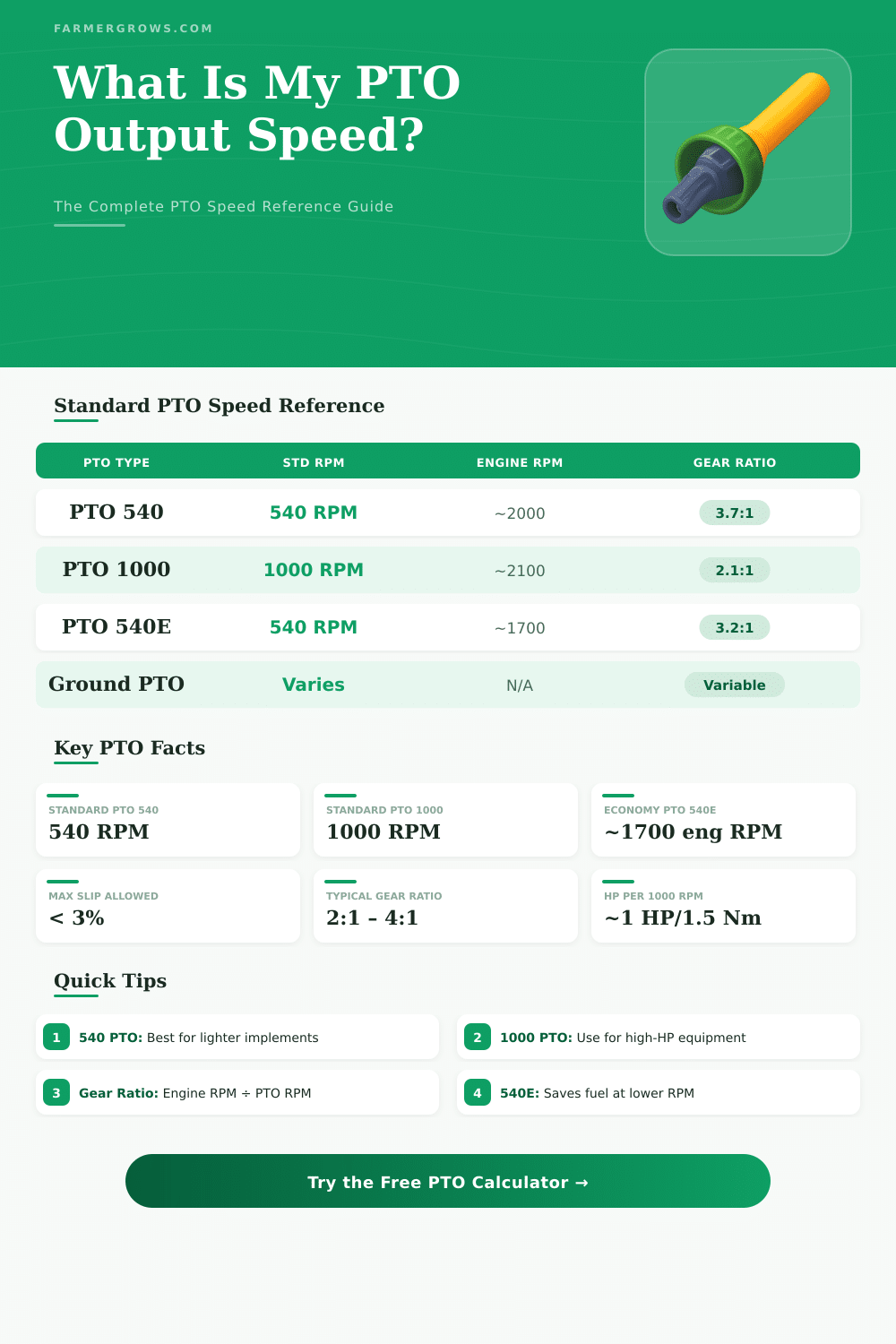
| PTO Type | Output RPM | Typical Engine RPM | Gear Ratio | Spline Count | Shaft Dia. | Typical HP Range |
|---|---|---|---|---|---|---|
| PTO 540 (SAE) | 540 RPM | 1900–2200 | ~3.5–4.1:1 | 6 | 1-3/8 in (35mm) | Up to 65 HP |
| PTO 540E Economy | 540 RPM | 1400–1700 | ~2.6–3.1:1 | 6 | 1-3/8 in (35mm) | Up to 65 HP |
| PTO 1000 (SAE) | 1000 RPM | 1900–2200 | ~1.9–2.2:1 | 21 | 1-3/4 in (45mm) | 65–200 HP |
| PTO 1000E Economy | 1000 RPM | 1500–1900 | ~1.5–1.9:1 | 21 | 1-3/4 in (45mm) | 65–200 HP |
| Ground Drive PTO | Variable | N/A | Speed-dependent | 6 or 21 | 1-3/8 or 1-3/4 in | Varies |
| Hydraulic PTO | Variable | N/A | N/A | N/A | Hydraulic ports | Up to 50 HP |
| Gear Ratio | @ 1500 RPM eng | @ 1800 RPM eng | @ 2000 RPM eng | @ 2200 RPM eng | Target PTO |
|---|---|---|---|---|---|
| 2.0:1 | 750 RPM | 900 RPM | 1000 RPM | 1100 RPM | ~1000 PTO |
| 2.2:1 | 682 RPM | 818 RPM | 909 RPM | 1000 RPM | ~1000 PTO |
| 3.0:1 | 500 RPM | 600 RPM | 667 RPM | 733 RPM | — |
| 3.5:1 | 429 RPM | 514 RPM | 571 RPM | 629 RPM | ~540 PTO |
| 3.7:1 | 405 RPM | 486 RPM | 541 RPM | 595 RPM | ~540 PTO |
| 4.0:1 | 375 RPM | 450 RPM | 500 RPM | 550 RPM | ~540 PTO |
| 4.5:1 | 333 RPM | 400 RPM | 444 RPM | 489 RPM | — |
| PTO HP | @ 540 RPM (ft·lbf) | @ 540 RPM (N·m) | @ 1000 RPM (ft·lbf) | @ 1000 RPM (N·m) |
|---|---|---|---|---|
| 20 HP | 195 ft·lbf | 264 N·m | 105 ft·lbf | 143 N·m |
| 40 HP | 390 ft·lbf | 529 N·m | 210 ft·lbf | 285 N·m |
| 65 HP | 633 ft·lbf | 858 N·m | 341 ft·lbf | 463 N·m |
| 100 HP | 974 ft·lbf | 1,320 N·m | 525 ft·lbf | 712 N·m |
| 150 HP | 1,461 ft·lbf | 1,981 N·m | 788 ft·lbf | 1,068 N·m |
| 200 HP | 1,948 ft·lbf | 2,641 N·m | 1,050 ft·lbf | 1,424 N·m |
| Implement | Required PTO RPM | Typical HP Draw | Gear Ratio Needed | Notes |
|---|---|---|---|---|
| Rotary Mower / Bush Hog | 540 RPM | 10–60 HP | ~3.5–4.1:1 | 6-spline shaft |
| Round Baler | 540 or 1000 | 40–120 HP | Varies | Check manual |
| Square Baler | 540 RPM | 25–80 HP | ~3.7:1 | Flywheel required |
| Rotary Tiller | 540 RPM | 15–75 HP | ~3.7:1 | Depth affects load |
| Hay Mower Conditioner | 1000 RPM | 40–100 HP | ~2.1:1 | 21-spline shaft |
| Grain Auger | 540 RPM | 5–30 HP | ~3.7:1 | Capacity dependent |
| Sprayer Pump | 540 RPM | 5–20 HP | ~3.7:1 | Flow-rate dependent |
| PTO Generator | 1000 or 1800 | 20–150 HP | 2.0–2.1:1 | Freq. critical (60 Hz) |
| Wood Chipper | 540 or 1000 | 20–100 HP | Varies | Flywheel smooths load |
| Post Hole Digger | 540 RPM | 5–25 HP | ~3.7:1 | Soil type matters |
The PTO speed matters more than many folks know when you choose a tractor or get ready to use it That Power Take-Off system moves power to various tools (mowers), balers, tillers, augers, corn huskers, grain elevators, snow blowers and manure spreaders. The problem is, not every PTO twists the same. They have different speeds according to the tractor and the tool that you hook up.
In April 1927 ASAE made the first real industry standard for PTO speed. They chose 536 rpm, give or take 10 and clockwise rotation. Today the standards shifted a bit.
Match PTO Speed to Your Tools
Modern tractors usually use 540 rpm or 1000 rpm for their PTO. Some new models also offer economic options that change the speed.
540 rpm is the most common spedd. Almost all tools, especially for small tractors, are made exactly for that speed. Truly, most PTO tools work best at 540 rpm.
But here is the trick: because the PTO passes through the transmission, that 540 speed depends on the engine speed.
Most today’s tractors have tachometers that show the engine speed to reach 540 or 1000 rpm at the PTO. Usually that is between 2000 and 2200 rpm. Some models have PTO gearboxes to choose several speeds, for instance 540, 750 and 1000.
In the 1950s, diesel tractors reached 540 rpm in only 1800 engine rpm, but new models commonly require around 2600 rpm.
In the range of 100 to 200 horsepower bigger tractors have 540/1000 PTO, although there is only one splined shaft left. The driver simply clicks a switch in the cab to choose the wanted speed. A tractor with 1000-rpm PTO reaches its maximum 1000 ft-lb torque only at about 190 PTO horsepower.
Here is what becomes interesting: the engine can turn more slowly and still keep the PTO at 540 rpm by means of the 1000 gearing. Here is the advantage of economy settings. For the first pass with a mower you require much power, so the engine must turn fast; around 1800 rpm.
At a 540 mower the 540 setting keeps the blade at the right speed.
Wheel speed PTO is entirely different. It is for tools that require precise input according to the travelspeed of the tractor, for instance rakes. For feed mixers or potato harvesters you must increase the PTO speed.
Speed increaser gearboxes take the tractor output and expand it according to a gear ratio, occasionally directly to a hydraulic pump. Match the PTO speed to the actual work makes everything smooth and keeps things safe.