PPFD Calculator
Estimate average canopy PPFD, DLI, fixture coverage, and crop-stage fit from fixture PPF, count, canopy size, hanging height, beam angle, dimmer level, and optical losses.
This calculator uses practical grow-light approximations: average PPFD is effective canopy PPF divided by canopy area, beam footprint is based on height and beam angle, and DLI is PPFD multiplied by photoperiod.
Gentle intensity keeps young roots and leaves active without forcing excess transpiration.
Lettuce, herbs, and microgreens often perform well with moderate PPFD and steady DLI.
Faster canopy expansion usually needs stronger light, especially under longer photoperiods.
Fruit crops can use high PPFD when nutrients, CO2, airflow, and temperature keep pace.
PPFD Estimate
The estimate combines fixture PPF, dimmer level, canopy area, spill capture, reflectance recovery, and optical losses.
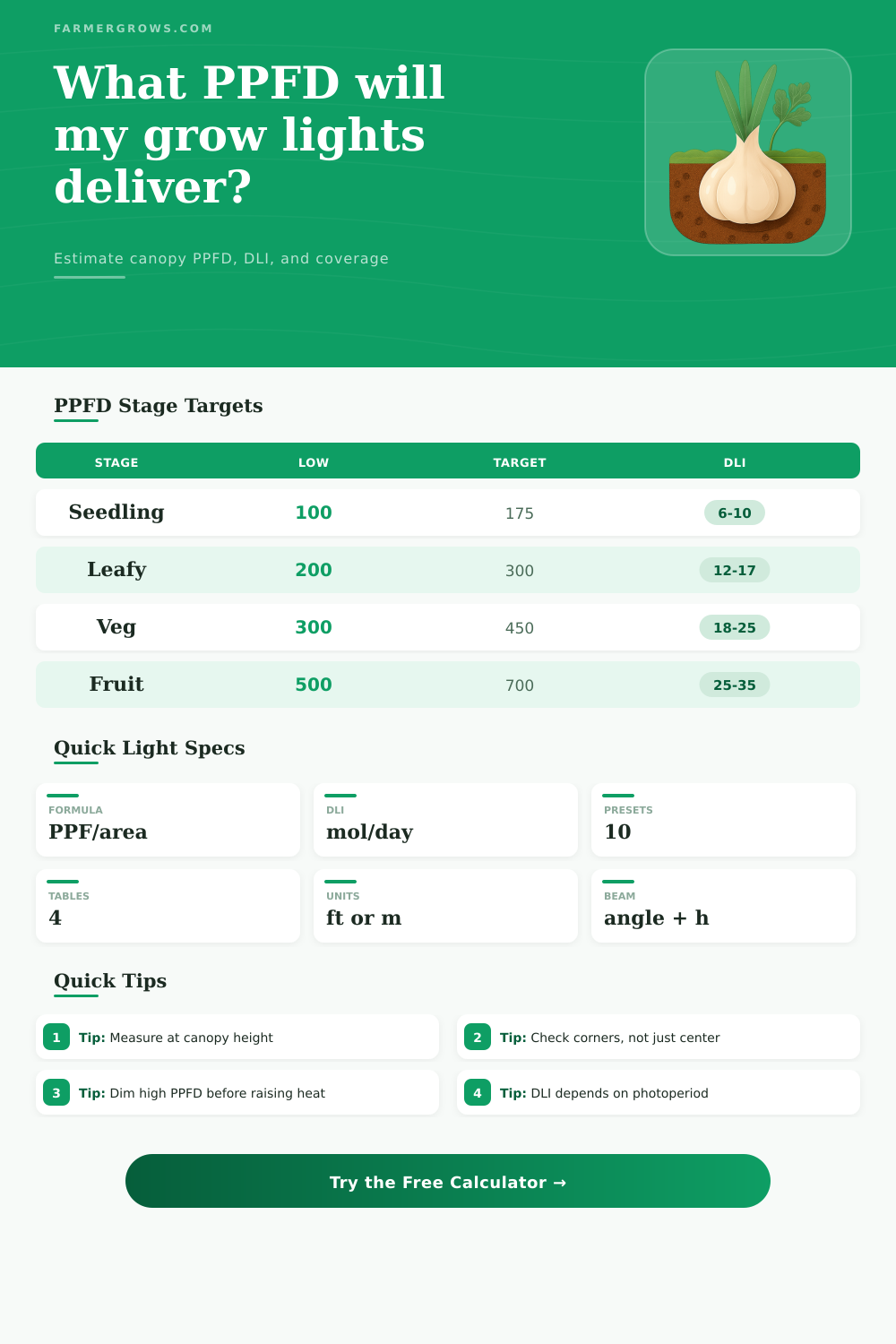
| Crop stage | Typical PPFD range | Common photoperiod | Approx DLI range |
|---|---|---|---|
| Seedling / clone | 100-250 umol/m²/s | 16-18 hours | 6-16 mol/m²/day |
| Microgreens | 150-300 umol/m²/s | 14-18 hours | 8-19 mol/m²/day |
| Leafy greens | 200-400 umol/m²/s | 14-18 hours | 10-26 mol/m²/day |
| Culinary herbs | 250-500 umol/m²/s | 14-18 hours | 13-32 mol/m²/day |
| Vegetative growth | 300-600 umol/m²/s | 16-18 hours | 17-39 mol/m²/day |
| Flowering transition | 450-750 umol/m²/s | 12-14 hours | 19-38 mol/m²/day |
| Fruiting vegetables | 500-800 umol/m²/s | 12-16 hours | 22-46 mol/m²/day |
| High-light fruiting | 700-1000 umol/m²/s | 12-16 hours | 30-58 mol/m²/day |
| Beam angle | Footprint diameter formula | At 12 in height | At 24 in height |
|---|---|---|---|
| 60 degrees | 2 x height x tan(30 degrees) | 1.15 ft diameter | 2.31 ft diameter |
| 90 degrees | 2 x height x tan(45 degrees) | 2.00 ft diameter | 4.00 ft diameter |
| 110 degrees | 2 x height x tan(55 degrees) | 2.86 ft diameter | 5.71 ft diameter |
| 120 degrees | 2 x height x tan(60 degrees) | 3.46 ft diameter | 6.93 ft diameter |
| Metric | Formula | Meaning | Use in calculator |
|---|---|---|---|
| Source PPF | PPF per fixture x fixture count | Total fixture photon output | Before dimming and losses |
| Effective PPF | Source PPF x dimmer x retention x capture | Photons estimated on canopy | Includes loss and spill checks |
| Average PPFD | Effective PPF / canopy m² | Canopy-average intensity | Main intensity estimate |
| DLI | PPFD x hours x 3600 / 1,000,000 | Daily photons per area | Stage and crop planning |
| Canopy setup | Example fixtures | Planning note | Meter check |
|---|---|---|---|
| 2 x 4 ft shelf | One 250-350 PPF bar set | Good for seedlings, herbs, leafy crops | Check both ends of shelf |
| 4 x 4 ft tent | One 600-900 PPF panel | Often enough for veg to moderate fruiting | Check corners and center |
| 4 x 8 ft bench | Two 600-900 PPF fixtures | Spacing matters more than raw watts | Map a 3 x 5 grid |
| Greenhouse bay | Multiple bars over rows | Sunlight adds DLI, not uniformity | Measure with shade patterns |
Canopy map tip: Average PPFD hides hot spots. Take readings at the center, corners, and edge rows, then compare the lowest zones with the crop-stage target.
Height tip: Raising a fixture widens the beam but lowers peak intensity. Lowering it raises center PPFD but can leave darker edges if spacing is tight.
PPFD is a measurement of the number of photosynthetically active photon that land on a square meter in one second. If you are using a light fixture over your seedling, you must be aware of the PPFD value because this measurement will determine the amount of light that reaches your plant. The value of PPFD will change based on a variety of variable.
These variable include the height of the fixture, the beam angle of the light fixture, and the position of the dimmer. The calculator allow for you to calculate PPFD for your plants, but does not provide to you the variables necessary to manually calculate such a value. Thus, you must understand what the value of PPFD mean for the growth of your plants.
How PPFD Affects Your Plants
PPFD is not a value that you apply to all stage of plant growth. For instance, seedlings and fresh cuttings contains the most tender growth and require PPFD levels that are lower than those that more developed plant require. As the plants develops true leaves and more root, they can tolerate higher level of PPFD and often benefit from increased exposure to PPFD.
High level of PPFD too quick may lead to either leaf-edge burn in the leaves or slowed growth of the plants root. These types of damage are difficult to see in young plant, so you should use the calculator to test different setting for the dimmer switch before you make changes to the light fixture that is providing the PPFD to the plants. One of the variable that will change the PPFD that reaches the plants is the height of the light fixture.
By raising the height of the fixture above the plants, you will decrease the PPFD that reaches the plants due to the increased distance between the source of light and the plants. The beam angle of the light fixture will tell you the angle at which the light beam spread to half of its initial strength. However, the beam angle does not provide information about how the PPFD will change with the distance between the fixture and the plants.
For instance, a one-hundred-and-twenty degree optic will create a certain beam spread at a height of twelve inch from the plants, but that same optic will create a different beam spread at twenty-four inch from the plants. You can use the PPFD calculator to determine if change are necessary to the position of the light fixture. Other factor that will reduce the amount of PPFD that reaches the plants are the reflectance of the surface surrounding the plants and optical loss in the fixtures lens.
White wall and mylar sheeting will increase the amount of light that is reflected back to the plants. The alternative of reflective surface with dark color will reflect less light to the plants. Furthermore, the buildup of dust on the lenses of the light fixture can create optical loss.
Other optical loss can result from aging light emitting diode (LEDs). The calculator allow for you to set a percentage for reflectance of the walls and ceiling around the plants and for the amount of optical loss in the fixtures. These percentage will allow the calculator to present a conservative estimate to you of the PPFD that will reach the plants.
The Daily Light Integral (DLI) is a calculation that translate the reading of the PPFD to the number of photon that are distributed to the plants each day. Thus, while the PPFD may be the same for two different lighting setup, if one grows for more hour than the other, it will provide a higher DLI. To calculate the DLI, the calculator take the value of PPFD and the length of the photoperiod, multiplies those two value, and converts the answer to moles per square meter per day (mol/m2/day).
This unit is used in the crop table within grow resource to determine the DLIs required by different plant variety during each growth stage. If you only take a reading of PPFD at the center of your plant, you may not provide the same amount of light to each leaf. The corner and edge of your plants will receive less PPFD than those at the center.
To compensate for this, you should walk a meter across the plants, taking PPFD reading at several different point on the plants. This will allow you to make sure that the PPFD provided to each plant is even, and that you can adjust the positioning of the light or the setting of the dimmers to provide the appropriate amount of light to your plant. The PPFD level that your plant receive can impact the way in which they use that light.
High level of PPFD will heat the leaf of the plants. High leaf temperature will cause the stomata on the leaf to begin to close. If the stomata on the leaf begin to close, the plants will not be able to perform the process of photosynthesis.
Providing good airflow to the plants will allow for higher level of PPFD to be provided to the leaves without negatively impacting the stomata of those leaf. Thus, while the light meter will tell you the PPFD being provided to the plants, you will need a thermometer to ensure that the leaf remain within an appropriate temperature range for utilizing the PPFD provided to them. You should use the calculator to determine the PPFD that will be distribute to your plant.
However, you must monitor the plants to ensure that the PPFD level are within the range of those plant’s tolerance. The PPFD that is suitable for one variety of plant at one size may not be suitable for that same plant variety at a larger size in the same space. You need to glance at the reading from the meter, compare the plant to the reading of PPFD, and make adjustment in the positioning or setting of the light.