Post Hole Size Calculator
Estimate recommended hole diameter, depth, concrete volume, and bag count for fence, deck, mailbox, gate, pergola, and farm utility posts.
Use this estimator before digging post holes. Local frost maps, deck permits, utility markings, engineered loads, and hardware manufacturer instructions should still control the final layout.
Recommended Post Hole Size
The estimate combines post size, above-grade height, frost depth, soil, load, spacing, and selected embedment ratio.
| Post type | Actual size used | Light hole | Standard hole | Heavy/gate hole |
|---|---|---|---|---|
| Wood 4x4 | 3.5 in square | 8 to 10 in | 10 to 12 in | 12 to 14 in |
| Wood 5x5 | 4.5 in square | 10 to 12 in | 12 to 14 in | 14 to 16 in |
| Wood 6x6 | 5.5 in square | 14 in | 16 in | 18 to 20 in |
| Round wood 4 in | 4 in round | 8 to 10 in | 10 to 12 in | 12 to 14 in |
| Steel pipe 2 3/8 in | 2.375 in round | 6 to 8 in | 8 to 10 in | 10 to 12 in |
| Use case | Embedment start | Minimum depth | Diameter factor | Design reminder |
|---|---|---|---|---|
| Fence line | 1/3 exposed height | 24 in | 3.0 x post | Spacing and soil usually drive small adjustments |
| Corner or end | 1/3 exposed height | 30 in | 3.2 x post | Wire tension and direction changes need more mass |
| Gate post | 40% exposed height | 36 in | 3.6 x post | Gate width increases leverage at the hinge post |
| Deck support | Code or frost depth | 36 in | 3.5 x post | Footing diameter may need a separate bearing check |
| Mailbox or sign | 1/4 exposed height | 20 to 24 in | 2.5 to 3.0 x post | Keep breakaway and roadside rules in mind |
| Soil type | Diameter add | Depth add | Drainage note | Field clue |
|---|---|---|---|---|
| Dense gravel | 0 in | 0 in | Drains quickly | Holds shape with angular stone |
| Sandy soil | 1 in | 2 in | Use a gravel base | Walls can slump while digging |
| Firm loam | 0 in | 0 in | Normal drainage | Good average setting condition |
| Plastic clay | 2 in | 4 in | Avoid trapping water | Sticky walls and slow drainage |
| Soft fill | 4 in | 6 in | May need wider footing | Loose, organic, or recently placed soil |
| Hole diameter | Concrete depth | Gross cu ft | 80 lb bags before post | Common use |
|---|---|---|---|---|
| 8 in | 24 in | 0.70 cu ft | 1.2 bags | Mailbox, small pipe, light garden post |
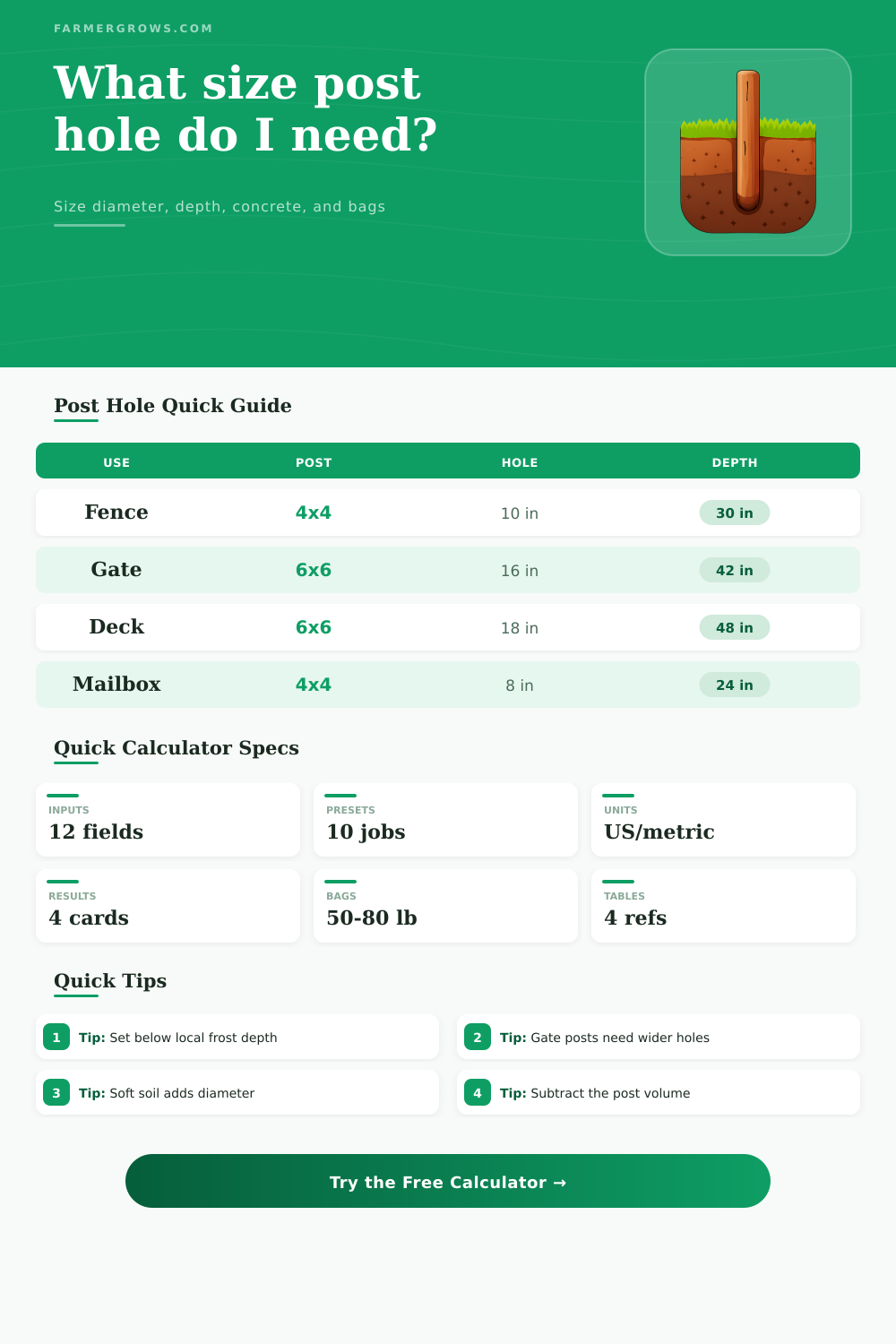
| 10 in | 30 in | 1.36 cu ft | 2.3 bags | 4x4 line posts and light rails |
| 12 in | 36 in | 2.36 cu ft | 3.9 bags | 4x4 to 5x5 heavier fence posts |
| 16 in | 42 in | 4.89 cu ft | 8.2 bags | 6x6 gate, corner, or tall fence post |
| 18 in | 48 in | 7.07 cu ft | 11.8 bags | Deck or pergola pier starting point |
Before digging: Mark utilities, check frost depth, and confirm whether your project needs a permitted footing size. Deck posts often need more than a simple post-width rule.
Before pouring: Keep loose soil out of the bottom, add drainage gravel where appropriate, and recheck that the hole diameter has not enlarged after augering or hand cleanup.
When you dig a post hole for a fence, the size of the post hole will determine whether the fence remain straight or whether the fence begins to lean. The fence can lean if the ground beneath the fence freeze or if a gate swing on its post. In either of these cases, the post hole must be deep and wide enough to resist the force upon the fence.
The size of the post hole that you dig will depend upon a diameter of the fence post, the depth of the fence post, the type of concrete that you use for the fence post, and in what way you plan to use the fence posts. The use of the fence post will determine the diameter and depth of the post hole. For instance, the posts for a line post in a light fence doesnt experience much torque.
How Deep and Wide to Dig Fence Post Holes
However, a gate post experience the weight of the gate as well as the torque created by the gate when it is opened and closed. Additionally, any posts used for a deck or a pergola will experience more additional vertical weight. Thus, each of these different use of fence posts will require a decision to be made regarding which category the fence posts will fall into to determine the math that you will use to dig each post hole.
The type of soil in which you are to install the fence posts will affect the stability of each post. For instance, if the soil is dense gravel, then drainage will occur and the soil will grip the fence post, allowing for a smaller diameter of the post. Clay will hold water against the fence post and expand when it holds that water, requiring a larger diameter for the fence post hole in clay soils.
Additionally, soft fill or recently disturbed soil will provide very little resistance to the fence post, requiring a wider post hole in these soils. Thus, before digging the post hole, it may be beneficial to dig a test hole to determine the type of soil that exist in the area, as the type of soil will determine the diameter and depth of the posts. In cold climates, it is important to consider the frost line in relation to the depth of the post holes.
If the concrete of the fence post is beneath the frost line, the ground will freeze and push against the fence post to force it to rise. When the ground thaw, the fence post will drop. Therefore, in milder climates it may be permissible to not follow the frost line rule for digging the post holes, but outside of those climates the posts must be deep enough to account for the ground movement caused by freezing and thawing of the ground.
A common method of setting the depth of the post holes is to make the depth equal to one-third of the height of the fence (which you can determine from the height of the post) and then to ensure that the depth include the frost line depth, which will create a post hole that is deep enough and wide enough. The volume of the concrete for each fence post is another important measurement in digging the post holes. You can subtract the volume of the post from the total volume of the cylinder that is created by the post and the post hole, which will allow for saving concrete in the order; however, there will need to be some extra concrete provided for two reason: the auger holes are not perfect cylinders and there needs to be extra concrete added to the top of the post hole to avoid ponding water against the fence post.
Thus, the calculator that you use will include a buffer for the concrete to account for each of these reason, to ensure that there will be enough concrete to fill the post holes to the necessary depth and height. There are also some design and construction patterns to the dimensions of the posts. For example, a 4×4 post in firm loam will require a certain diameter and depth for the post hole.
A 6×6 post that you are to use as a gate post in an area that experience much wind may require different dimensions than the 4×4 post. These patterns can help to verify the calculations made by the calculator, but you should always rely on the specification for the fence. Finally, the fence posts will need to be allowed to cure for 24 hour before any weight is to be placed upon them.
After curing the posts for 24 hours, you should test them to see if they are stable within the post holes. A quick push or pull of the fence post can determine if the fence posts are stable. If the fence posts are not stable, the post holes must be fixed before building the remainder of the fence or deck.