Pond Liner Calculator
Estimate a flexible pond liner from length, width, depth, side slope, shelves, overlap, freeboard, underlayment, seam allowance, roll width, and shape factor.
Load a pond layout, then adjust the actual site measurements. Presets change size, depth, side slope, shelves, overlap, freeboard, roll width, and material.
Liner Estimate
Recommended liner cut and roll planning will appear after calculation.
Use the material grid as a planning reference. Always confirm the manufacturer rating for potable water, fish safety, UV exposure, joining method, and puncture resistance.
| Profile | Best use | Liner effect | Field note |
|---|---|---|---|
| Vertical wall 0:1 | Formal block or timber edge | Shortest side travel | Needs stable walls before liner is placed. |
| Steep 0.5:1 | Compact garden ponds | Small added width | Protect corners and folds with underlayment. |
| Standard 1:1 | Most backyard water gardens | Balanced cut size | Works well with one plant shelf. |
| Plantable 1.5:1 | Wildlife and plant shelves | More side travel | Allows safer planting zones around the pond. |
| Gentle 2:1 or 3:1 | Large natural edges | Largest liner cut | Often reduces erosion and improves access. |
| Roll width | Typical use | Seam allowance | Planning advice |
|---|---|---|---|
| 10 ft | Small basins and streams | 6 to 8 in | Expect more panels on wide ponds. |
| 15 ft | Common backyard rolls | 8 to 10 in | Often avoids seams on compact ponds. |
| 20 ft | Medium garden ponds | 8 to 12 in | Good balance of handling and fewer seams. |
| 25 ft | Large koi or farm garden ponds | 10 to 12 in | Plan helpers because sheets get heavy. |
| 30 ft plus | Custom fabricated panels | Installer spec | Confirm shipping fold direction before layout. |
| Site condition | Underlayment choice | Overlap target | Why it matters |
|---|---|---|---|
| Clean sand | Same as liner or optional | 12 in edge | Smooth soil has lower puncture risk. |
| Garden loam | Full fabric plus 5% | 12 to 18 in edge | Protects against roots and small stones. |
| Rocky clay | Full fabric plus 10% | 18 in edge | Extra fabric helps cover sharp pockets. |
| Boulder shelves | Double cushion zones | 18 to 24 in edge | Add scrap fabric under heavy stones. |
| Waterfall basin | Continuous fabric path | 24 in splash edge | Extra edge helps prevent hidden leaks. |
| Pond opening | Depth | Common allowance | Approx liner cut |
|---|---|---|---|
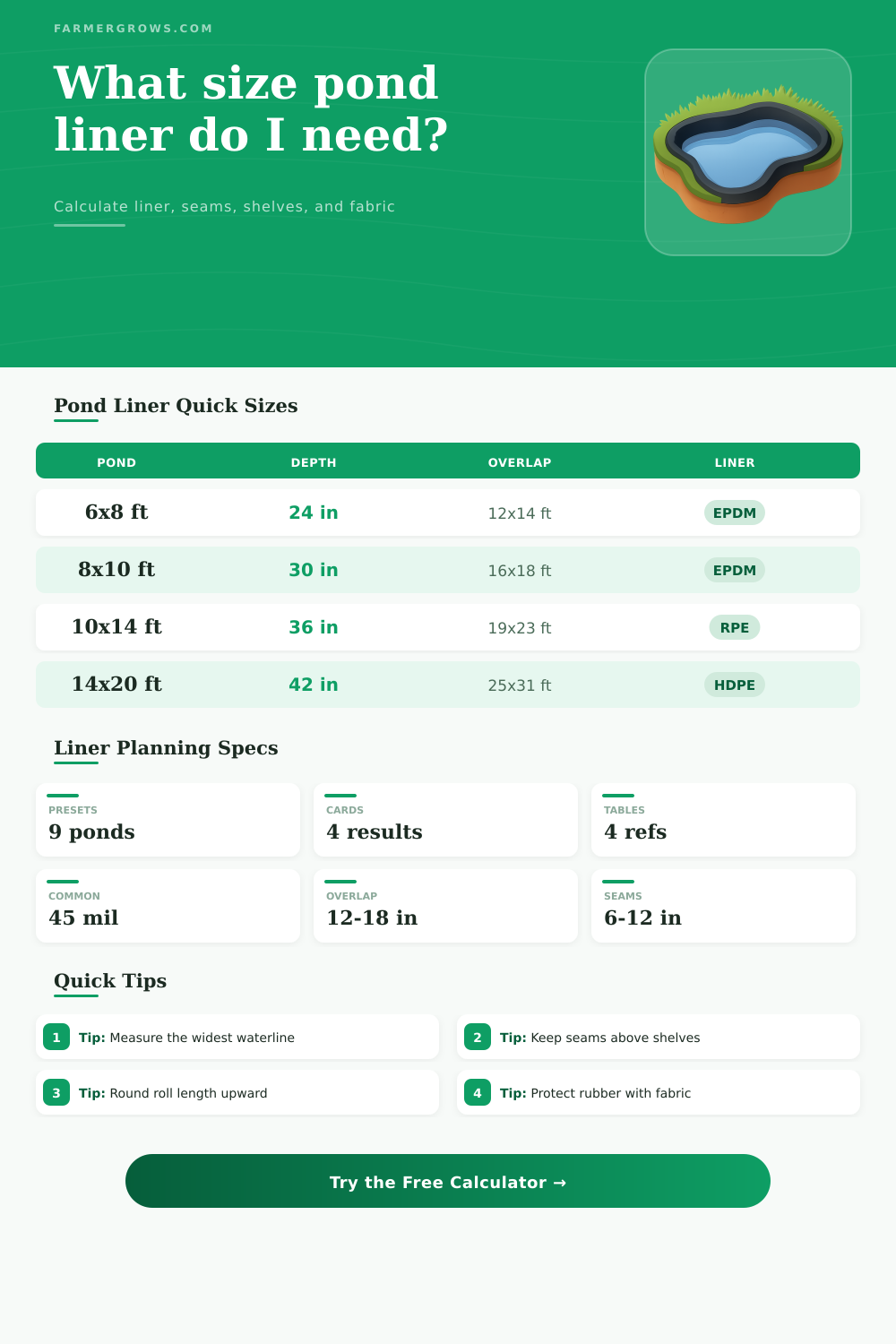
| 6 x 8 ft patio pond | 24 in | 12 in overlap, simple walls | 12 x 14 ft |
| 8 x 10 ft wildlife pond | 30 in | 18 in overlap, one shelf | 16 x 18 ft |
| 10 x 14 ft formal pond | 36 in | 18 in overlap, steep sides | 19 x 23 ft |
| 12 x 16 ft koi pond | 48 in | 18 in overlap, one shelf | 24 x 28 ft |
| 14 x 20 ft freeform pond | 42 in | 24 in overlap, two shelves | 28 x 34 ft |
Final excavation often grows after shelves, anchor trenches, and rounded corners are cleaned up. Measure the finished hole before ordering a custom liner.
When a seam is unavoidable, place it on a gentle shelf or flat run where the liner can be cleaned, pressed, and inspected before filling.
When you are planning to build a pond in your backyard, you must calculate the correct dimensions for an pond liner. Calculating the correct dimensions for a pond liner are necessary to ensure that the liner will cover the pond completely. A pond liner must cover the length of the pond, the width of the pond, and the depth of the pond.
Additionally, a pond liner must also cover the slope of the pond walls and any shelf within the pond. A liner must account for the slope of the pond walls since the sloped sides of the pond will require more liner than a vertical wall. The shelves in the pond also require additional liner for the liner to cover those horizontal shelves of the pond.
How to Measure and Choose a Pond Liner
In addition to calculating the dimensions of the pond itself, you must purchase extra material for freeboard and for the liner to overlap with the edge of the pond. Freeboard is an additional distance between the surface of the water and the edge of the pond. An amount of freeboard must be incorporated into the depth of the liner to account for the possibility of heavy rain falling on the pond.
Similarly, the liner will need to overlap with the edge of the pond. The pond liner must be buried into the ground or weighted down to prevent the wind or animals in the yard from being move the pond liner. Because the pond liner must include both freeboard and overlap, the total size of the pond liner will be larger then the size of the pond itself.
Another consideration for pond liner is the potential use of an underlayment for the pond liner. An underlayment is a layer of fabric that you will place between the pond liner and the soil in which the pond will be built. Underlayment is used to prevent the pond liner from being punctured by stones or roots in the soil.
Additionally, the underlayment will protect the pond liner from sharp objects in the soil. If you will use the underlayment for the pond liner, the underlayment must be the same size as the pond liner to ensure that it also covers the entire area of the pond. For very large ponds, it may be necessary to use more than one piece of pond liner.
In these cases, the area in which the pond liners will be joined together are called seams. These seams require additional pond liner for the pond liner to be bond to the other piece of pond liner. These seams should be placed on flat shelves within the pond rather than on the slopes of the pond.
Placing the seams on the flat shelves makes it more easier to inspect the pond liner for damage and to repair any damage to the pond liner. The thickness of the pond liner is another factor to consider when building a pond. The thickness of the liner will determine how the liner will perform within the pond.
Thin pond liners are easier to fold into the corners of the pond. However, rocks or other objects within the pond is more likely to puncture thin pond liners. Heavy pond liners are more resistant to being punctured by objects in the pond.
However, they are more difficultly to move and to shape when placing the pond liner into the ground. The thickness of the pond liner can be determined based off the amount of activity that will occur around the pond. In addition to pond liner thickness, calculating the volume of the pond is also necessary to determine the correct pond equipment.
The volume of the pond is the total amount of water that the pond will hold. The volume of the pond may differ from the calculated volume of the pond. Ponds often have sloped sides and shelves.
Therefore, the volume of the pond is usually less then the volume of a rectangular box of the same dimensions. Additionally, calculating the volume of the pond will allow the pond owner to purchase a pond pump and pond filter of an appropriate size for the volume of the pond. Finally, calculating all the measurements for the pond liner and underlayment prior to purchase will allow the pond owner to determine exactly how much pond liner and underlayment will be necesary.
Knowing the measurements will allow the pond owner to avoid making extra trip to the pond supply yard to purchase additional pond liner and underlayment. Additionally, knowing the measurements in advance will ensure that the pond liner will match the dimensions of the hole in the ground in which the pond will be built.