
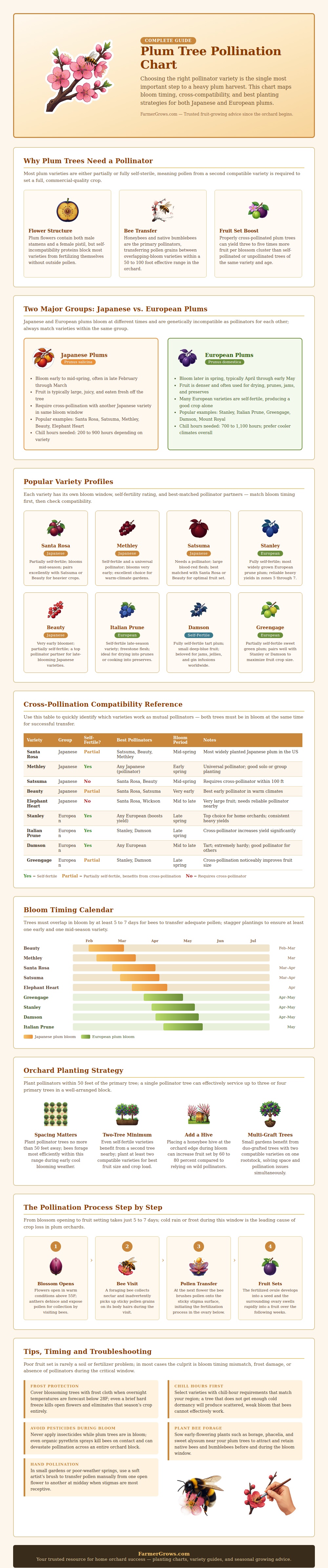
In the spring, you bring home a plum tree that blooms as expected and looks promising. Come summertime, hoping for some fruit? You get nothing but naked branches. Why? Because with one exception (more on this below), most plum trees is self-sterile, meaning they requires a nearby tree of a different variety to deliver compatible pollen.
Blooming at the same time are essential for fruit set. For example, there are two groups: European plums and Japanese plums, and to get fruit you has to select a partner from within same group. For instance, if your tree is a Japanese type, such as Santa Rosa, it will not pollinate a European kind such as Stanley; they just don’t match up in timing (they don’t even bloom at all at the same time). The Europeans typically come later, after the soil has warmed up in April or May. The Japanese, though, can be quite early, when ground is still frozen in springtime. Crossing between these two groups won’t work, they’re never going to be able to pollinate each other.
How to Get Fruit from Your Plum Tree
Pick Your Partner: The chart highlights Methley as a universal pollinator because it blooms very early and works well with almost any other Japanese variety. If you’re in a hot zone where spring comes fast, early is good. In late-bloomers, heat waves can knocks them out before the bees show up. In cool zones, European species such as Stanley adapt best to rough winters.
It won’t take many trees. A pair of compatible specimens within 50 feet will typically suffice. When air’s still, pollen-laden bees can easily bridge that gap. Even when you choose compatible varieties, weather can still interfere with pollination. If it gets too cold (a hard freeze) then all the bloom are destroyed and that’s the end of the season.
In spring, spraying pesticide will kills the bees required to do the fertilizing. Even though your pests were controlled, you lost the crop. To encourage native pollinators, sow some cover crops such as sweet alyssum or borage. You could of also have a beehive near trees.
For smaller gardens where insects aren’t numerous, you can hand-pollinate. With a soft paintbrush, you dab around inside one flower and brush the pollen onto other’s center. That’s how it happens in nature, and it only requires a few minutes each evening at the best time.
Cross-pollination makes plums better. Cross-pollination makes them sweeter and juicier. And they produces more fruit, up to three times as much than a single tree. This is because cross-pollination also improves quality. The genetic mix makes the fruit sweeter and meatier. They’re sweeter and more juicy. And they have higher yields, up to three times that of a single tree because the cross-pollination also boosts quality. (The genetic mix sweetens and fleshes up the fruit.)
Before ordering, first consider chill hour requirements and local frost dates. Your potential partner needs to bloom at the same time as you. Then look out the window in springtime. Perhaps there’s a willing tree already right there? S/he might just be your ticket to a successful harvest.