Pole Barn Heater BTU Calculator
Estimate the heating load for a pole barn from shell losses, infiltration, and door recovery, then size the heater output with a realistic reserve.
Choose a jobsite-like starting point. Each preset is tuned for a specific pole barn heating pattern, from tight insulated shops to leaky open bays and wash stalls.
Heating Load Results
Live output updates as you change the barn geometry, insulation, and leakage settings.
These tables hold the local assumptions used by the calculator. They are intentionally specific to pole barn heating so the output is easier to defend on a real job.
| Use case | Target F | Design F | What it means |
|---|---|---|---|
| Frost hold shed | 45 | 10 | Pipe protection |
| Weld repair bay | 60 | 0 | Fast warm-up |
| Horse tack room | 58 | 5 | Steady comfort |
| Wash bay | 55 | -5 | Wet air spikes |
| Open-front bay | 48 | 15 | Heavy reserve |
| Assembly | Effective R | U-factor | Use note |
|---|---|---|---|
| Bare steel wall | R-8 | 0.125 | Minimal liner |
| Batt wall | R-13 | 0.077 | Common retrofit |
| Insulated wall | R-19 | 0.053 | Shop standard |
| Roof liner | R-30 | 0.033 | Warmer lofts |
| Insulated slab | 0.04 U | 0.040 | Edge sealed |
| Condition | Base ACH | Door factor | Typical pole barn use |
|---|---|---|---|
| Tight foam shell | 0.35 | 0.05 | Workshop |
| Average shell | 0.70 | 0.20 | Mixed use |
| Leaky shell | 1.25 | 0.45 | Older bay |
| Open-front bay | 2.00 | 0.95 | Livestock shelter |
| Frequent doors | 0.90 | 0.45 | Repair shop |
| Fuel | Raw heat | Useful note | Best fit |
|---|---|---|---|
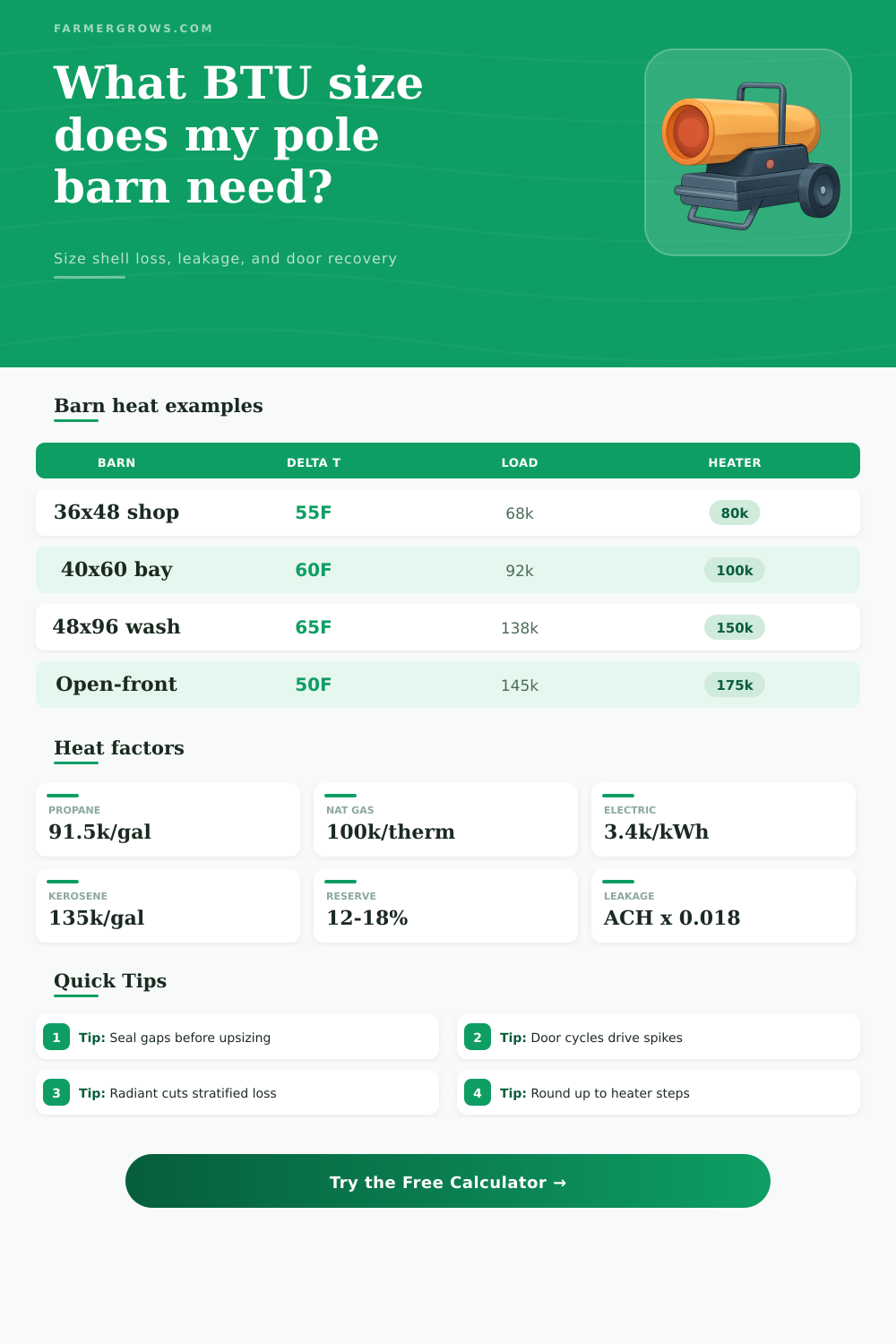
| Propane | 91,500 BTU/gal | Tanks on site | Remote barns |
| Natural gas | 100,000 BTU/therm | Piped service | Large shops |
| Kerosene | 135,000 BTU/gal | Compact storage | Service bays |
| Electric | 3,412 BTU/kWh | Simple install | Small rooms |
Fan-forced unit heater
- Best for quick recovery after doors open.
- Moves heat well across a busy bay.
- Can stratify in high eave barns.
- Good for repair and wash work.
Radiant tube heater
- Best for high ceilings and long aisles.
- Reduces warm-air buildup near the ridge.
- Comfort stays strong at floor level.
- Good for livestock and open work zones.
Infrared plaque heater
- Best when people or animals stay in one zone.
- Very low stratification loss.
- Ideal for tack rooms and wash corners.
- Less useful for fast full-barn recovery.
Hydronic fan coil
- Best for steady all-day shop comfort.
- Pairs well with radiant floor systems.
- Quiet and even, but slower to install.
- Strong choice for insulated workshops.
The calculator rounds the final recommendation up to the next practical heater step so you are not stuck with a borderline size on a cold snap.
To size a heater for a pole barn, you need to calculate the heat loss that occur through the building envelope (walls, roof, and floor) and through air infiltration. Such calculations is necessary because pole barns do not have steady heat loads, and they are subjected to significant temperature change when the barn doors are opened. If you do not size your heater appropriate, you may end up either spending money on a heater that is far too large, or you may end up with a pole barn that is far too cold to meet your need.
The building envelope consist of three main components: the walls, the roof, and the floor. Each of these component loses heat through conduction. The amount of heat that is lost through the walls, for instance, is dependent upon the area of those walls times the R-value of the insulation and the difference in the temperature between the inside of the pole barn and the outside air.
How to Size a Heater for a Pole Barn
The same is true of the roof, though the area of the roof is usually greater than the area of the walls. This is due to the pitch of the roof; the steeper the pitch, the more greater the area of the roof. Additionally, the floor will also lose heat through conduction; dirt floor or uninsulated concrete floors allow for heat to continuous leave the pole barn.
Another way in which the pole barn may lose heat is through air infiltration. Air infiltration is the movement of outside air into the pole barn through the doors. Air infiltration can be calculated through the air changes per hour and the total volume of the pole barn.
Air infiltration is measured in cubic feet per minute. In order to heat the pole barn to the desired target temperature, the air that infiltrated into the barn will need to be heating. Additionally, because the doors to the barn are opened very frequent, air infiltration will occur through those barn doors.
Overhead doors will allow for more infiltration than man doors, and the more that barn doors are opened, the more infiltration will occur into the pole barn. This movement of air will need to be account for in the sizing of the heater. Once you have determined the total heat loss that occurs through conduction and air infiltration into the barn, you must calculate the efficiency of the heater that you will use to heat the pole barn.
The efficiency of gas heater ranges from 80 to 90 percent. The total heat loss divided by the efficiency of the heater will produce the output that the heater should have. Additionally, 12 to 18 percent more heat output should be add to that calculation.
This additional heat output acts as a buffer for the pole barn should there be extreme cold snaps or high wind. Heater outputs are usually available in specific quantity, such as 80,000 BTU heaters and 100,000 BTU heaters. Therefore, you should round up the output of the heater to the nearest available heater size.
Depending upon the type of heater that you use, the heat will be distributed different within the pole barn. Fan-forced heaters will blow hot air into the pole barn; however, this heat will rise towards the ceiling of the pole barn. Radiant tube heaters will warm objects in the barn rather then the air in the barn.
This type of heat is useful in that it will help to keep the heat of the barn at floor level. Infrared plaques can help heat specific area of the pole barn; however, they are not typically used to heat the entire pole barn. Hydronic coil heaters will provide even heat distribution throughout the pole barn if you have an insulated floor slab.
However, hydronic heater installation are more complex than gas heaters. The type of winter climate in which your pole barn will be located will also have an effect upon the size of the heater that is required for your pole barn. More specifically, the design temperature for the winter month will be used to calculate the difference in temperature between the inside and outside of the pole barn.
Using an average temperature will result in undersizing the heater for your pole barn. Additionally, the fuel source for the heater will have an effect upon the cost of heating your pole barn. Should you size the heater correctly for the building envelope, the doors, and the air infiltration into the barn, the temperature within the pole barn will remain steady.