🌲 Pole Barn Header Calculator
Check span, bending, shear, and deflection limits for pole barn headers using actual sizes, real species data, and uniform load inputs.
Calculation breakdown
| Species | Fb | E | Note |
|---|---|---|---|
| SPF No.2 | 875 psi | 1.4 Mpsi | Light duty framing |
| Douglas Fir-Larch No.2 | 900 psi | 1.6 Mpsi | Stiff and common |
| Southern Pine No.2 | 1100 psi | 1.4 Mpsi | Higher bending value |
| LVL 1.9E | 2600 psi | 1.9 Mpsi | Long-span engineered header |
| Nominal | Actual | Area | Use |
|---|---|---|---|
| 2x6 | 1.5 x 5.5 | 8.25 in2 | Shed and shelf |
| 2x8 | 1.5 x 7.25 | 10.88 in2 | Short floor header |
| 2x10 | 1.5 x 9.25 | 13.88 in2 | Deck and porch |
| 2x12 | 1.5 x 11.25 | 16.88 in2 | Longer simple spans |
| Use | Load | Ratio | Comment |
|---|---|---|---|
| Floor header | 40 psf | L/360 | Common occupancy |
| Deck header | 60 psf | L/360 | Outdoor live load |
| Roof header | 20 psf | L/240 | Snow or roof service |
| Shelf header | 20 psf | L/180 | Light storage use |
A pole barn header is the structural beams that spans the opening of a door in a pole barn. A pole barn header must be able to support many type of weight, and the header must prevent the barns roof or walls from sag. The header will need to support the weight of the roof trusses, the weight of the wind, and the weight of the snow that land on the roof.
If the header is too small to support the roof and the snow load, the header will sag. If the header are allowed to sag, the roof may fail. The first measurement you need to determine is the span of the header.
How to Size a Pole Barn Header
The span is the distance between the two post that support the pole barn header. You should not use the total length of the barn wall to determine the header span. A longer span of header will require a header that is more stronger than a header with a shorter span.
The next measurement you need is the tributary width. The tributary width is the area of the roof that contribute to the load on the header. If the distance between the posts is 16 feet, the tributary width is 8 feet.
If you dont correctly calculate the tributary width, your calculations for the header will not correctly reflect the load on the header. The loads on a pole barn header include dead loads and live loads. The dead loads include the weight of the roof sheathing, roof trusses, and metal roofing.
The live loads include the weight of the snow that falls on the roof and the weight of any people that is on the roof. Each of these loads must be multiply by the tributary width to find the line load of the header. The line load is measured in pounds per foot (lb/ft) and is the load that the header will need to support.
The type of wood used for the header will impact the strength of the pole barn header. Different types of wood can include different amount of stiffness and strength. For instance, Douglas Fir is stronger than spruce pine fir, and Southern Pine is stronger than many other types of wood.
You should use the actual dimensions of the lumber rather than the nominal (named) dimensions of the lumber. For instance, the nominal dimensions of 2×10 lumber are actually 1.5 inches in one dimension and 9.25 inches in the other dimension. If you use the nominal dimensions in the calculations for the header, the strength will be overestimate.
Deflection is a measurement of how much a pole barn header bend. The deflection of the header is not the same as the header failing. Deflection will cause the header to droop.
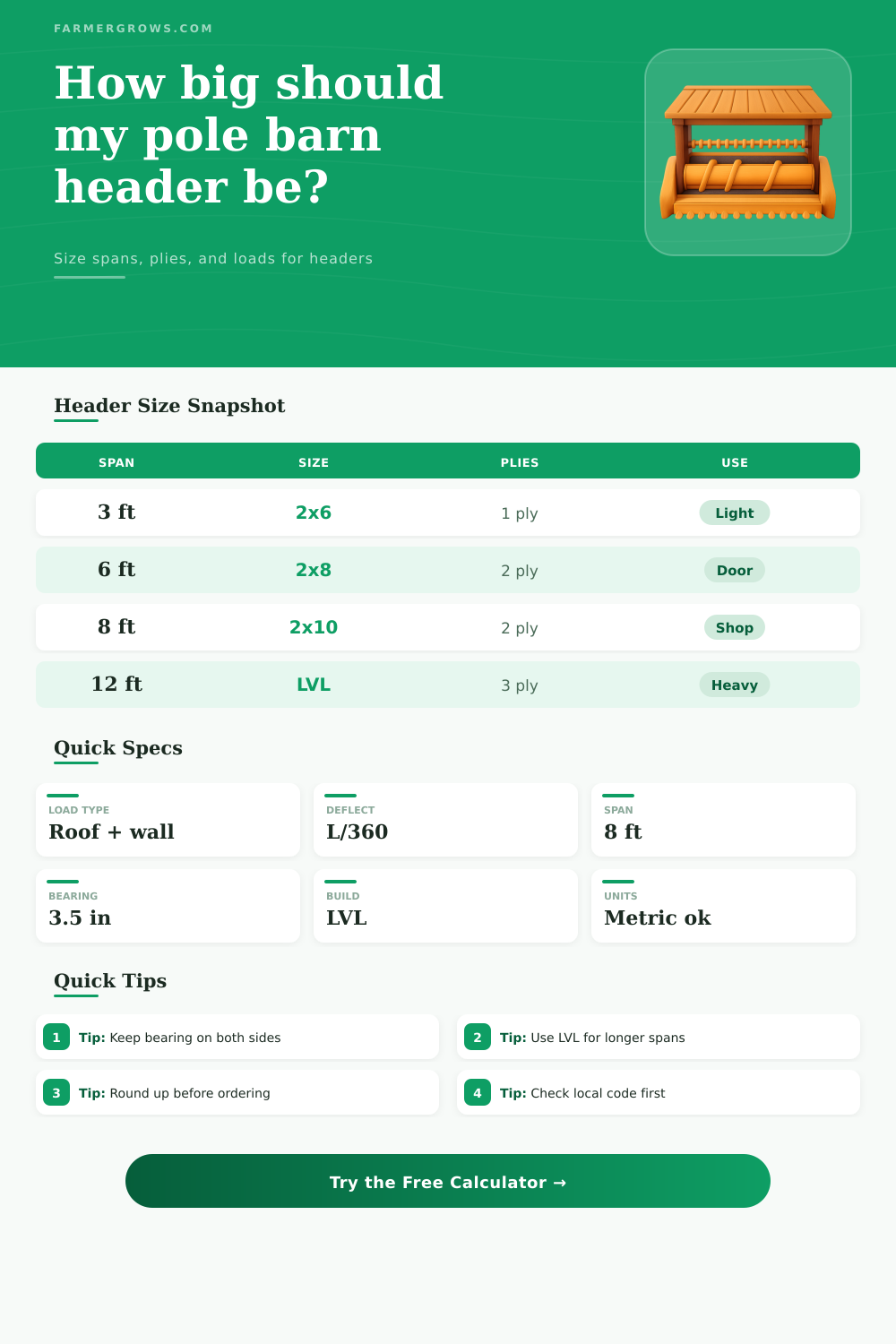
The deflection limits for a pole barn header are such that deflection is limited to L/360. This means that the span of the header divided by 360 should equal the deflection of the header. If the header droops too much, water will pool on the roof of the barn. Additionally, the header drooping may make the pole barn appear unstable.
If the pole barn header will be in contact with moisture, you must reduce the strength of the header by 10% to 20% since moisture weaken the strength of the wood. Pole barn headers can be made out of different materials. The most common material is sawn lumber.
Sawn lumber may contain knots in the wood that may weaken the header. Laminated Veneer Lumber (LVL) is another material that can be used for headers. LVL is strong and often used for header spans of more than 15 feet.
Glulam is another material that can be used for headers. Glulam is a strong material and a good choice for carports. In all cases, round up the measurements of the header to ensure that the header can accommodate the loads and still provide for the lifespan of the pole barn.
The pole barn header must have proper bearing on the posts. Bearing is the area of contact between the pole barn header and the support posts. The header should have at least 3 inches of bearing on each of the support posts.
This will ensure that the weight of the roof is distributed over a larger area rather than being place onto the headers ends. Do not cut notches into the header; notching the header will reduce the strength of the header by 20% to 30%. Notching may also cause the header to fail under large load.
Finally, you must compare your calculations to three limits for the pole barn header. The three limits are the limit for bending, the limit for deflection, and the limit for shear. You must not exceed each of these loads.
If the calculations for the header indicate a high percentage of utilization of the header strength, the header is close to its maximum strength. This is not recommended; instead, always add in a safety margin so that the header will not reach its maximum strength under any given loads.