Plant Available Nitrogen Calculator
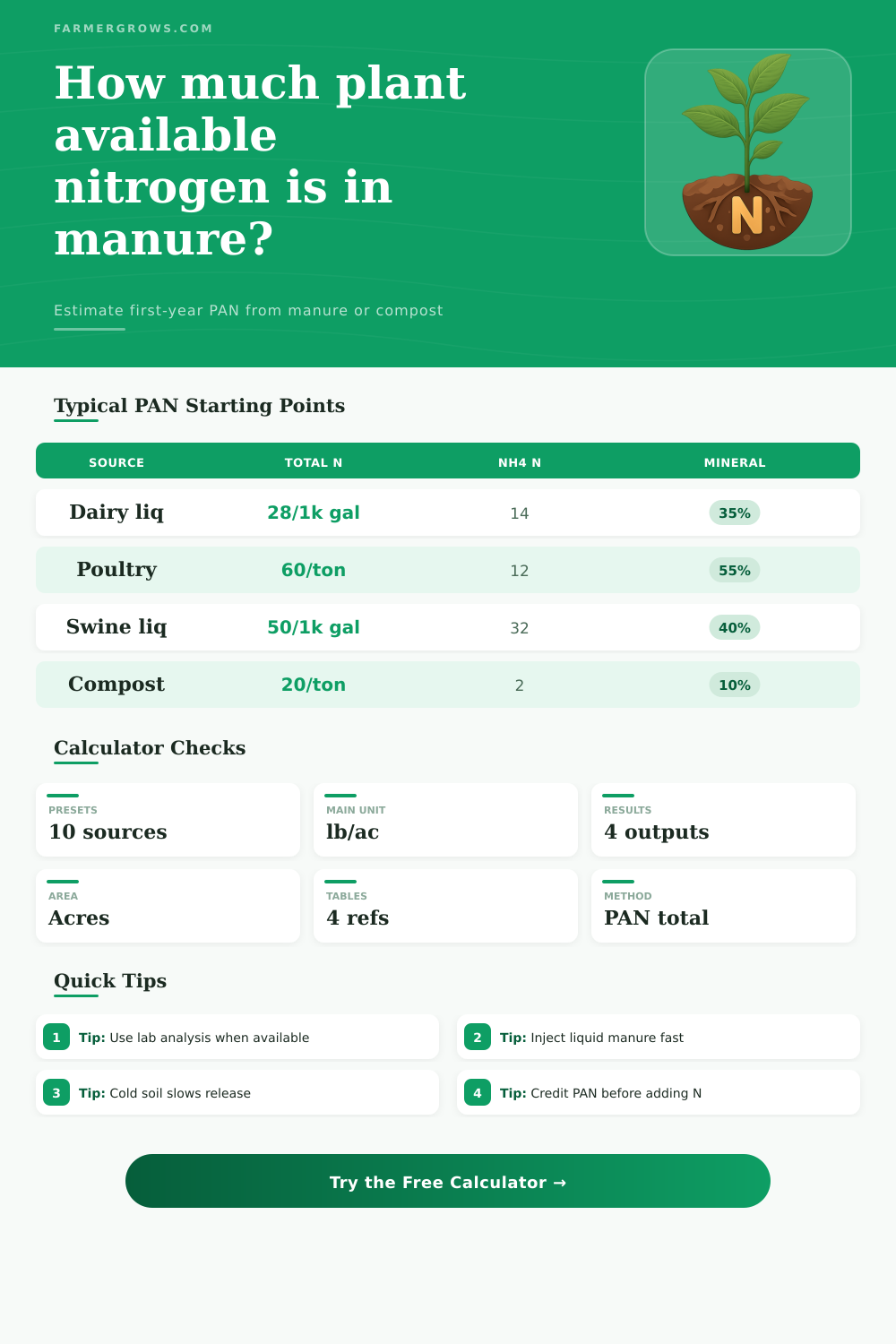
Estimate first-year PAN from manure, litter, slurry, lagoon effluent, or compost using lab N values, application timing, incorporation delay, soil conditions, rate, and acres.
Use lab analysis when you have it. Presets are planning values only because manure storage, bedding, dilution, weather, and spreader calibration can change nitrogen availability sharply.
First-Year Plant Available Nitrogen
Results separate ammonium N retained after timing and incorporation from organic N mineralized during the crop year.
| Source | Typical unit | Total N | Ammonium N | First-year organic N release |
|---|---|---|---|---|
| Dairy liquid manure | 1,000 gal | 24 to 32 lb | 10 to 18 lb | 25% to 40% |
| Swine lagoon or slurry | 1,000 gal | 35 to 60 lb | 22 to 40 lb | 30% to 45% |
| Broiler litter | ton | 50 to 75 lb | 8 to 18 lb | 45% to 60% |
| Solid bedded dairy manure | ton | 12 to 24 lb | 2 to 6 lb | 20% to 35% |
| Finished compost | ton | 12 to 25 lb | 0 to 4 lb | 5% to 15% |
| Application timing | Ammonium timing factor | Organic N timing factor | Best fit |
|---|---|---|---|
| In-season or sidedress | 1.00 | 1.05 | High synchrony with crop uptake |
| Spring preplant | 0.95 | 1.00 | Common baseline for annual crops |
| Late summer with cover crop | 0.85 | 0.85 | Cover crop can hold some available N |
| Fall before spring crop | 0.65 | 0.70 | More leaching and denitrification exposure |
| Winter surface applied | 0.45 | 0.55 | Highest weather risk before crop use |
| Incorporation delay | Ammonium retained | Typical method | Field note |
|---|---|---|---|
| Injected or knifed in | 98% | Liquid manure toolbar | Best protection from ammonia loss |
| Immediate incorporation | 95% | Disk or cultivator same pass | Strong option for broadcast manure |
| Within 24 hours | 85% | Next-day tillage | Good when weather is mild |
| After 1 to 3 days | 70% | Delayed tillage | Loss rises in warm windy weather |
| Surface, not incorporated | 40% | No-till surface spread | Use conservative ammonium credit |
| Soil condition | Mineralization factor | Ammonium risk factor | Use in calculator |
|---|---|---|---|
| Warm moist active soil | 1.15 | 1.00 | Fast organic N release |
| Normal spring soil | 1.00 | 1.00 | Default planning condition |
| Cool or slightly dry soil | 0.80 | 0.98 | Slower microbial activity |
| Cold or dry soil | 0.65 | 0.95 | Lower early-season release |
| Saturated or compacted soil | 0.75 | 0.85 | Denitrification risk is higher |
Before spreading: Use a recent manure analysis and calibrated spreader rate. The same manure type can vary enough to change the N credit by dozens of pounds per acre.
Before sidedressing: Subtract the first-year PAN credit from crop N need, then adjust for soil nitrate tests, legume credits, yield goal, and local nutrient management rules.
When a persons applies manure or compost to a field, the nitrogen levels in the manure as determined on a laboratory report isnt always the amount of nitrogen that the plants can use. The test performed on the manure will reveal the total amounts of nitrogen in the manure. However, the total amount of nitrogen in the manure are not the same as the amount of plant available nitrogen.
Some of the nitrogen will volatilize into the air, some will move below the plant roots through leaching, and the remaining nitrogen will remain in organic compounds that the plants cant use. Therefore, using a plant available nitrogen calculation can help to determine how much nitrogen from the manure the plants can use. Using such a calculation will help to turn laboratory test measurements of nitrogen into a realistic number regarding the amount of nitrogen that can be credited to the crops during the first growing season of the plants.
How Much Nitrogen from Manure Can Plants Use
The nitrogen in manure and compost exists in two primary forms: ammonium nitrogen and organic nitrogen. Ammonium nitrogen is a form of nitrogen that plants can absorb, but if the manure that contains this nitrogen is sitting on the soil surface, it will volatilize. Organic nitrogen will not be available to the plants until soil microbes begins to break down the organic compound.
The rate at which soil microbes break down organic nitrogen depends on the soils temperature, the soil’s moisture levels, and the amount of carbon rich bedding in the manure. Using a calculator that separates the ammonium nitrogen from the organic nitrogen will provide a more accurately calculation of the amount of nitrogen that will be available to the plants. The separation also allow for the calculation to factor in when and how the farmer will apply the manure to the field.
The method in which the manure will be applied will impact the amount of ammonium nitrogen that is contained in the manure and remains in the soil. If the farmer is to inject the manure into the soil or till it immediately into the soil, most of the ammonium nitrogen will remain in the soil. However, if it takes a few days for the manure to be incorporated into the soil, especially when it is warm and breezy outside, a large portion of the ammonium nitrogen will volatilize into the air.
The delay in applying manure will have less of an impact on organic nitrogen because microbes will continue to break down organic nitrogen at the same rate regardless of when application of manure occur. For instance, because liquid dairy manure contains a large amount of ammonium nitrogen, the timing of its application will have a significant impact on how much nitrogen it contributes to the soil. In contrast, because finished compost contains a majority of organic nitrogen, it will have less of an impact on the amount of nitrogen that is available to the plants.
The timing of application of manure to fields can also impact the amount of nitrogen that is available to the plants. Applying manure in the spring to fields that are actively growing crops can ensure that the mineralized nitrogen from organic compounds remains in the field and the plants utilize it. However, applying manure in the fall or winter can result in the volatilization of the ammonium nitrogen and the leaching of nitrate into the soil.
Additionally, soil conditions that are warm and moist will increase the activity of microbes that break down organic nitrogen. Applying manure to soil that is too cold or too wet can result in fewer microbes participating in the decomposition of organic nitrogen compounds, resulting in the loss of nitrogen through denitrification. Using the calculation of the amount of plant available nitrogen in manure allows farmers to determine how much commercial nitrogen fertilizer to purchase for the plants.
If compost and manure contain a large amount of available nitrogen, there will be less commercial nitrogen fertilizer required to provide to the plants. However, if there is a relatively small amount of available nitrogen in the compost and manure, the full commercial nitrogen fertilizer program will have to be maintained, and the manure and compost will be used only to help build the soil. By calculating the amount of plant available nitrogen, farmers can avoid the mistake of assuming that each pound of nitrogen contained in manure will be available for the plants each growing season.
Although the plant available nitrogen calculation can be helpful, it is not likely that the calculations will be entirely accurate. Variables in the manure can differ from load to load. The spreaders used to apply manure to the fields may not be calibrated to the same measurements each year.
The weather may change after adding the manure to the fields. Therefore, using the calculation with the actual results of the manure will allow for the best comparison between calculated and actual nitrogen contributions to the fields. By comparing the calculated amount of available nitrogen to the actual yields in the fields over a period of several years, farmers can determine if they need to change the amount of nitrogen they apply to the fields each season.
The plant available nitrogen calculation is merely a starting point for the nitrogen that is contributed by manure to the soil. However, using this calculation more times and comparing the calculated figures to the actual figures will make the calculation more accurate.