Urea Fertilizer Calculator
Estimate 46-0-0 urea product pounds, effective nitrogen after volatilization loss, acres or turf area, split applications, timing risk, and bag count.
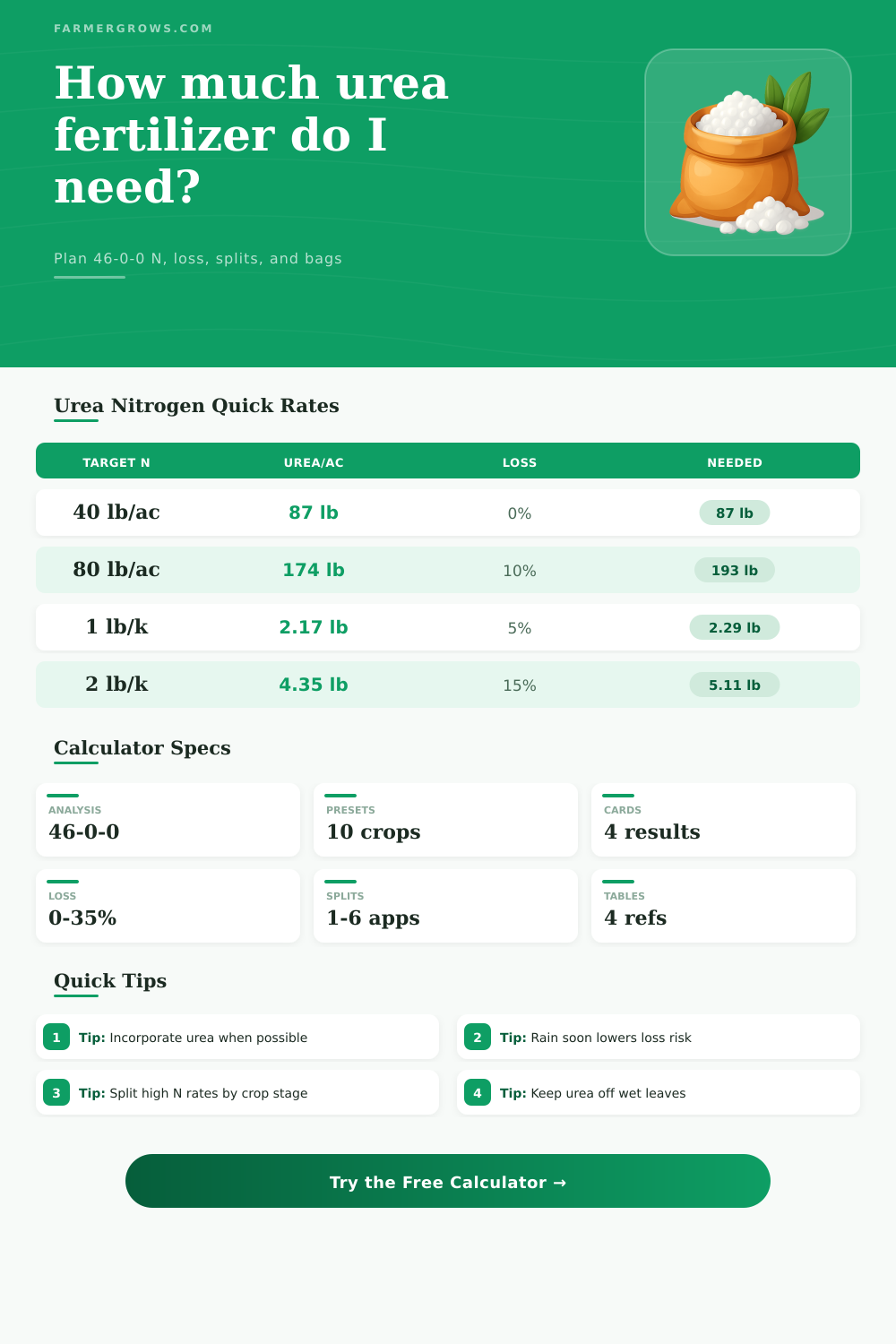
Use this for planning from a soil-test or crop recommendation. Urea is 46% nitrogen by weight, so every 100 lb of product contains 46 lb of N before field loss.
Urea Application Results
Results update from the current urea rate, timing, acreage, and split plan.
| Target available N | Urea before loss | With 5% loss | With 10% loss | With 20% loss |
|---|---|---|---|---|
| 25 lb N/ac | 54 lb/ac | 57 lb/ac | 60 lb/ac | 68 lb/ac |
| 40 lb N/ac | 87 lb/ac | 92 lb/ac | 97 lb/ac | 109 lb/ac |
| 60 lb N/ac | 130 lb/ac | 137 lb/ac | 145 lb/ac | 163 lb/ac |
| 80 lb N/ac | 174 lb/ac | 183 lb/ac | 193 lb/ac | 217 lb/ac |
| 120 lb N/ac | 261 lb/ac | 275 lb/ac | 290 lb/ac | 326 lb/ac |
| Timing condition | Typical loss range | Calculator preset | Best use | Planning note |
|---|---|---|---|---|
| Incorporated within 12 hours | 0 to 4% | 2% | Preplant or tilled field | Lowest volatilization risk for untreated urea. |
| Rain or irrigation within 24 hours | 2 to 8% | 5% | Topdress before weather | Rainfall amount and soil moisture still matter. |
| Cool dry surface broadcast | 5 to 12% | 8% | Early spring small grains | Cool soil slows conversion and loss. |
| Warm dry surface broadcast | 10 to 25% | 15% | Summer pasture or turf | Apply before rain when possible. |
| Residue, thatch, or high pH | 18 to 35% | 25% | No-till residue, turf thatch | Consider stabilizer, irrigation, or split rates. |
| Crop or use | Common single N rate | Split pattern | Urea note | Watch point |
|---|---|---|---|---|
| Corn preplant plus sidedress | 60 to 120 lb/ac | 2 applications | Use soil credits before adding urea. | Avoid large surface rates without rain. |
| Winter wheat topdress | 40 to 90 lb/ac | 1 to 2 applications | Early spring rain often helps incorporation. | Match timing to tiller and stem growth. |
| Hay after cutting | 30 to 70 lb/ac | After each harvest | Apply after regrowth begins and before moisture. | Do not overfeed stressed stands. |
| Pasture flush | 25 to 60 lb/ac | Rotational windows | Light splits reduce burn and waste. | Keep livestock off until granules dissolve. |
| Turf or lawn | 0.5 to 1.0 lb/1000 | 2 to 5 applications | Water in soon after applying urea. | Keep granules off wet foliage. |
| Formula item | Formula used | Example | Why it matters |
|---|---|---|---|
| Urea product | available N / 0.46 / efficiency | 80 N at 90% = 193 lb urea | Loss raises the product needed. |
| Efficiency | 1 - loss percent | 10% loss = 0.90 | Applied N is not all crop-available. |
| Gross N applied | product x 0.46 | 200 lb urea = 92 lb N | Shows label nitrogen before loss. |
| Available N | gross N x efficiency | 92 lb x 0.90 = 82.8 lb | Compares to the recommendation. |
| Bag count | total product / bag size | 1,930 lb / 50 = 38.6 bags | Round up for whole bags or totes. |
Tip: If urea stays on warm residue, loss can climb quickly. Schedule the application ahead of rain, irrigation, incorporation, or use a stabilized product where appropriate.
Caution: Urea can burn leaves and seedlings when granules lodge in wet foliage or are banded too close. Follow crop, soil-test, and label guidance.
Urea is a concentrated nitrogen fertilizers, but it is also a low-cost nitrogen fertilizer. Because urea is both concentrated and low-cost, it is easy to ship to many different locations. However, it can be wasteful if the nitrogen in the urea dont reach the crop that you are fertilizing.
To determine how much urea to purchase, you must decide how much nitrogen the plant should receive and how much extra urea to buy to account for the nitrogen that may dissapears before the plants can use that nitrogen. The amount of urea you have to buy will depend on the weather, the soil surfaces, and how quick you can get the urea granules into the soil. The difference between the amount of urea that you apply to the field and the amount of urea that the crop uses is known as volatilization loss.
How to Calculate How Much Urea to Buy
If the urea volatilize into ammonia, it can leave the soil, especially on warm and moist surfaces. The amount of urea that volatilizes into ammonia depend on the amount of residue that covers the soil, the pH of the soil, the temperature of the soil, and whether it rains in the fields or if you till the fields to move the urea into the soil. If you apply a relatively small amount of urea to the field, losing a small percentage of that urea to volatilization may not be a problem.
However, if you apply a relatively large amount of urea, even a small percentage of volatilization will require you to purchase many extra bag of urea to provide enough nitrogen for the plants. Enter the amount of nitrogen that you would like to add to your fields, the size of your fields in acres, and an estimate of your volatilization loss with the calculator. Choose a percentage for volatilization loss that matches your fields.
Choosing a percentage of zero for volatilization loss might mean that you will not supply the field with enough nitrogen. Another factor that will impact volatilization loss is when you apply the urea to the field. If you incorporate the urea into the soil within a few hours of applying it to the field, volatilization loss will be lower.
If there is a soaking amount of rain in the field within one day of applying the urea, volatilization loss will be lower due to the urea getting incorporated into the soil. Applying urea to dry ground on the surface will result in higher volatilization loss. If you choose to apply urea to dry ground on the surface with heavy residue, you will have to increase the allowance for volatilization loss with the calculator so that you purchase the proper amount of urea to reflect the conditions of the field.
The calculator includes buttons for crops like corn, wheat, hay, and turf so that you can set the variable for those crops without guessing the numbers. Using split applications for urea can help to lower the volatilization loss of the urea. If you apply all of the urea at once, there will be a higher volatilization loss of that urea.
By splitting the amount of urea into two or three applications, you reduce volatilization loss for each application of urea. You can adjust the later applications according to the rainfall in the fields or the growth stage of the crop. The calculator keeps track of the amount of urea used in the first application and the remaining amount of urea so that you can make split applications of urea according to the recommendations of the calculator.
The total amount of urea that you will use in your fields and the size of each bag of urea derive the number of bags of urea that you will have to buy. The tables located on the page show how different percentages for volatilization loss can change the total amount of urea that will be required to provide the crops with the desired amount of nitrogen. The tables also include the typical volatilization loss rates for different conditions of incorporating the urea into the soil.
These tables will help you determine whether your fields has low, moderate, or high volatilization loss of urea. These tables allow you to determine whether using a volatilization loss reducer or making an extra trip with an incorporator is worth the cost of purchasing the stabilizer or making the trip with the incorporator to the fields. Volatilization loss can be changed during the application of urea.
If there is rain that is going to be forecast for your fields, you can increase the percentage for volatilization loss. If your fields are managed with no-till farming and heavy residue cover and it is warm in the fields during the time of application, you will have to purchase more urea for the plants to use. Thus, you can see the trade-off between the amount of urea that you purchase and the amount of nitrogen that your crops will receive prior to beginning to spread the urea in your fields.
With time, you will be able to determine which fields require more conservative estimate for volatilization loss of urea. Your experience with the fields will allow you to determine if the urea stay dry or if it rains in the fields. This calculator wont replace your experience with the fields, but it will allow you to turn that experience into numbers for the amount of urea you can order.