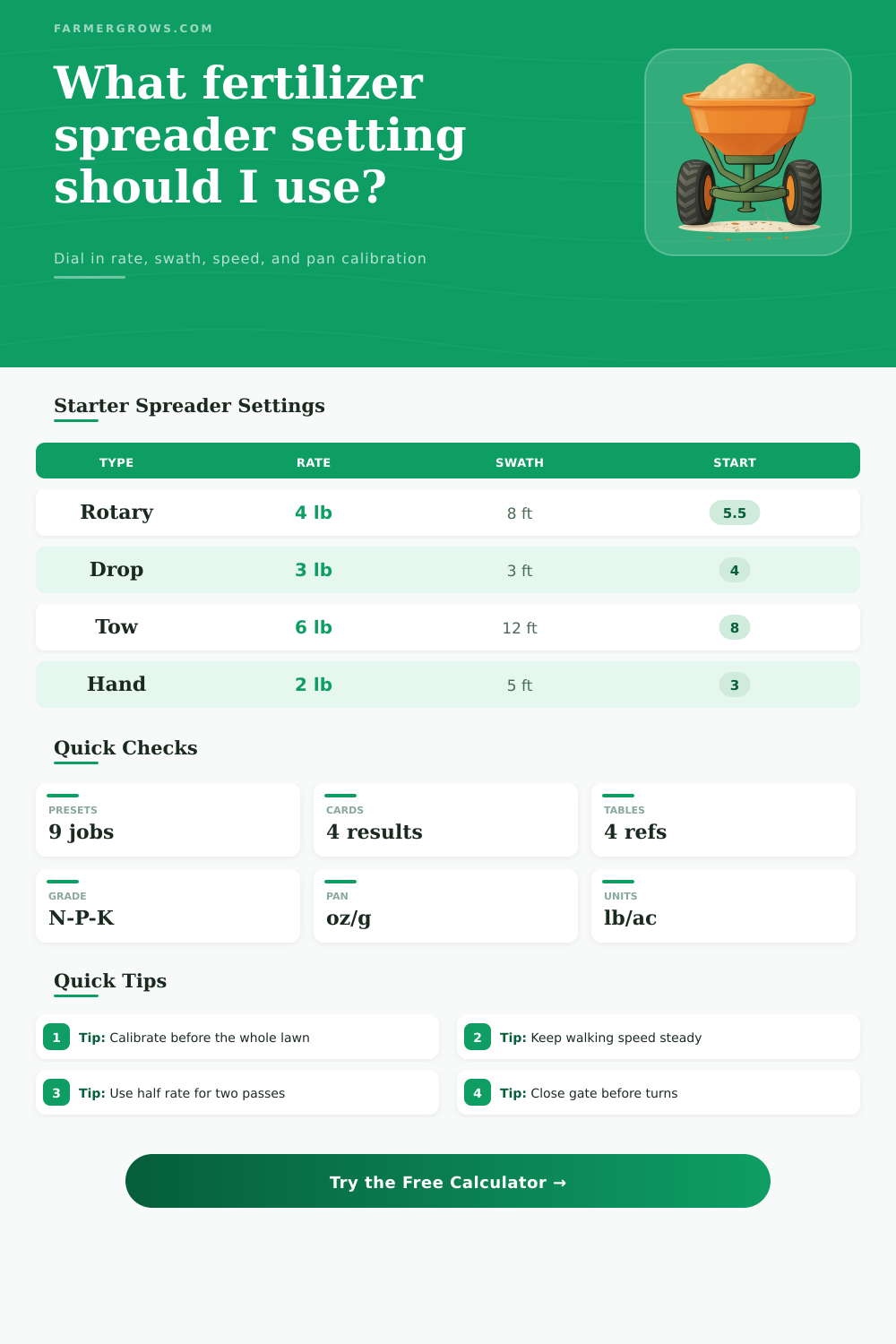
Fertilizer Spreader Setting Calculator
Estimate a practical spreader opening from your target fertilizer rate, N-P-K grade, granule size, swath width, walking speed, calibration strip, catch pan weight, and number of passes.
Use the calculated setting as a starting point, then confirm it with your own pan or tray test. Brand scales vary, fertilizer density changes by product, and moisture can change flow on the same day.
Broadcast rotary
Wide pattern and fast coverage. Use overlap and edge guards carefully because center-to-edge distribution is not perfectly even.
Drop spreader
Narrow, predictable band. Best near beds, walks, and small lawns, but missed strips show quickly if passes are not tight.
Handheld
Useful for touch-up work and slopes. Arm speed matters as much as walking speed, so calibration is especially important.
Tow-behind
Higher hopper capacity and wider swath. Confirm speed from the tractor or mower instead of guessing by throttle position.
ATV or tractor
Good for pasture and food plots. Rate checks should use a measured course and multiple pans across the swath.
Spreader Setup Results
Use the card values to start the spreader, then adjust with the catch pan correction before applying the full area.
| Fertilizer grade | N at 4 lb/1000 | P2O5 at 4 lb/1000 | K2O at 4 lb/1000 | Common use |
|---|---|---|---|---|
| 24-0-6 | 0.96 lb | 0.00 lb | 0.24 lb | Established turf nitrogen feeding |
| 18-24-12 | 0.72 lb | 0.96 lb | 0.48 lb | Starter fertilizer for seed or sod |
| 10-10-10 | 0.40 lb | 0.40 lb | 0.40 lb | Garden beds and general balanced feeding |
| 16-4-8 | 0.64 lb | 0.16 lb | 0.32 lb | Turf maintenance with some potassium |
| 46-0-0 | 1.84 lb | 0.00 lb | 0.00 lb | High nitrogen, easy to overapply |
| Granule size | Flow behavior | Setting nudge | Calibration note |
|---|---|---|---|
| Fine prill | Flows quickly and can bridge in damp hoppers | Start 5% lower | Use a smaller pan grid so dust is not lost |
| Medium lawn granule | Predictable flow on most rotary spreaders | Base setting | Most bag charts assume this style |
| Coarse prill | Throws farther but may feed slowly | Start 5% higher | Confirm the real overlapped swath |
| Mixed blend | Different particles can separate in the hopper | Start 8% higher | Shake or stir before the pan test |
| Organic pellet | Irregular, light, and slower to meter | Start 12% higher | Calibrate at the speed you will spread |
| Damp or dusty | Clumps, dust, and inconsistent gates | Start 10% lower | Break clumps and repeat pan readings |
| Speed or swath change | What happens | Typical setting response | Field check |
|---|---|---|---|
| Walk faster | Less material falls per square foot | Open slightly or slow down | Retest pan at the new speed |
| Walk slower | More material falls per square foot | Close slightly | Watch for dark fertilizer streaks |
| Use wider swath | Same flow covers more area | Open slightly | Do not count weak edge throw as swath |
| Use narrower swath | Same flow covers less area | Close slightly | Good for borders and small strips |
| Two passes | Each pass should apply half the total rate | Use lower per-pass target | Cross the second pass at 90 degrees |
| Target rate | 3 ft drop strip, 100 ft | 8 ft rotary strip, 100 ft | 12 ft tow strip, 100 ft | One-acre product |
|---|---|---|---|---|
| 2 lb/1000 sq ft | 9.6 oz | 25.6 oz | 38.4 oz | 87 lb/ac |
| 3 lb/1000 sq ft | 14.4 oz | 38.4 oz | 57.6 oz | 131 lb/ac |
| 4 lb/1000 sq ft | 19.2 oz | 51.2 oz | 76.8 oz | 174 lb/ac |
| 5 lb/1000 sq ft | 24.0 oz | 64.0 oz | 96.0 oz | 218 lb/ac |
| 6 lb/1000 sq ft | 28.8 oz | 76.8 oz | 115.2 oz | 261 lb/ac |
Calibration tip: Make one pass over a measured strip with the hopper already flowing, weigh the captured material, and adjust only one variable at a time.
Application tip: Split high nitrogen rates into two passes or separate dates when turf is stressed, soil is dry, or burn risk is high.
Setting the spreader correctly require precision because using the incorrect settings for the spreader will result in dark green stripes or burned patch on the lawn. The spreader setting is a measurement of the opening of the spreader, the speed of the individual push the spreader, and the width of a swath the spreader will cover. The setting has to be matched to the speed of the individual and the width of the swath the spreader will cover to ensure that the lawn receives the proper amount of granules.
If the spreader setting isnt accurately to the lawn, it can lead to under or overapply the granules. There is several variables that will influence the setting of the spreader. The rate of the fertilizer, the grade of the fertilizer, and the area of the lawn is three different mathematical variables.
How to Set and Check Your Lawn Spreader
The swath width, the rate at which the individual travels on the lawn, and the type of granule are three different variable to consider when setting the spreader. Using fine granules in a spreader setup for coarse granules can cause the spreader to apply too much fertilizer to the lawn. Additionally, using a spreader setup with a large swath and having an individual that cover large swathes quickly will result in underapplying the fertilizer to the lawn.
Calibration of the spreader will help determine if the setting of the spreader is correct. Using a strip of lawn and a catch pan to hold the amount of fertilizer applied from the spreader will allow the individual to set the spreader appropriately. If there is too little fertilizer in the pan, the individual must increase the opening of the spreader to increase the amount of fertilizer apply to the lawn.
In the opposite situation, if too much fertilizer is applied to the strip of lawn, the individual must decrease the opening of the spreader. Using a catch pan to weigh the fertilizer allows for an accurate measurement of the amount of fertilizer applied. This is more accurate then calculated estimates.
Depending on the type of spreader the individual plans on using, it can change the setting for the spreader. Rotary spreaders will cover more of the lawn quickly but may create heavy spot in the middle of the lawn. Therefore, the person must take care in how the person overlaps the spreaders.
Drop spreaders will apply the fertilizer to the lawn in a line. However, if the person isnt even with the lawn, there will be missed strip of the lawn. If the spreader is handheld, the speed with which the individual moves their arms will change the setting of the spreaders.
Tow-behind and tractor spreaders cover more of the lawn because of the spreaders larger hopper. Therefore, it is more difficult to calibrate the rate at which the tow-behind or tractor travels across the lawn with the spreader setting. Another factor that will influence how the spreader works is the amount of moisture in the granules.
If a bag of granules is left open and moisture enters the bag, the amount of moisture within the granules will change how the granules move through the spreader. This change in movement will change how much fertilizer is applied to the lawn. The setting must then be recheck in the event that the granules feel different or if the weather change in the area where the lawn is located.
Using a spreader calculator and a catch pan allows an individual to find the best setting for the spreader prior to applying the fertilizer to the lawn. The calculator will provide the individual with the setting of the spreader. However, the catch pan will provide the final confirmation of the setting.
By using a catch pan to calibrate the setting of the spreaders, an individual can use this method for different product and different spreaders. By constantly testing the spreaders, the setting can remain the same throughout the fertilization of the entire lawn. It should of been done carefuly.
You’re going to want to check the granules too. There are alot of ways to mess up if you dont watch the speed. Make sure you recieve the right amount of granules.
Its important to be moddern with your techniques.