Liquid Fertilizer Calculator
Estimate product gallons, N-P-K delivery, spray tank coverage, carrier water, fertigation ppm, and dilution ratio from liquid fertilizer analysis and density.
Use the guaranteed analysis from the label and the product density in pounds per gallon. Results are planning estimates; confirm crop safety, label limits, injection calibration, and compatibility before field application.
Liquid Fertilizer Result
Results use product analysis by weight, liquid density, selected gallons per acre, tank volume, carrier water, and irrigation water volume.
| Liquid product | Typical density | N per gallon | P2O5 per gallon | K2O per gallon |
|---|---|---|---|---|
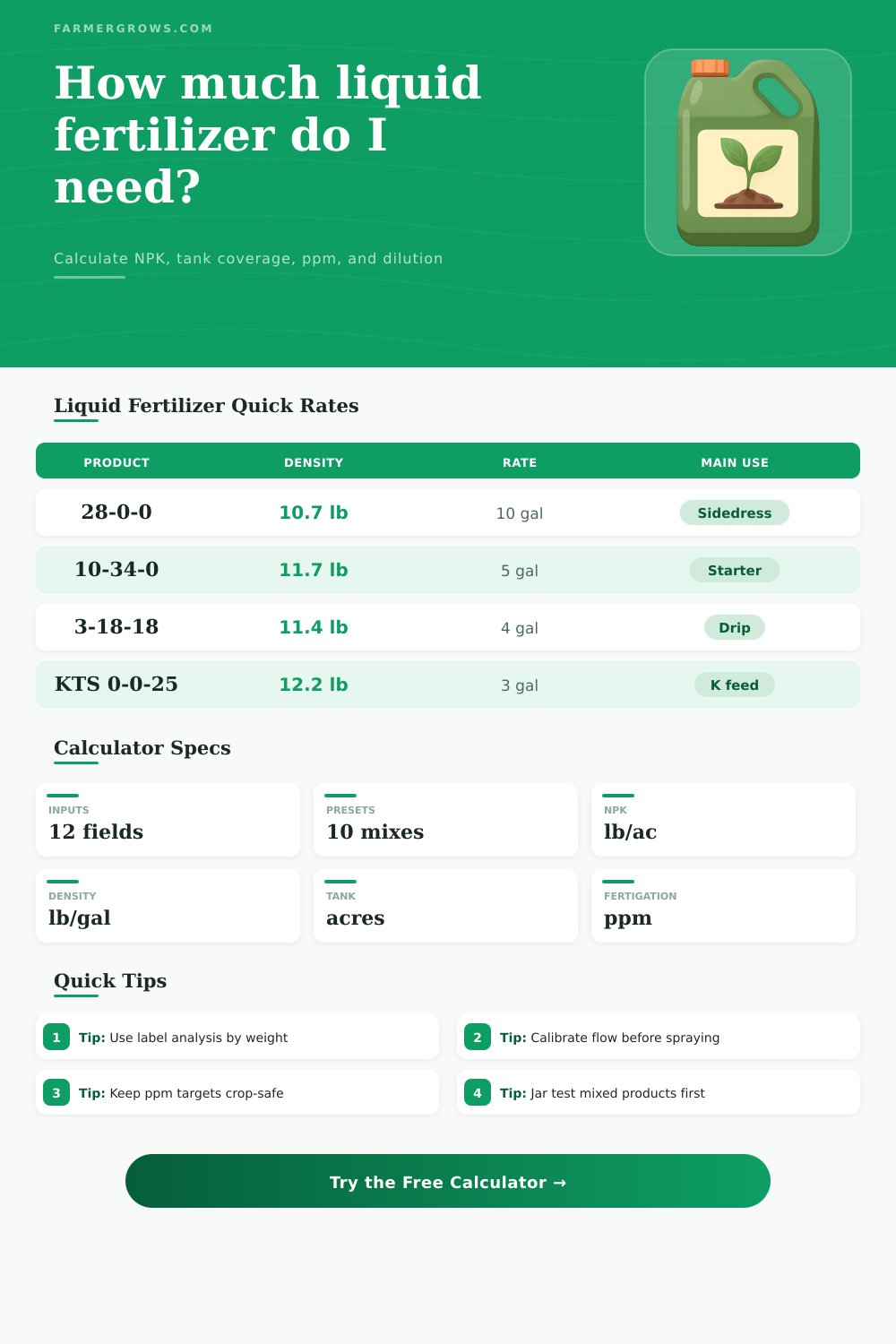
| UAN 28-0-0 | 10.6 to 10.8 lb/gal | 2.97 to 3.02 lb | 0 lb | 0 lb |
| UAN 32-0-0 | 11.0 to 11.1 lb/gal | 3.52 to 3.55 lb | 0 lb | 0 lb |
| 10-34-0 starter | 11.6 to 11.8 lb/gal | 1.16 to 1.18 lb | 3.94 to 4.01 lb | 0 lb |
| 3-18-18 solution | 11.2 to 11.5 lb/gal | 0.34 lb | 2.02 to 2.07 lb | 2.02 to 2.07 lb |
| KTS 0-0-25 | 12.1 to 12.3 lb/gal | 0 lb | 0 lb | 3.03 to 3.08 lb |
| Application setting | Common rate | Carrier water | Placement | Field note |
|---|---|---|---|---|
| Planter starter | 3 to 7 gal/ac | 0 to 10 gal/ac | 2x2 band or in-furrow | Check seed safety and salt index |
| Broadcast spray | 5 to 20 gal/ac | 10 to 25 gal/ac | Flat fan or stream | Agitation and nozzle choice matter |
| Stream bar UAN | 10 to 35 gal/ac | 0 to 15 gal/ac | Between rows | Reduces leaf burn compared with mist |
| Drip fertigation | 1 to 8 gal/ac | Irrigation water | Injected into drip | Split feeds are easier to steer |
| Greenhouse feed | Stock based | Injector ratio | Fertigation line | Control ppm and EC closely |
| Target nutrient | Formula used | What changes rate | Watch point |
|---|---|---|---|
| N lb/ac | gal/ac x density x N% | Analysis, density, gallons | Leaching, volatilization, crop stage |
| P2O5 lb/ac | gal/ac x density x P2O5% | Starter grade and band rate | Seed contact limits and soil test |
| K2O lb/ac | gal/ac x density x K2O% | Potassium grade and density | Salt injury and crop demand |
| Fertigation ppm | lb nutrient / water acre | Water gallons and product rate | Injector calibration and EC |
| Dilution ratio | water volume / product volume | Carrier, irrigation, stock rate | Compatibility and precipitation |
| Tank size | Total spray volume | Acres at 10 gal/ac | Acres at 20 gal/ac | Acres at 30 gal/ac |
|---|---|---|---|---|
| 300 gal | fertilizer + carrier | 30 acres | 15 acres | 10 acres |
| 500 gal | fertilizer + carrier | 50 acres | 25 acres | 16.7 acres |
| 800 gal | fertilizer + carrier | 80 acres | 40 acres | 26.7 acres |
| 1,000 gal | fertilizer + carrier | 100 acres | 50 acres | 33.3 acres |
| 1,200 gal | fertilizer + carrier | 120 acres | 60 acres | 40 acres |
Tank mixing: Add water first, keep agitation running, and jar test new product combinations before filling a sprayer or fertigation stock tank.
Rate checking: The label analysis is by weight, so density controls pounds per gallon. A small density error becomes a nutrient error across every acre.
The percentage figures on the label of an liquid fertilizer product are expressed as percentages by weight. However, many people may assume the percentage value are of volume. Such an assumption is incorrect because the density of the liquid fertilizer differs.
Due to the different densities of the fertilizers, different volumes will contain different amount of nutrients. For example, a gallon of liquid fertilizer with a heavy weight will contain more nutrient than a gallon of a light liquid fertilizer. People need to understand the density of the fertilizers to understand how much nutrient is contained within the fertilizer product.
Why Density Matters for Liquid Fertilizer
By treating every gallon of fertilizer as the same amount, farmers may underfeed there crops or overapply the fertilizer to the crop. The fertilizer calculator will produce mathematical result after a farmer enters the density, analysis percentages, and application rate for the fertilizer. The fertilizer calculator will calculate the number of pounds of nutrient that the fertilizer will deliver per acre.
Additionally, the calculator will produce the application rate that the farmer need to reach the target nutrient value for the soil. The calculator will also calculate the number of acres that the tank will cover when the farmer adds carrier water to the fertilizer tank. Furthermore, the calculator will determine the behavior of the fertilizer when it are injected into the irrigation lines.
However, the calculator will not produce a single magic number for the farmer. Instead, it will allow the farmer to make trade-offs in the fertigation process. Density is a factor that many people calculate incorrect when applying liquid fertilizers to their crops.
For example, a liquid fertilizer that is labeled as containing 10.7 pounds per gallon is 28 percent heavier than water. The extra weight of the fertilizer is due to the nutrients and salts in the fertilizer. Any change in the density will change every other calculation with the fertilizer.
The fertilizer calculator will adjust the number of pounds of nutrient per gallon when the farmer change the density of the fertilizer. The number will instantly change so that the farmer can see if another brand of fertilizer will deliver the same nutrient load as the fertilizer that they are currently use. The amount of area that can be covered with the liquid fertilizer depends on the density of the fertilizer.
Once the farmer knows the number of gallons of fertilizer and water per acre that will be applied, the calculator will inform the farmer of how many acre can be treated with the given tank size. This number prevents the farmer from planning the work that they will complete with the tank only to discover that they has forgotten to account for the volume of water that will be added to the fertilizer tank. For example, a 1000-gallon tank will cover more acres at a rate of 12 gallons per acre than it will at a rate of 30 gallons per acre.
Fertigation presents additional calculations for the farmer. The fertilizers that is safe to spray on the crops can be harmful to the crops when they are pushed through the drip lines. The fertilizer calculator will inform the farmer of the parts per million of the fertilizer based on the number of gallons of water that pass through the injector.
This will allow the farmer to determine if the fertigation is safe for the crop or if the fertilizer should be applied in additional events. The reference tables on this page are used to allow the farmers to make comparisons between the fertilizers that they have and the other on the market. These reference tables will show the typical densities of the fertilizers and the nutrients that they contain.
These tables will also show the rate ranges of the fertilizers for different placement methods. These rates are not prescriptions for the farmers to follow but provide context for the farmer to understand whether the amount of fertilizer that they plan to use is within normal practice or outside of it. There are a few limitations to the fertilizer calculator.
The fertilizer calculator cannot take into account the soil that is to receive the fertilizer, the crop stage, and the weather conditions. For example, even if the fertilizer application rates work out correctly, if the weather is hot and dry, the crops could burn. Additionally, applying the fertilizer at a high rate will lower the profits for the grower of the crop.
The fertilizer calculator removes the uncertainty of mathematics for the farmer to focus on the variable in the field. The fertilizer calculator should of been used as a quick check to ensure that all the numbers work out correctly. The farmer must plug in the numbers, look at the outputs, and decide if the rate of fertilizer application make sense for their crops.
This will allow the farmer to avoid any fertilizer application that may require correction later in the growing season.