Nitrogen Balance Calculator
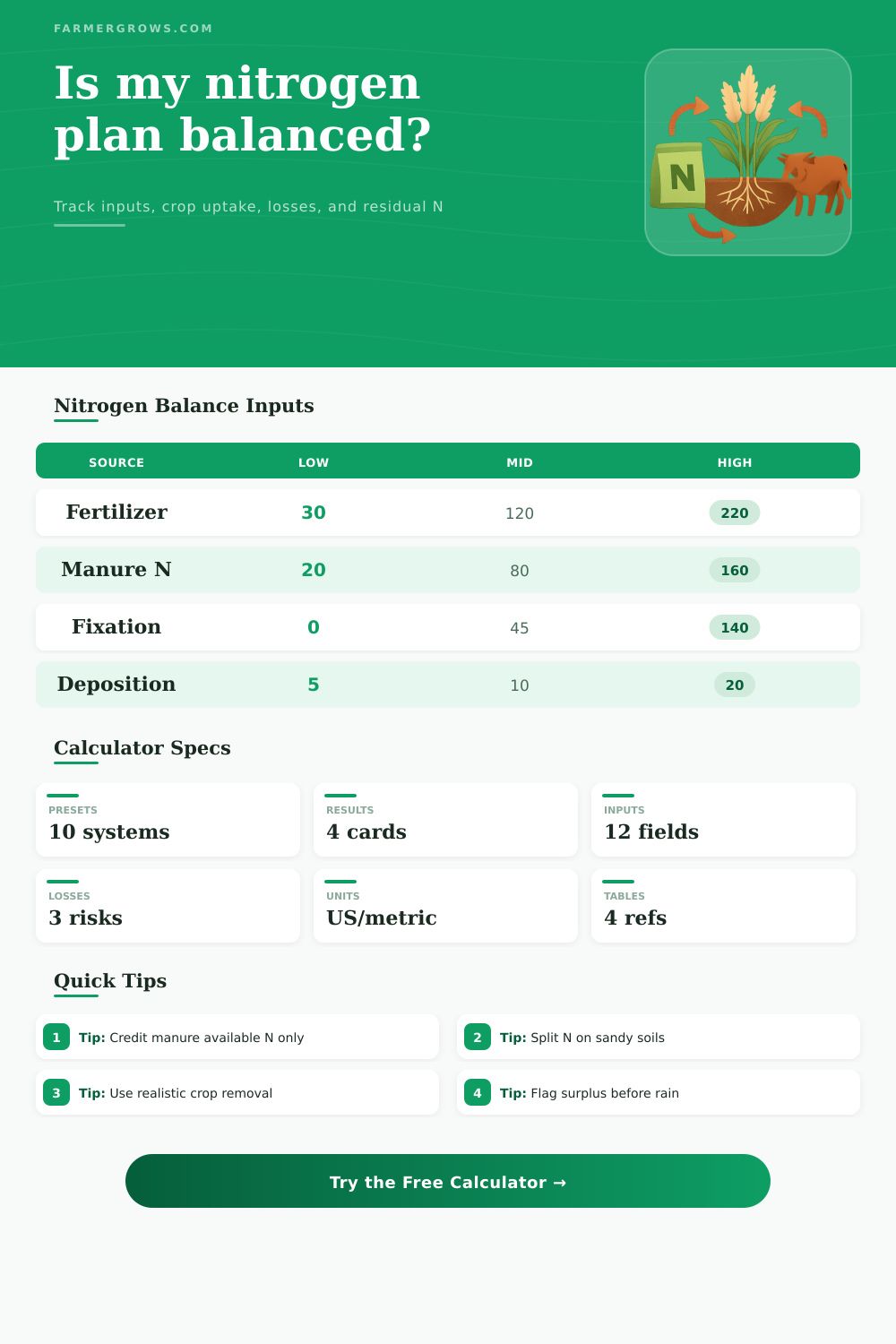
Estimate field nitrogen supply from fertilizer, manure, fixation, deposition, soil residual, and mineralization, then compare it with crop uptake, crop removal, and N loss pathways.
Use this as a planning worksheet with current soil tests, manure analyses, local recommendations, and realistic yield goals. The calculator uses per-acre or per-hectare rates, then converts internally to pounds of N per acre.
Nitrogen Balance Results
The balance compares available N with uptake, likely losses, and your selected residual target.
| Crop | Yield basis | Harvest removal | Whole-crop uptake |
|---|---|---|---|
| Corn grain | bushel per acre | 0.65 to 0.75 lb N/bu | 1.0 to 1.2 lb N/bu |
| Corn silage | ton per acre | 7 to 9 lb N/ton | 9 to 12 lb N/ton |
| Soybean | bushel per acre | 3.5 to 4.0 lb N/bu | 4.5 to 5.5 lb N/bu |
| Winter wheat | bushel per acre | 1.1 to 1.4 lb N/bu | 1.6 to 2.0 lb N/bu |
| Alfalfa hay | ton per acre | 45 to 55 lb N/ton | 55 to 65 lb N/ton |
| N source | Typical credit range | Timing note | Calculator entry |
|---|---|---|---|
| Fertilizer N | Nearly full applied rate | Best near crop demand with split timing where risk is high. | Enter actual nutrient N, not product pounds. |
| Injected liquid manure | 45% to 75% first-year N | Lower ammonia loss than surface application. | Total manure N times availability percent. |
| Surface poultry litter | 30% to 60% first-year N | Rain or incorporation soon after spreading raises credit. | Total litter N and first-year availability. |
| Legume fixation | 40 to 150 lb/ac | Credit depends on crop, nodulation, biomass, and previous removal. | Enter direct credit for the season. |
| Soil mineralization | 20 to 80 lb/ac | Warm moist soils and high organic matter release more N. | Enter local estimate or soil-health credit. |
| Pathway | Low risk | Medium risk | High risk |
|---|---|---|---|
| Leaching | Fine soil, split N, modest rain | Mixed texture or wet spring | Sandy soil, heavy rain, nitrate before uptake |
| Volatilization | Injected, incorporated, or rain soon | Surface N with partial moisture | Surface urea or manure, warm residue, no rain |
| Denitrification | Well-drained or cool dry soil | Short saturation periods | Warm saturated soil with nitrate present |
| Residual carryover | Moderate residual with cover crop | Some fall nitrate remains | Large surplus ahead of wet season |
| Balance after crop and losses | Interpretation | Common next step | Field note |
|---|---|---|---|
| More than 40 lb/ac surplus | High residual or loss exposure | Reduce later N, add cover crop, or check yield goal. | Risk rises before heavy rain or irrigation. |
| 10 to 40 lb/ac surplus | Modest cushion | Acceptable for many systems if residual target is intentional. | Watch sandy fields and tile-drained acres. |
| -10 to 10 lb/ac | Near balanced | Good planning zone when crop demand and timing are realistic. | In-season tests can refine sidedress decisions. |
| More than 10 lb/ac deficit | Possible N shortfall | Add split N, raise organic credit only with evidence, or lower yield goal. | Deficit can limit yield or protein. |
Tip: Separate total manure N from first-year available N. Organic sources often keep releasing after the crop peak, so the available percentage matters more than the lab total alone.
Caution: A large surplus is not automatically stored for next season. Wet soils, sandy texture, surface urea, and saturated conditions can move N into loss pathways quickly.
Nitrogen are a nutrient that can affect how a corn crop grow. Nitrogen is also a nutrient that a field can lose if the weather is wet and warm. Many farmers track nitrogen to see if they has low levels of nitrogen, which will show up in pale leaf with lower levels of protein, or if there is high levels of nitrogen, which will cause the nitrogen to leave the field before the crop can use it.
There are many source of nitrogen and many ways that nitrogen can leave the field. A person must track the amount of nitrogen that come into the field to the amount that the crop takes up and the amount that the soil loses. The nitrogen calculator provided above will turn your nitrogen account into a worksheet that you can use.
How to Plan Nitrogen for Corn Using a Calculator
You will have to enter the size of the field, the type of crop that will be grown, and the yield that you will get from that crop. You will have to enter how much nitrogen will come from fertilizer, manure, legume fixation, air deposition, and the slow release of organic matter in the soil. You will have to rate the potential loss of nitrogen to the field based off the type of soil in the field and the local weather.
After you enter the number, the calculator will subtract the potential losses of nitrogen and compare the remaining amount to the amount of nitrogen that the crop will take up and the amount of nitrogen that you want leave in the soil for the next crop to grow. The calculator will show you whether your nitrogen plan has too little nitrogen, if it balances out to what you need for your crop, or if you have too much nitrogen in your plan. One of the most surprising source of nitrogen that comes into the field is from the residual nitrate that is in the soil before the field begins that season.
Many soil tests in the spring can reveal that there is thirty or forty pound of residual nitrate in the soil. Many farmers do not account for this nitrogen in their plan for that season. When you subtract this amount from the total amount of nitrogen that the crop will need, there will be less nitrogen that has to come from fertilizer, and there will be a reduction in the risk of having too many nitrogen in the field during the late part of the season.
Using manure works in the same way. If you enter the total amount of nitrogen in the manure into the plan, you can separate the portion that will become available to the field during the first year of applying that manure. If the manure is dairy manure that is injected into the field, it will have around a 45 percent availability rate for the nitrogen in the manure.
If the farmer applies poultry manure to the field surface, it will have around a 35 percent availability rate. This distinction must be made for the nitrogen from manure to be accurateley accounted for in the plan. The nitrogen that leaves the field happens in ways that do not await the harvest of the crop.
If the soil contains sandy soil or receives a heavy amount of spring rain, the nitrogen can wash below the crop roots in a process called leaching. Volatilization can occur when urea or manure applied to the field’s surface release ammonia gas into the atmosphere before the soil can absorb the nitrogen. Denitrification can occur when warm temperatures in the soil that receives a high amount of water for more than one or two days transform the nitrogen into a gas in the soil.
Each of these potential losses can be accounted for in the nitrogen calculator to provide the most accurate estimate of how much nitrogen the fields will contain at the end of the season. If the field rates highly for potential leaching, there will be nitrogen loss in the calculation of the amount of nitrogen that remains in the field. The nitrogen calculator accounts for both the crop’s removal of nitrogen as well as the uptake of nitrogen by the crop as a whole.
The amount of nitrogen that the crop removes is the amount of nitrogen in the crop’s grain or forage. The uptake of nitrogen by the crop as a whole includes the amount of nitrogen in the crop’s roots, stubble, or cover crop. The difference between the two is the amount of nitrogen in the soil that will mineralize to feed the next crop that will be planted into the field.
A surplus of nitrogen will show up in the nitrogen calculator. This surplus is often intentional, especially if the soil in the field is heavy with nitrogen. Sandy soil will have the same surplus of nitrogen as the heavy soil, but that surplus will leave the field before the spring season.
The tables listed on the calculator contain the ranges for nitrogen values. The goal of the crop will determine the amount of nitrogen that each acre must contain. A corn crop that will yield 190 bushels of corn will remove 0.67 pounds of nitrogen per bushel of corn, but the whole crop will take up 1.1 pounds of nitrogen per bushel of corn.
The difference between the two values accounts for how much nitrogen is taken up that will mineralize to feed the next crop in the field. Other values in the tables can include the amount of nitrogen that legumes can contribute to the field. A stand of alfalfa can contribute 80 pounds of nitrogen to the soil where corn will be planted the following spring.
A stand of soybeans may contribute 40 pounds of nitrogen. The nitrogen in these values will influence your nitrogen plan, and using the appropriate amount will keep your nitrogen balance honest. Some of the common mistake that farmers can make with nitrogen calculations include using last year’s manure analysis to determine the amount of nitrogen that the manure will contain this year.
Other mistakes would be to ignore the variation in availability between injected dairy manure and surface-applied poultry manure. Another would be ignoring the amount of residual nitrogen in the field before planting the crop. If you ignore the amount of nitrogen that will remain in the soil after the crop is harvested in the nitrogen calculation plan, the number that is obtained will have no benchmark against which to compare the amount of nitrogen that comes from fertilizer.
The nitrogen calculator will not catch all the variables in the field, but it will surface the variables that are most important to the farmers prior to the beginning of the season. Having a balanced plan for nitrogen does not necessarily mean having a balance of nitrogen in the field. Some surplus of nitrogen will leave in the field in the form of nitrate that the crop can take up or released into the atmosphere in the form of ammonia gas.
Too much surplus of nitrogen can pose a threat to the environment, though, as well as increasing the cost of the inputs to the fields. Running the nitrogen calculator prior to making the first application of nitrogen to the field can allow farmers to make adjustments to their nitrogen plan. Taking this single step before planting and applying nitrogen to the field will ensure that the farmers have control over this aspect of crop growth.