
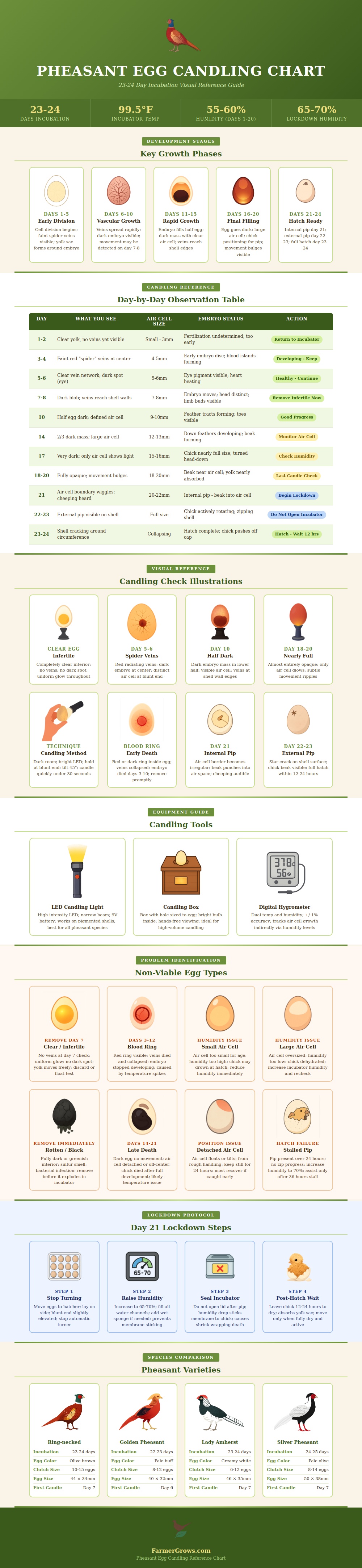
Candling pheasant eggs allow you to check for embryo development. Candling pheasant eggs will allow you to see whether a pheasant egg are fertile or not. By using a light source, you can look through the shell of the pheasant egg to view it’s internal structure.
To understand the stages of development of the embryo inside the pheasant egg, you must use a candling chart to help you read the development of the embryo. During the first four day of incubation, when you look into the pheasant egg, it will look mostly clear inside. You might think that there is nothing happening in the pheasant egg, but the embryo is forming blood island and forming a network of vessels.
How to Candle Pheasant Eggs
These structure are too small to be visible through the shell of the pheasant egg. Do not candle your pheasant eggs too frequently in this initial four-day period, as candling can cool the eggs and slow the growth of the embryo within. Many people chooses to wait until day seven of incubation to candle their eggs the first time, to ensure that the embryo development is visible enough to be read.
Around the middle of the second week, the veins that spread across the inner surface of the pheasant egg will become visible. A dark spot will form in the center of the shell of the pheasant egg; this is the embryo. You may also notice movement within the egg.
The air cell at the blunt end of the pheasant egg should steadily grow in size. If the air cell do not grow within the pheasant egg, then the humidity within the incubator is likely too high. If the air cell grows too large and too quick within the pheasant egg, then the humidity within the incubator is too low; low humidity can dry out the pheasant eggs.
At approximately day seventeen, the inside of the pheasant egg will appear almost completely dark due to the embryo that is inside of the egg. The embryo is performing positioning movement to initiate pipping, and the air cell is the only visible part of the pheasant egg. Using candling at this stage will allow you to verify the progress of the embryo inside the pheasant egg.
Day seventeen is the last time you should candle your pheasant eggs prior to the lockdown process. During the lockdown process, you must stop turning the pheasant eggs. You must also increase the humidity within the incubator so that the membrane of the pheasant egg remains flexible.
Should you open the incubator at this last stage, you may drop the humidity within the incubator; dropping the humidity can lead to the membrane drying out and the trapped chick being unable to exit the egg. Some of the pheasant eggs may look different then others. However, you should not remove any pheasant eggs from the incubator too soon just because they look different from the others.
Fertile pheasant eggs will develop at different rate. You must compare the appearance of the pheasant eggs to one another. If one pheasant egg appears to be completely clear within whereas the others contain visible development of the embryo, then the clear egg is likely infertile.
If a few of the pheasant eggs have a blood ring inside the shell instead of spreading vein, the eggs have experienced a failure during incubation. A blood ring can be used to identify problem pheasant eggs. A blood ring within the shell of the pheasant egg mean that the embryo had begun to develop but then passed away within the egg.
A completely dark colored pheasant egg with no movement within the air cell after day twenty means that the embryo has also passed away. In the rare chance that a pheasant egg exhibits a greenish color and emits a sulfur smell, it is likely that the egg is rotten; in this case, you should remove the rotten pheasant eggs to ensure that they do not negatively impact the other pheasant eggs within the incubator. Due to the different species of pheasant, some species will take different length of time to incubate.
For example, ring-necked pheasant eggs take twenty-three to twenty-four days to incubate; golden pheasant eggs may take one day less then the ring-necked pheasant eggs; silver pheasant eggs may take one day more than the ring-necked pheasant eggs. The color of the shell of the eggs will also play a factor in how easy you can view the veins within the eggs. If the color of the shell is olive or buff, it will be harder to view the veins within the egg compared to pheasant eggs with a pale shell color.
When candling the pheasant eggs, you must account for the color of the shell. By candling the pheasant eggs in the incubator, you will be able to learn of the signal of a successful hatch of the pheasant eggs. Through candling, you will learn how fast the air cell should expand.
You will also learn the appearance of a healthy internal pip of the pheasant egg and how the darkness should spread within the shell. If a chick begins to pip, you should not assist it; most chicks can pip and emerge on their own if the humidity within the incubator has remained steady. Should the chick become stuck for more than one day, you may assist it by softening the membrane of the egg.