Pesticide Mixing Calculator
Size tank batches, water, product, adjuvant, and overage for field, orchard, and spot spray jobs
📊 Mixing Results
| Task | Typical Rate | Tank Note | Best For |
|---|---|---|---|
| Field broadcast | 10–20 GPA | 50–200 gal | Big fields |
| Orchard airblast | 50–100 GPA | 100–300 gal | Tree crops |
| Backpack spray | 0.5–2 gal | 1–4 gal | Spot jobs |
| Garden hose-end | 20–40 GPA | 2–16 gal | Small areas |
| Tank Size | 10 GPA | 15 GPA | 20 GPA |
|---|---|---|---|
| 50 gal | 5 ac | 3.3 ac | 2.5 ac |
| 100 gal | 10 ac | 6.7 ac | 5 ac |
| 200 gal | 20 ac | 13.3 ac | 10 ac |
| 400 gal | 40 ac | 26.7 ac | 20 ac |
| From | To | Factor | Use |
|---|---|---|---|
| 1 gal | 3.785 L | x 3.785 | Tank volume |
| 1 fl oz | 29.57 mL | x 29.57 | Product rate |
| 1 acre | 0.4047 ha | x 0.4047 | Area rate |
| 1 sq ft | 0.0929 m² | x 0.0929 | Spot areas |
| Type | Mix Note | Agitation | Use Case |
|---|---|---|---|
| EC | Blend well | Medium | Field spray |
| WP | Wet first | High | Dry powder |
| SC | Shake well | Low | General use |
| OD | Mild mix | Medium | Oil blends |
To perform precise pesticide mixing, a person must ensure that they applies the correct amount of herbicide to the correct area. However, if a person dont perform precise pesticide mixing, then the herbicide may be too weak at the edges of the field to which it is applied, or the herbicide may be too strong in the center of that fields. Furthermore, if a person should run out of herbicide in the middle of a row of fields, they will lose momentum in applying the herbicide to those field.
Performing precise pesticide mixing allows a person to maintain control over the process of applying the herbicide to the fields. A person must balance the volume of the liquid with the number of acres that are to be treated with the herbicide, and the rate of the herbicide with the size of the pesticide tank that will be used to distribute the pesticide. The label on the pesticide contains instructions that a person must follow.
How to Mix Herbicide Correctly
The spray volume is one of the main determinations for the pesticide mixture, and the spray volume is measured in gallons per acre. Using too small of a spray volume may lead to some of the fields not being treated with the herbicide with which they are infect with weeds. Using too high of a spray volume will waste both the fuel that the pesticide sprayers use to move to the fields, as well as the time that is required for the herbicide to treat the fields to which the pesticide is applied.
A person must determine the product rate, which is how many fluid ounces of herbicide per acre are to be used as prescribed by the label of the pesticide. Adjuvants are added to the herbicide to ensure that the spray sticks to the plant’s surfaces, or to help the spray to even distribute the herbicide. Adjuvants are added in small amount to the herbicide solution, but are critical in performing their specific function within the herbicide.
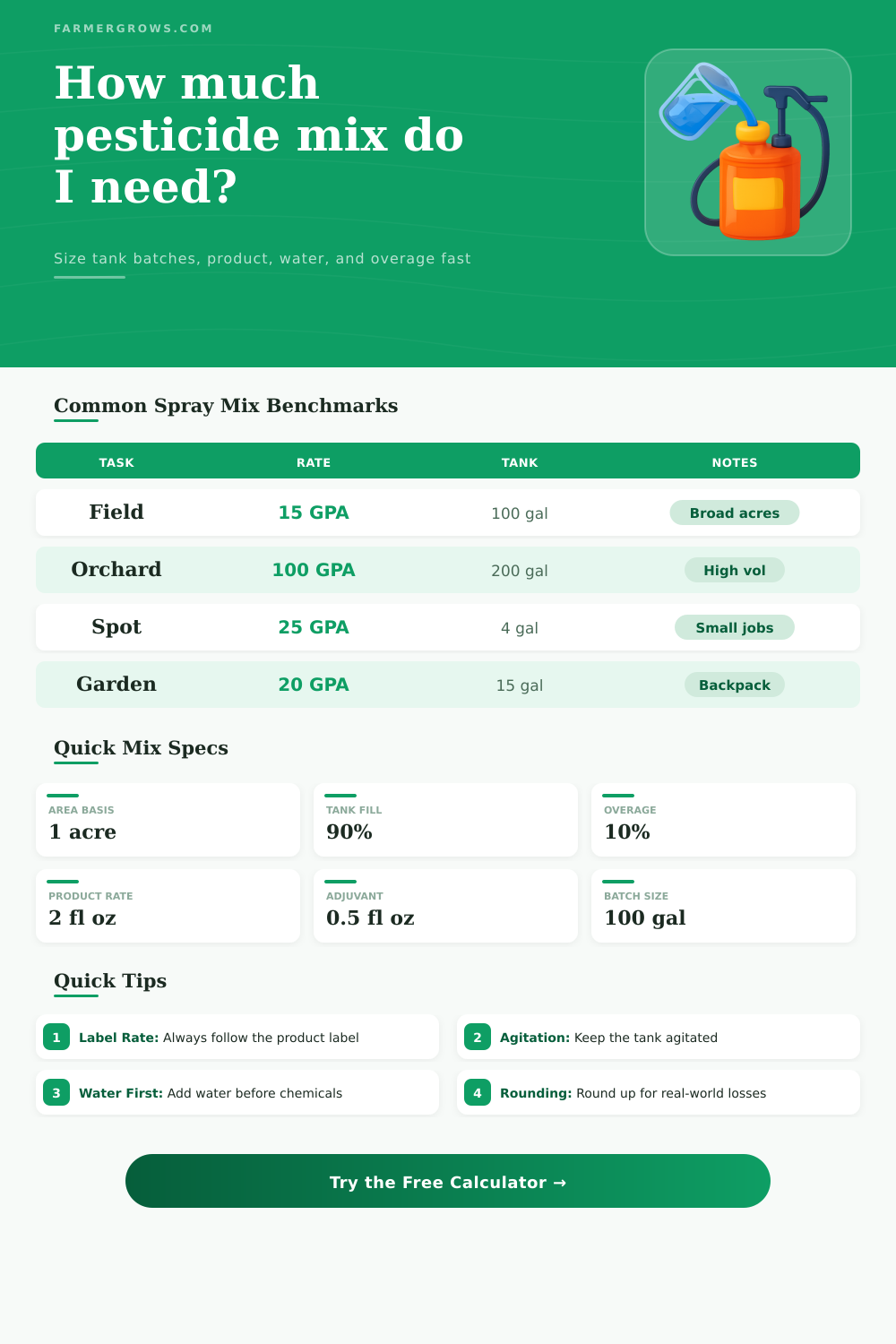
Furthermore, the size of the tank in which the herbicide is mixed must match the field that will be treated; otherwise, a person may have to continually refill the tank with the herbicide. For instance, a 100-gallon tank may be used to spray acres at a rate of 15 gallons of herbicide per acre, but an airblast sprayer that sprays trees may require 100 gallons of herbicide per acre. A person should never fill the tank with the pesticide to the very top.
Instead, the pesticide should be filled to 90% of the tank’s capacity, allowing space for the herbicid’s liquids to move within the tank when the sprayer is in operation. Furthermore, adding a slight overage of the amount of herbicide that is required for the acres to be treated allows for compensation in the case of nozzle clogs or drift of the herbicide into the field that are not to be treated. Concentration of the herbicide, which indicates the percentage of active ingredient by weight in the pesticide, is one additional factor for a person to know when performing precise pesticide mixing.
Presets allow a person to quickly calculate tasks related to spraying the fields; these presets can calculate the number of liters in a given number of gallons, the number of hectares in an area in acres, and the number of square feet in an area that may be treated with herbicide. Furthermore, if the areas to be treated are small, such as lawns, a calculation of the number of square feet of those lawns will allow a person to calculate the amount of herbicide to use. If a person increases the spray rate, more batches of the herbicide will have to be prepared.
Similarly, if a person decreases the overage, they may run out of herbicide before treating all of the acres that are required to be treated with the herbicide. When mixing the herbicide with the liquid that will fill the tank, a person should first add the liquid to the tank, and then add the herbicide. By adding the herbicide to the water and using constant agitation to mix the two liquids, one can avoid forming clumps of the herbicide that may otherwise plug the nozzles of the pesticide sprayer.
These regulations are included on the label of the pesticide product, as the label contains information regarding safety margins for the individual that mix and sprays the pesticide. For instance, emulsifiable concentrates will mix with water, but wettable powder products will require additional wetting agents to ensure that the pesticide remains suspended within the water. Similarly, oil-based pesticides will create milkshake-like mixtures, so medium stirring is required to avoid introducing air into the pesticide product.
Herbicides may be prescribed for different spray volumes for different types of field. For instance, pastures may require lower spray volumes of herbicide to target the weeds that are growing in those fields, but orchards may require high volumes of the herbicide to ensure that the underside of each leaf is treated with the herbicide. Vineyards that use airblast sprayers may require a minimum of 50 gallons of herbicide per acre to effectively move the herbicide through the trellised vines.
A person that uses a backpack sprayer can use a 15 gallon tank to spray vegetables, but 20 gallons of herbicide per acre should be used to ensure that the rows of vegetables are treated by the herbicide. Furthermore, 100 gallons of herbicide will cover 6.7 acres at a rate of 15 gallons of herbicide per acre, but if the number of gallons per acre is halved, the number of acres that can be covered with the same volume of herbicide will double. A person should pay attention to the change in the seasons when using herbicides; in the spring, pre-emergent herbicides that kill weeds before they emerge from the ground may be used with lower spray volumes.
In the summer, however, the use of post-emergent sprays will require higher spray volumes to ensure that the herbicide can reach the leaves of the weeds that are already established within the fields. During dry period, the pesticide can be added to smaller batches to avoid losing the herbicide to evaporation. During years that experience high levels of rainfall in which a person is spraying treated fields, higher volumes of the herbicide may be used.
A person can plan the process of precise mixing of the herbicide by working backwards from the treatment of the field. For instance, a person can determine how many acres will be treated and how much herbicide is required per acre, and then use those determinations to prescribe the correct spray volume of the herbicide; the size of the tank can also be used to determine how many batches of the herbicide will have to be prepared. By planning the spraying of the fields in this manner, a person will spend less time spraying the field, and will waste less of the herbicide and the resources required to spray the fields.
Actualy, a person should of used more care to avoid mistakes. Most people dont realize how much the weather affect the process, and it is alot more complicated than it looks. Some people think the herbicide should be mixed different than what the label says, but they is wrong.
Youll find that the correct amount is important to recieve the best results. Its better to be safe.