Pea Seed Rate Calculator - kg/ha and Seed Count
Estimate seed mass, seed count, and planting density for peas from plot size, spacing, germination, and thousand-seed weight.
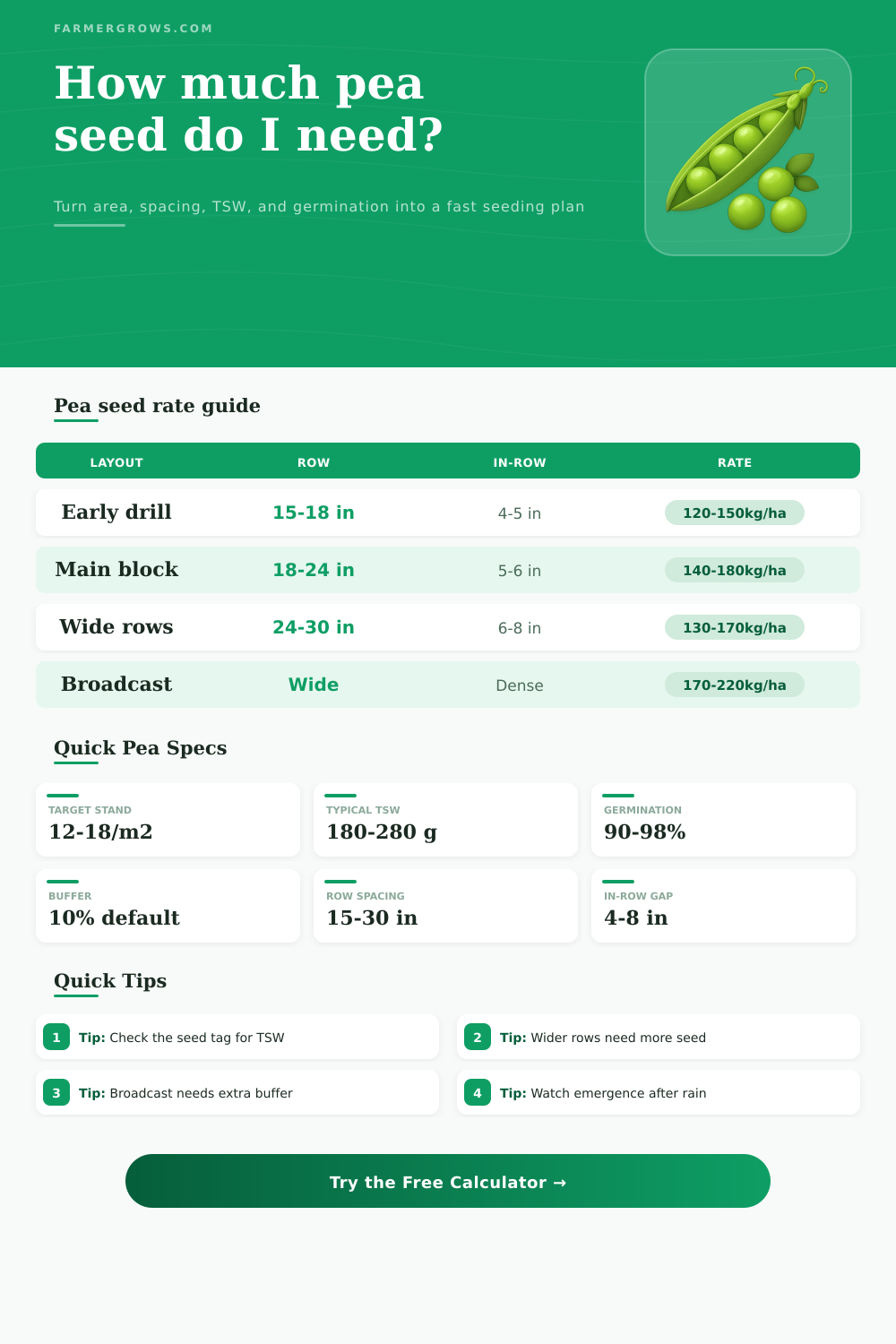
| Pea system | Row spacing | In-row gap | Typical rate |
|---|---|---|---|
| Early drill | 15-18 in | 4-5 in | 140-170 kg/ha |
| On-time row | 18-24 in | 5-7 in | 150-190 kg/ha |
| Wide row | 24-30 in | 6-8 in | 130-175 kg/ha |
| Broadcast | Wide | Dense | 180-230 kg/ha |
| TSW | Seeds/kg | Seeds/lb | Pea note |
|---|---|---|---|
| 250 g | 4,000 | 1,814 | Small seed |
| 350 g | 2,857 | 1,296 | Medium |
| 450 g | 2,222 | 1,008 | Large seed |
| 550 g | 1,818 | 825 | Heavy lot |
| Row spacing | In-row gap | Plants/m2 | Seeds/ha |
|---|---|---|---|
| 15 in | 4 in | 167 | 666,667 |
| 18 in | 5 in | 120 | 480,000 |
| 24 in | 6 in | 83.3 | 333,333 |
| 30 in | 8 in | 50.0 | 200,000 |
| Field | Germination | Buffer | Note |
|---|---|---|---|
| Firm moist | 94-97% | 0-5% | Best start |
| Normal seedbed | 92-95% | 5-10% | Common |
| Dry topsoil | 88-92% | 10-15% | Add seed |
| Crusted/no-till | 84-90% | 15-20% | Watch loss |
To determine the amount of pea seeds to sow into the ground, a farmer or gardener must consider many different factors. The amount of pea seeds to sow will depend on the targeted stand of plants that the grower desires. The target stand for most farms or gardens will be between 12 and 18 plant per square meter.
This target stand will ensure that there is enough plant to produce strong yields while ensuring that each plant has enough room to grow without competing with the other plant for resources like light and air. Additionally, another important factor to consider is the row and in-row spacing of the planted peas. The row spacing and in-row spacing will determine how many plant will occupy a given area.
How to Calculate How Many Pea Seeds to Sow
For example, row spacing for planted area might be 24 inches if farmers are using machinery to plant the rows. However, farmers might use 15 inches in areas where early drill sowing methods are used in raised beds. In-row spacing should be between 4 and 8 inches to find the best balance between the competition between each pea plant and the requirement of ground coverage by the plants.
The germination rate of the seeds will also play a role in the number of seed to be sown into the ground. Many pea seeds will germinate at a rate between 90 and 98 percent of the total number of seeds that are planted into the soil. However, losses during the establishment of the young pea plant can occur due to birds, cold weather, or crusty soil.
Furthermore, the survival rate of these young plant will drop to 85 percent or less. Therefore, 10 percent more seeds should be sown than calculate to account for these possible losses. The thousand seed weight of the plants, or the TSW, will help determine the amount of mass of the seeds that are required to reach the target stand.
The weight of pea seeds ranges between 180 grams for the small cover crop types of peas and 280 grams for the plump soup variety of peas. By using the thousand seed weight that is listed on the seed tag, you can calculate the necessary amount of kilogram of seeds per hectare or pounds of seeds per acre. The density of the plants will change based off the planting setup for the area.
For instance, an area planted with an early drill that creates rows that are 15 to 18 inches in width and 4 inches between each plant will result in a density of 140 to 170 kg/ha. Such a density results in quick ground cover by the plants and minimizes the number of weed that can grow within the planted areas. Main block planting areas will have rows that are 18 to 24 inches in width and 5 to 6 inches between each plant.
Such a setup will result in a density of 140 to 180 kg/ha. Such a spacing allows for the peas to bush out and grow without becoming tangled with other plant in the same area. Finally, if wide rows or broadcast sowing methods are used, 170 to 220 kg of seeds per hectare will be required to reach the target stand of 12 to 18 plant per square meter.
The soil conditions within the planting area will impact the number of pea seeds that are required. If the soil has a firm seedbed that is moist and of good tilth, a buffer of only 5 percent will be required. However, if you plant dry topsoil without tilling the soil first, a buffer of 10 to 15 percent of the calculated amount will be required.
The weather in which the peas will be planted will also impact the plants, regardless of the calculations. Additionally, the thousand seed weight of the seeds will impact the number of seeds that are calculated to be required for planting. For instance, if the seeds to be planted are light in weight and contain 200 grams of seeds per thousand seeds, there will be 5,000 seeds per kilo of seeds.
However, if the seeds are heavy and contain 300 grams of seeds per thousand seeds, there will only be 3,300 seeds per kilo of seeds. Such a difference in weight means that a greater amount of heavy seeds will be required to cover the same amount of land as lighter seeds. Furthermore, the variety of peas that will be planted will impact the total number of plant that will be grown.
For instance, snow peas will grow to be taller then shelling peas and will allow for more space between each plant. However, shelling peas will grow to be more compact and will require more density of plants to provide sufficient pod set on the plants. The method in which the seeds will be harvested will also impact the number of seeds that will be calculated.
If you use broadcast sowing methods to grow the peas for harvest, a minimum buffer of 20 percent will have to be sown into the ground. However, if drilled rows are planted for harvest, fewer seeds will need to be planted into the ground. Finally, the seed tag for each type of pea seed will contain information regarding the thousand seed weight of the seeds and the germination rate of the plants.
Ensuring that you check this information before sowing the seeds will prevent mistakes from being made when calculating the number of seed to be planted into the ground.