Garden Manure Calculator
Estimate garden manure volume, bag count, and weight for rectangles, circles, triangles, or custom areas. The calculator handles manure type, depth, moisture, and buffer so you can plan a cleaner order.
Pick a real garden job to seed the inputs. Each preset sets shape, dimensions, manure type, depth, moisture, incorporation style, and buffer.
Garden Manure Output
Calculated from the selected shape, depth, manure type, moisture, and buffer.
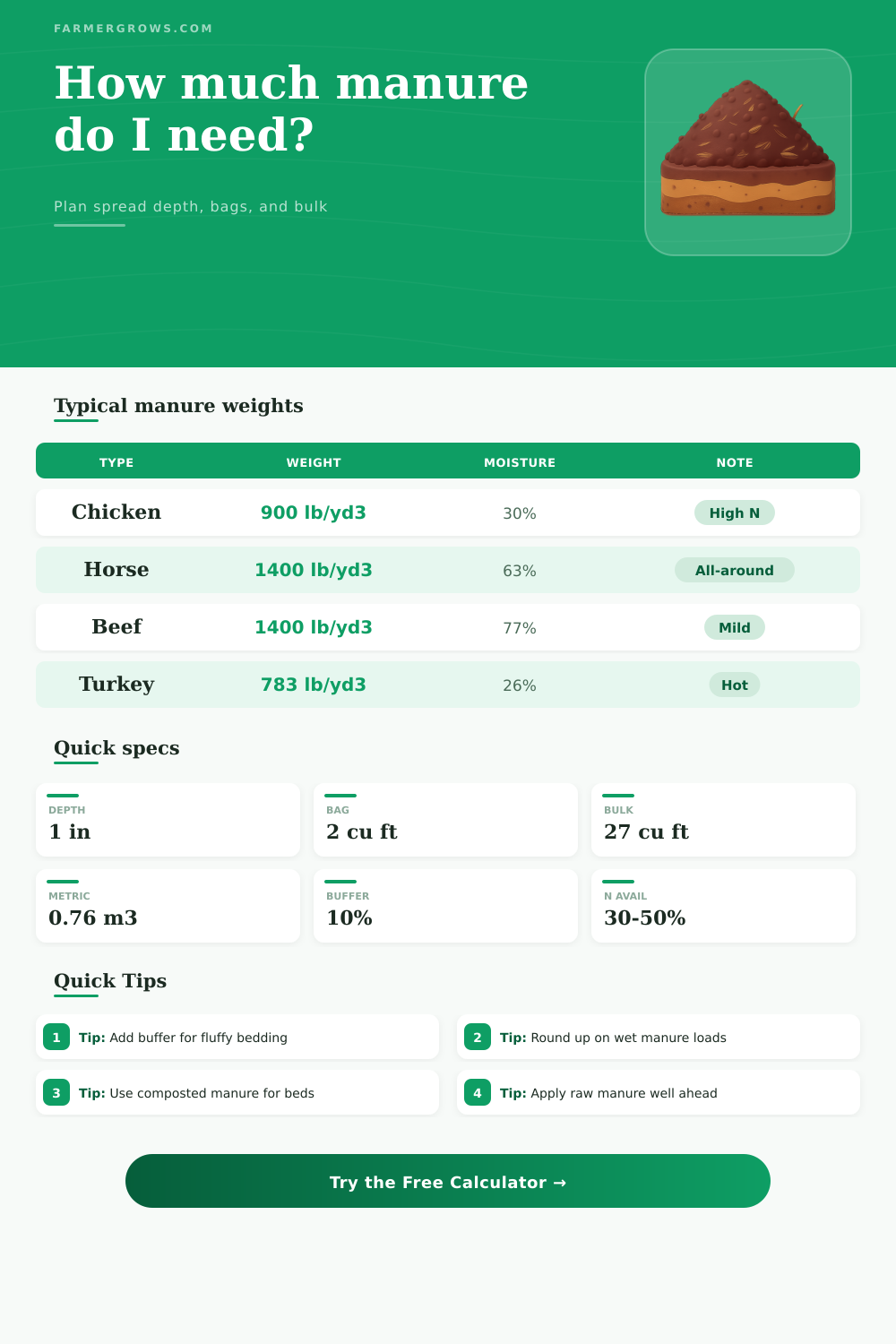
| Type | lb/yd3 | lb/ft3 | Moisture |
|---|---|---|---|
| Chicken with litter | 900 | 33.3 | 30% |
| Turkey litter | 783 | 29.0 | 26% |
| Horse manure | 1400 | 51.9 | 63% |
| Dairy cow | 1400 | 51.9 | 65% |
| Beef cow | 1400 | 51.9 | 77% |
| Sheep | 1400 | 51.9 | 72% |
| Rabbit | 1400 | 51.9 | 75% |
| Laying hen | 1400 | 51.9 | 60% |
| Type | N % | P2O5 % | K2O % |
|---|---|---|---|
| Chicken | 2.0 | 2.7 | 1.4 |
| Turkey | 3.1 | 2.9 | 1.7 |
| Rabbit | 2.3 | 1.1 | 0.4 |
| Sheep | 1.0 | 0.5 | 1.0 |
| Beef | 0.9 | 0.6 | 1.1 |
| Dairy | 0.8 | 0.5 | 1.2 |
| Horse | 0.7 | 0.4 | 1.1 |
| Goat | 0.4 | 0.5 | 0.1 |
| Depth | 1 yd3 covers | 1 m3 covers | 2 cu ft bags/yd3 |
|---|---|---|---|
| 0.5 in | 648 sq ft | 60.2 m2 | 13.5 |
| 1 in | 324 sq ft | 30.2 m2 | 13.5 |
| 1.5 in | 216 sq ft | 20.1 m2 | 13.5 |
| 2 in | 162 sq ft | 15.1 m2 | 13.5 |
| 3 in | 108 sq ft | 10.0 m2 | 13.5 |
| 4 in | 81 sq ft | 7.5 m2 | 13.5 |
| 6 in | 54 sq ft | 5.0 m2 | 13.5 |
| Size | Volume | Bags/yd3 | 1 in cover |
|---|---|---|---|
| 0.75 cu ft | 0.75 cu ft | 36.0 | 20.3 sq ft |
| 2 cu ft | 2.00 cu ft | 13.5 | 54.0 sq ft |
| 3 cu ft | 3.00 cu ft | 9.0 | 81.0 sq ft |
| 1 yd3 bulk | 27.00 cu ft | 1.0 | 324.0 sq ft |
| Project | Area | 1 in need | 2 in need |
|---|---|---|---|
| Herb strip 4 x 8 | 32 sq ft | 0.10 yd3 | 0.20 yd3 |
| Berry row 3 x 20 | 60 sq ft | 0.19 yd3 | 0.37 yd3 |
| Kitchen patch 10 x 10 | 100 sq ft | 0.31 yd3 | 0.62 yd3 |
| Orchard ring 20 ft | 314 sq ft | 0.97 yd3 | 1.94 yd3 |
Use the reference tables to compare manure types, bag sizes, and coverage rates before you order. The calculator follows shape, depth, moisture, buffer, and nutrient inputs so the estimate stays practical for real garden work.
To determine the correct amounts of manure to add to your garden, you must calculate the volume of your garden area and the depth of the manure to be apply to the soil. By calculating the volume of manure that is needed, you will be able to prevent two different issue: you will not have to much manure that may burn your plants or contain too many nutrient for the soil in your garden. Manure contain three main nutrients: nitrogen, phosphorus, and potassium.
Additionally, the different type of manure contain different amounts of these nutrients. For instance, chicken manure contains high amounts of nitrogen while beef manure contains a light, more balanced nutrient content. Another factor to consider with manure is it’s density.
How to figure out how much manure your garden needs
Dry manure is less dens than wet manure. This means that dry manure will weigh less per cubic yard than wet manure. Because of this, it is important to consider the weight of the manure needed to be purchased when determining how many manure bag or how many cubic yard of manure you will order.
In order to find the volume of manure needed for your garden, calculate the area of your garden bed. For rectangular beds, simply multiply the length by the width of your bed to find the area in square feet. For circular garden beds, use the standard equation to calculate the area of a circle (pi times the radius of the circle squared).
Once you find the area of your garden bed, determine the depth that you would like to apply the manure to the soil. Multiply the area by the depth (again in feet) of the manure to be apply to the soil to find the total volume of manure needed. For example, if the depth that you calculate you need for your garden is two inches, you must convert that measurement to feet.
Add a buffer of ten percent to that calculated volume for manure. This ten percent buffer for the total volume of manure account for the spillage and even spreading of the manure. The depth at which you apply the manure to the soil is another factor that you must consider.
For instance, shallow application of manure of depths around half an inch may be used for lawns or playground area. However, deeper application of manure of depths of two or three inches may be applied to areas where heavy feeding plant will be growing. The roots of plants range in depth, so you will use deeper manure applications for different type of plants than shallow applications.
For instance, manure placed on the soils surface will aid in the growth of the plants shallow root. However, if you till the manure into the soil, the plants deeper roots will be able to utilize the nutrients provide by the manure. In addition to these consideration, you must also consider how you will purchase the manure.
Manure can be purchased in both large bulk quantities or in small bags. If you decide to purchase manure in bags, you can calculate the number of bags needed by dividing the total volume of manure needed by the volume of one bag of manure. If you decide to purchase manure in bulk, you must be aware of its weight.
For example, a load of wet beef manure will weigh more then a load of dry turkey manure. Thus, knowing the weight of the manure will assist in the purchase of the manure. Common mistake include not accounting for the shape of your garden when using the math equation for the area of rectangles, or not accounting for the moisture content of the manure when purchasing it in dry weights.
If these two factor are not accounted for, you may end up with either too little or too much manure for your garden. Another common mistake is not rounding up the amount of manure that is needed to the nearest whole bag or cubic yard. Most store dont sell fractions of bags or cubic yards of manure.
By taking the time to consider each of these factors, you can ensure that the amount of manure purchased will meet the need of the soil in your garden.