Pastrami Brine Calculator
Size an equilibrium brine for brisket flat, navel, turkey, venison, and other pastrami cuts using real meat weight, water ratio, salt percent, Cure No. 1 ppm, thickness, and injection rate.
This calculator assumes Cure No. 1 contains 6.25% sodium nitrite and uses an equilibrium brine based on the combined meat and water mass.
Your Pastrami Brine Batch
Deli Brisket
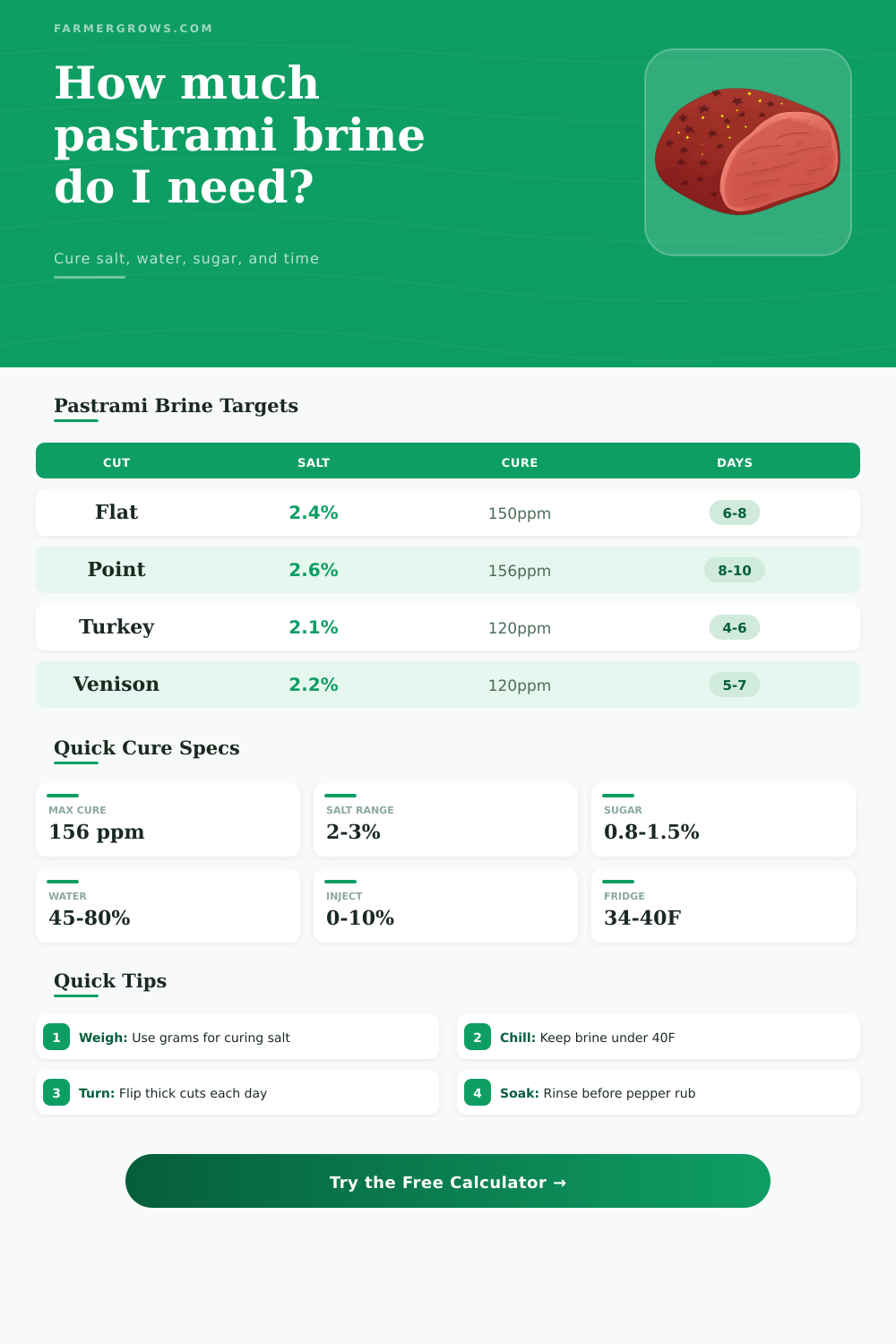
2.4% to 2.7% salt, 150 to 156 ppm Cure No. 1, and a 55% to 70% water ratio for full beef flavor.
Lean Roast
2.2% to 2.4% salt and 120 to 140 ppm nitrite keeps eye round or venison firm without tasting harsh.
Turkey Pastrami
2.0% to 2.2% salt, 120 ppm nitrite, and 1.2% sugar suit lighter poultry fibers and shorter cure times.
Injected Batch
Use a 5% to 10% pump on pieces over 3 inches thick to shorten diffusion distance and even out the cure.
| Target | Cure No. 1 formula | Use case | Note |
|---|---|---|---|
| 120 ppm | Total kg × 1.92 g | Turkey, venison, lean roasts | Milder cured color and flavor |
| 140 ppm | Total kg × 2.24 g | Lean beef pastrami | Balanced color without a high cure target |
| 150 ppm | Total kg × 2.40 g | Brisket flat | Common deli-style equilibrium target |
| 156 ppm | Total kg × 2.496 g | Traditional beef pastrami | Upper nitrite target used by this calculator |
| Ingredient | Best measure | Approx volume | Why it matters |
|---|---|---|---|
| Cure No. 1 | 0.1 g scale | 5.7 g per teaspoon | Small errors change nitrite ppm quickly |
| Diamond Crystal kosher salt | Gram scale | 9 g per tablespoon | Large flakes weigh much less by spoon |
| Morton kosher salt | Gram scale | 15 g per tablespoon | Denser flakes make volume swaps too salty |
| Fine sea or table salt | Gram scale | 18 g per tablespoon | Fine crystals pack tightly in a spoon |
| Thickest point | Immersion only | With 5% to 10% injection | Typical cuts |
|---|---|---|---|
| 1 to 1.5 in | 4 to 5 days | 3 to 4 days | Small flat, turkey tender |
| 2 to 2.5 in | 6 to 8 days | 5 to 6 days | Brisket flat, eye round |
| 3 to 3.5 in | 9 to 11 days | 7 to 8 days | Point cut, navel plate |
| 4 in or more | 12 to 14 days | 9 to 11 days | Large brisket, thick shoulder |
| Spice component | Light rate | Classic rate | Bold rate |
|---|---|---|---|
| Pickling spice in brine | 4 g per kg meat | 8 g per kg meat | 12 g per kg meat |
| Black pepper rub | 8 g per kg meat | 14 g per kg meat | 20 g per kg meat |
| Coriander rub | 6 g per kg meat | 12 g per kg meat | 18 g per kg meat |
| Garlic granules | 2 g per kg meat | 4 g per kg meat | 6 g per kg meat |
Making Pastrami requires the use of a brine. To make the correct brine is a necessary step in the preparation of pastrami as using an incorrect brine may result in bland or unsafe to eat meats. Many people attempt to make pastrami by guessing the amount of salt and cure to be added to the meat.
Guessing, however, may result in incorrect measurements of the ingredients necessary to make pastrami. The calculator provided here removes the guesswork of preparing the brine as the recipe takes into consideration the weight of the meat, the thickness of the meat, and the target percentages of the ingredients necessary for the brine to determine the exact amount of water, salt, sugar, and curing salts that should be used in the brine. The ingredient calculations will also provide the meat preparer with a timeline as to how many day the meat should remain in the brine.
How to Make the Right Brine for Pastrami
To utilize the calculator, the user must first select the cut of the meat that is to be used in the creation of the pastrami. Each cut of meat contains different amounts of muscle which will impact the amount of salt and cure that the meat absorbs. For instance, a cut of brisket flat will be leaner than a cut of brisket point due to the amount of fat marbling that is contained in the point cut.
Turkey breast meat is relatively delicate and venison meat can become too tight if the salt percentage is too high. Each cut of meat has a preset amount of salt and nitrite that can be used, but the user can manually change these to accommodate for individual flavor preference. Following the selection of the cut of meat, the user can select the water ratio that is to be used in the brine.
Different water ratios will result in different amounts of liquid to be used in the brine in relation to the weight of the meat that will be cured. A high water ratio will result in a loose brine that will cover the meat that is to be cured, but a low water ratio will result in less liquid that can result in stronger flavors. The equilibrium method is utilized in the creation of the brine as water ratios will impact the flavor of the meat that results from the brine.
The next variables to be determined are the percentage of salt and sugar that will be used in the brine. The salt will help to preserve the meat, but too much can make the meat too salty when consumed. The sugar will even out the salt flavor and allow the meat to brown when smoked.
The percentages of salt and sugar are set to safe levels so that the meat is not too salty or too sweet tasting like dessert. The user can manually adjust these percentages to taste. The amount of Cure No. 1 that is to be used is another difficult measurement for many cooks.
The calculator will convert the parts per million (ppm) of nitrite that the user chooses into the gram of curing salt that must be weighed out. This is calculated through taking the weight of the meat and water to be used divided by the concentration of nitrite in the Cure No. 1. This will ensure that the amount of nitrite that is used remains within legal limits and provides the meat with its characteristic pink color and protects it against bacteria growth.
By using the pastrami brine calculator, the user avoids the math that they would otherwise have to be performed to calculate the grams of curing salt. Following the determination of the amount of Cure No. 1, the user must determine the thickness of the meat that is to be cured and the injection rate. The thicker the cut of meat, the more time that the brine will have to penetrate the meat to ensure that the center of the meat is cured.
Thin cuts of meat will require only a few days to cure while thicker cuts may require more than one week of curing if using only immersion curing. If injecting the brine directly into the cut of meat, the cutting time will be shortened. The thickness and injection rate will determine the amount of days that the meat will need to cure to reach the center of the meat.
Following the completion of the calculations, the recipe will display the brine recipe along with the amount of days that the cut of meat should remain in the brine. The recipe will display each ingredient and the amount of each ingredient that will be used in the preparation of the brine. Additionally, the recipe can be shared with others to prepare the same recipe or the recipe can be scaled to accommodate for more meat.
Reference tables will display examples of the thickness of meat to cure time and the effect that different spice levels will have on the final rub of the pastrami. Some habits that should be utilized in the preparation of the brine include keeping the brine cold from the time that the brine is mixed until the meat is removed from the brine. Warm brine can lead to bacterial growth in the brine prior to curing the meat.
The bag of meat that is cured in the brine should be flipped or massaged every day to ensure even coating of the meat in the brine. Following the curing process, the meat should be rinsed with water and allowed to rest uncovered in the refrigerator for several hours or overnight to allow the meat to dry. Many people may be concerned that altering any of the variables to the recipe will ruin the preparation of the pastrami.
The equilibrium method is forgiving of alterations to the salt and cure percentages within the recommended range. However, if the curing time is too short or too long, the meat may not properly cure. Adding days to the curing time will not impact the curing of the meat, but cutting the time short may.
The benefit of utilizing the correct brine to make the pastrami is that the resulting pastrami will have even color throughout the cut and a balanced flavor in relation to salt content. The texture will be firm to the touch and not too mushy or dry. Additionally, because the brine has the correct measurements, the cook can focus on the smoking and slicing of the pastrami.