Oval Pond Volume Calculator
Estimate oval pond gallons, acre-feet, ellipse surface area, profile depth, bottom footprint, freeboard storage, shelves, and side-slope effects from major and minor axes.
Load a common oval pond layout, then adjust the axes, average depth, bank slope, shelf, and freeboard to match the waterline survey.
Uses major axis x minor axis at the waterline. This is the starting surface area for volume and evaporation estimates.
Water volume equals ellipse area times average depth, then converts to gallons, cubic meters, and acre-feet.
Solves a matching maximum depth and bottom ellipse from shelf width, shelf depth, and horizontal-to-vertical side slope.
Projects the bank-top oval above the waterline and estimates extra rim storage before water reaches the pond edge.
Oval Pond Volume Results
| Waterline oval | Surface area | Average depth | Approximate volume |
|---|---|---|---|
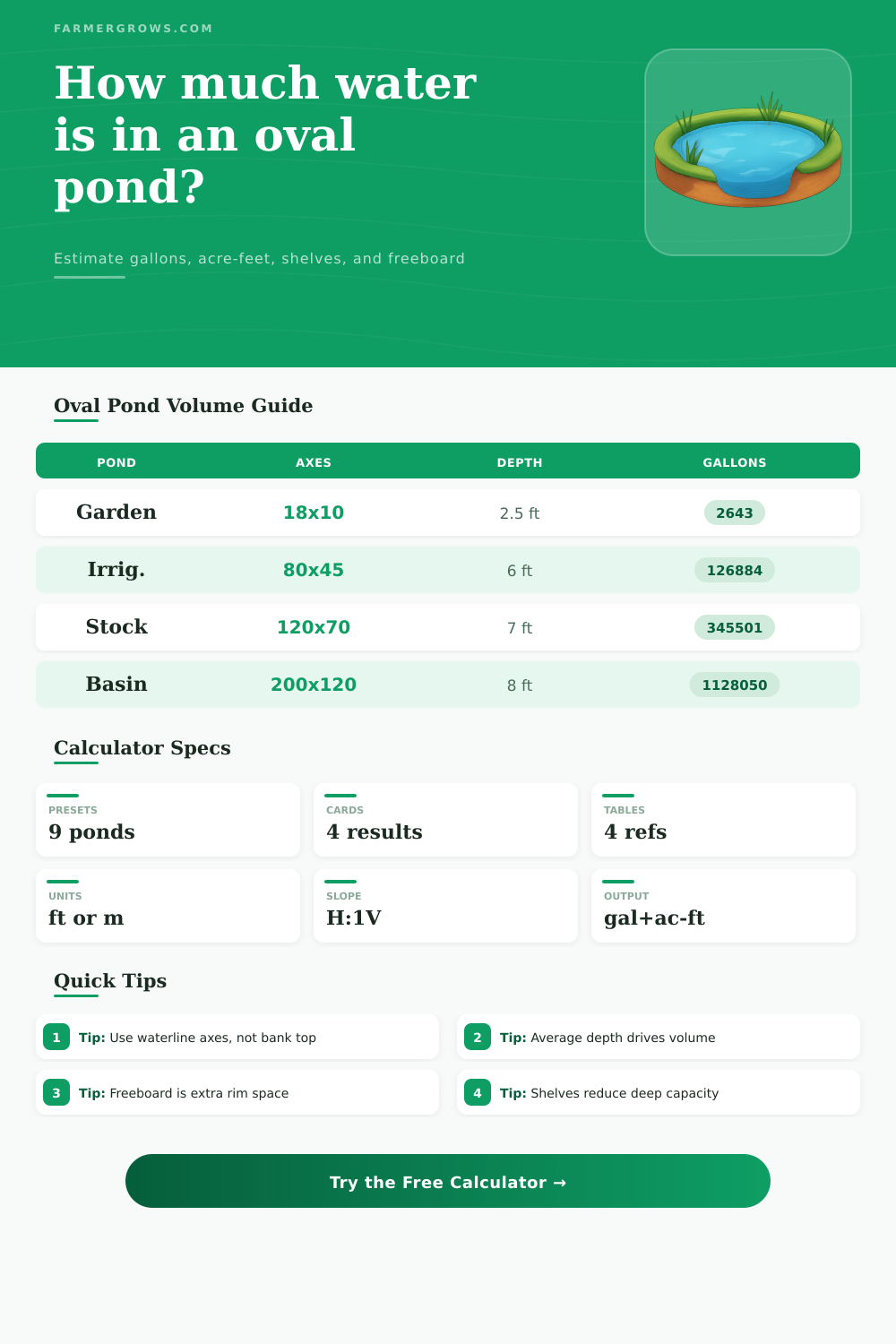
| 18 ft x 10 ft garden pond | 141 sq ft | 2.5 ft | 2,643 gal / 0.008 ac-ft |
| 50 ft x 28 ft wildlife pond | 1,100 sq ft | 4 ft | 32,901 gal / 0.101 ac-ft |
| 80 ft x 45 ft irrigation oval | 2,827 sq ft | 6 ft | 126,884 gal / 0.389 ac-ft |
| 120 ft x 70 ft stock pond | 6,597 sq ft | 7 ft | 345,501 gal / 1.060 ac-ft |
| 200 ft x 120 ft farm basin | 18,850 sq ft | 8 ft | 1,128,050 gal / 3.462 ac-ft |
| Profile feature | Typical entry | Volume effect | Planning note |
|---|---|---|---|
| No shelf, 2:1 slope | 2 horizontal to 1 vertical | More deep water than flatter banks | Common where banks are compact and stable. |
| No shelf, 3:1 slope | 3 horizontal to 1 vertical | Moderate bottom reduction | Useful default for many farm ponds. |
| Wet shelf, 1 to 2 ft deep | 2 ft to 8 ft wide | Reduces deep bowl capacity | Good for access, plants, and edge habitat. |
| Partial shelf coverage | 25% to 75% perimeter | Blends shelf and no-shelf volume | Use when only one side has a bench. |
| Very flat bank, 4:1 or 5:1 | 4 to 5 horizontal | Needs a wider pond for depth | Often chosen for safer equipment access. |
| Freeboard | Where it fits | What it represents | Use carefully when |
|---|---|---|---|
| 0.5 ft | Small lined garden ponds | Minimal normal water margin | Overflow is controlled and waves are small. |
| 1.0 ft | Small farm and wildlife ponds | Basic storm and wave buffer | Edges are mowed or walked often. |
| 1.5 to 2.0 ft | Irrigation and stock ponds | Useful working freeboard | Runoff can rise quickly during storms. |
| 3.0 ft or more | Large basins or dams | Design storage above normal pool | Engineer review and spillway sizing matter. |
| Unit | Equivalent | Formula | Best use |
|---|---|---|---|
| 1 cubic foot | 7.4805 gallons | cu ft x 7.4805 | Small pond water volume |
| 1 cubic yard | 201.974 gallons | cu ft / 27 | Excavation cross-check |
| 1 cubic meter | 264.172 gallons | cu ft / 35.3147 | Metric water volume |
| 1 acre-foot | 325,851 gallons | cu ft / 43,560 | Irrigation and storage planning |
| 1 acre-inch | 27,154 gallons | acre-ft / 12 | Rainfall or drawdown comparison |
Measure at the normal waterline: bank-top dimensions can overstate volume because freeboard is above the regular pool. Use the wet oval for gallons and use freeboard separately.
Keep average depth realistic: a pond with broad shelves may have a much lower average depth than its deepest spot. Sound several points and average them before ordering pumps, treatments, or irrigation capacity.
When you decide to build an oval pond, you must calculate the total volume of waters that the pond will hold. The total volume of water that an oval pond will hold is a critical measurement to determine. The total volume of water that an oval pond will hold will determine the size of the pump that you will need to install in the pond and the amount of water treatments that is required to treat the water in the pond.
Additionally, you will also use the total volume of water that will be in the pond to determine whether the pond holds enough water to irrigate your properties or to provide water for your livestocks. Oval ponds has different dimensions from rectangular and circular ponds. The area of an oval pond requires two different measurement to calculate its area.
How to Calculate the Water Volume of an Oval Pond
Additionally, the depth of an oval pond may not be constant due to the presence of shelves within the pond. When measuring the dimensions of an oval pond, it is critical to measure the pond at the waterline. The waterline will represent the actual volume of water that will be within the pond every day.
The distance from the waterline to the top of the banks within the pond is called the freeboard. This distance is created for cases of storm surge and other weather activities that will flood the pond around the banks. Therefore, when calculating the total volume of water that an oval pond will hold, you will not include the area calculated by the freeboard measurement.
If you include this value in your calculations, your measurement will show a more greater volume than the actual volume that the pond will contain when there is no flooding. An online calculator allows you to enter the axes measurements of the pond at the waterline, the average depth of the pond, the slope of the banks within the pond, the dimensions of any shelves that are within the pond, and the depth of the freeboard to calculate the number of gallons and acre-feet of water that the pond will contain. Calculating the average depth of an oval pond can be difficult.
The depth of one point within the pond does not necessarily indicate the total volume of the pond. To calculate the average depth, take several measurements of the depth within the pond and calculate the average of these measurements. Multiply the average depth by the area of the pond to calculate the total volume of the pond in gallons and acre-feet.
Additionally, the calculator can calculate the maximum depth that the pond will reach to produce the same total volume as the average depth that you calculate for the pond. The shelves that are within ponds can reduce the total volume of the pond. These shelves are created for the benefit of the wildlife and plants that live within the pond as well as to create a safer environment for those who use the pond.
However, the inclusion of shelves can reduce the total amount of water in the pond. There are calculators that will allow you to model shelves that cover the entire perimeter of the pond, a single side of the pond, or no shelves at all within the pond. The side slope of an oval pond can impact the total volume of the pond.
Steep slopes allow the pond to contain more water within a smaller area. However, steep slopes can be more difficultly to maintain when the pond fills and empty, and they are more likely to slump if the banks are not maintained properly. Flat sides to the pond will spread the depth of the pond out, thus reducing the total volume of the pond.
However, flat sides are safer for individuals who wish to use the pond. The online calculator includes the side slope calculation in both the deep portion of the pond and the freeboard of the pond. The freeboard of the pond is the distance from the waterline to the top of the banks of the pond.
This freeboard is necessary to allow the pond to not overtop during periods of heavy rain. Should an oval pond overtop, the water will damage the banks of the pond. For small ponds, freeboards of one foot may contain only a few thousand extra gallons of water.
For large ponds, though, one foot of freeboard will contain a significant number of additional gallons. The calculator will separate these two volumes so that you can determine whether the freeboard volume of the pond is necessary for irrigation or only for insurance should there be heavy rains that flood the pond. On the page, there are reference tables of different sizes of oval ponds and the number of gallons and acre-feet of water that these ponds will contain.
Additionally, the page also presents the conversion factors for gallons, acre-feet, and cubic feet. By calculating the total number of gallons and acre-feet that an oval pond will contain, you will be specific about the ponds dimension. Furthermore, the total volume will allow you to order the proper sized pump for the pond as well as the amount of water treatment that the pond will require.
Finally, if the water in the pond will be used to supply water to livestock, calculating the total volume will allow you to determine if the pond will provide enough water during dry spell. To calculate the total volume of an oval pond, it is critical to measure the depth of the pond when it is wet and to account for any features that may change the shape of the pond. By doing so, you will have calculated the capacity of the pond to contain water.