Nozzle Spacing Calculator
Calculate optimal nozzle spacing for boom sprayers based on nozzle height and spray angle
Nozzle Spacing Results
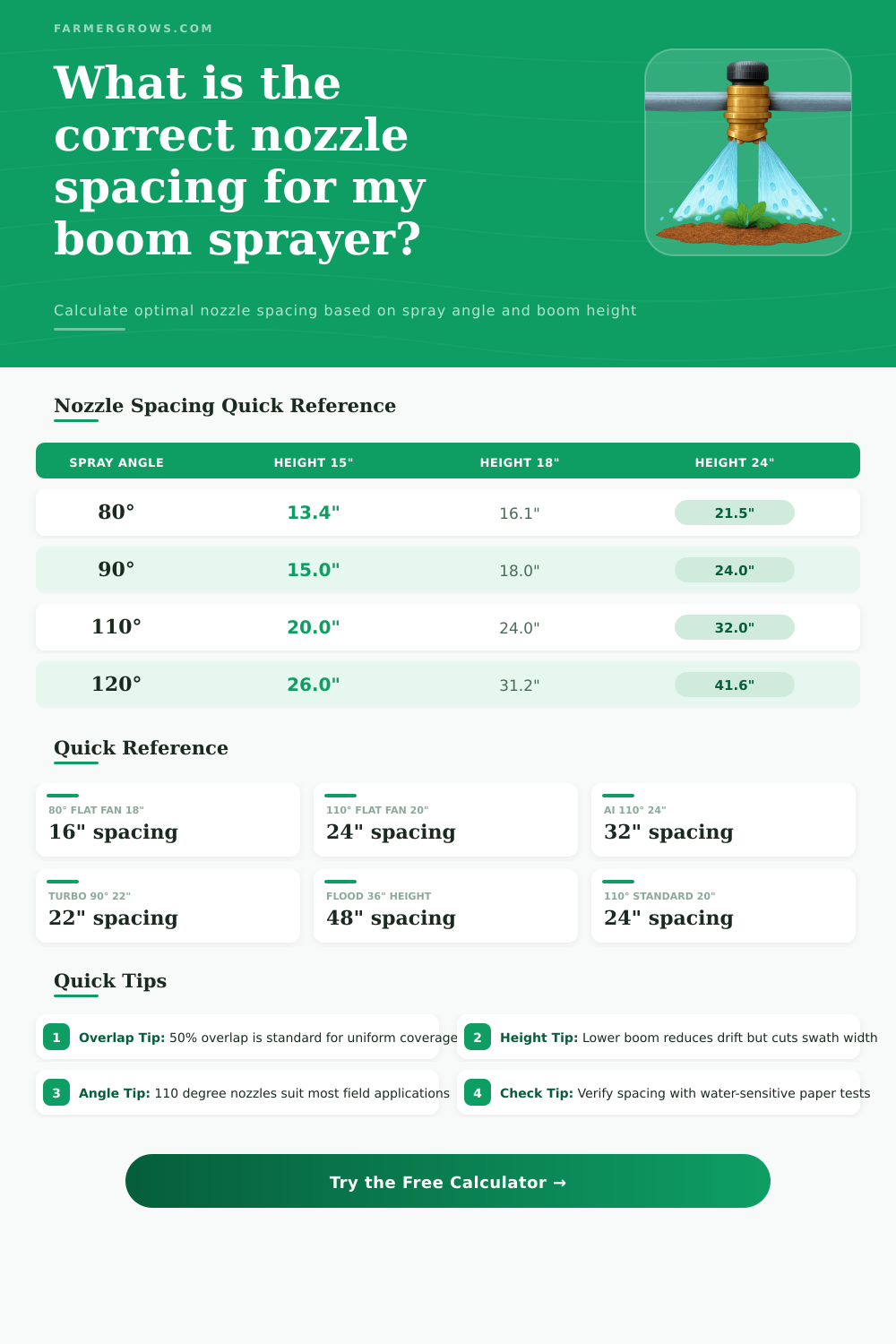
| Spray Angle | Height 15" | Height 18" | Height 24" |
|---|---|---|---|
| 80° | 13.4" | 16.1" | 21.5" |
| 90° | 15.0" | 18.0" | 24.0" |
| 95° | 16.3" | 19.6" | 26.1" |
| 110° | 20.0" | 24.0" | 32.0" |
| 120° | 26.0" | 31.2" | 41.6" |
| Height (in) | 80° Spray Width | 110° Spray Width | Rec. Spacing (110°) |
|---|---|---|---|
| 15" | 26.8" | 40.0" | 20" |
| 18" | 32.1" | 48.0" | 24" |
| 20" | 35.7" | 53.3" | 26" |
| 24" | 42.8" | 64.0" | 32" |
| 28" | 50.0" | 74.7" | 37" |
| 30" | 53.6" | 80.0" | 40" |
| Nozzle Type | Angle | Height Range | Typical Spacing | Best Use |
|---|---|---|---|---|
| Flat Fan 80° | 80° | 15–22" | 15–18" | Pre-emerge, contact herbicides |
| Flat Fan 110° | 110° | 18–30" | 20" standard | General field spraying |
| Air Induction 110° | 110° | 20–30" | 20" standard | Drift reduction, systemic herbicides |
| Turbo Flat Fan 90° | 90° | 18–26" | 18–22" | High-speed application |
| Extended Range 95° | 95° | 18–28" | 18–22" | Wide pressure range |
| Flood Nozzle 50° | 50° | 30–48" | 40"+ | Fertilizer, soil incorporation |
Nozzle spacing are another critical component of herbicide application. Incorrect nozzle spacing will result in unevenly coverage of the fields. With incorrect nozzle spacing, there will be streak in the field where the herbicide did not reach the crop.
These gap in coverage will result in a loss of the crop yield or the need to respray the fields with the herbicide. To avoid these problems, you must calculate nozzle spacing correctly. The nozzle spacing geometry are based off the spray angle of the nozzle and the height of the boom.
How to Set Nozzle Spacing and Overlap
Each nozzle will create a spray pattern that becomes wider the further the spray is from the boom. The width of the spray pattern is based on the spray angle of the nozzle and the distance from the boom to the crop or the soil. If you increase the height of the boom, the spray pattern will become wider.
Thus, the nozzle can be spaced farther apart. However, if the nozzles are spaced too far apart, there will be gaps between the spray patterns from each nozzle. To even out the spray pattern from each nozzle, there must be overlap between the nozzle.
The overlap between nozzles can be 50%, 30%, or 100%. Many farmer use a 50% overlap between nozzles as the most common overlap. This overlap is used to even out the boom bounce of the sprayer.
Using a 30% overlap can be beneficial when the fields require a light application of the herbicide or when drift of the spray is a concern. Lastly, a 100% overlap is used when applying preemergent herbicides since there must be absolute uniformity in the coverage of the fields. The type of nozzle will determine the spray angle of the nozzle.
Hence, the type of nozzle will dictate the nozzle spacing requirement for the fields. If using flat fan nozzles with a 110-degree spray angle, these are often used for row crop. Using flat fan nozzles with a 110-degree spray angle will require a 24- to 26-inch nozzle spacing if the height of the boom is 20 inches.
However, if using 80-degree flat fan nozzles, the nozzles will need to be placed 16 inches apart. Lastly, air induction nozzles maintain the same 110-degree spray angle. However, air induction nozzles will allow air into the nozzles to create larger droplet.
Thus, the herbicide drift will be reduced. However, the larger droplets will reduce the finesse of the nozzle’s coverage. Turbo fans use a 90-degree angle to maintain the spray pattern at higher speeds, while flood nozzles use a narrow 90-degree angle for coarse application like fertilizer.
Boom height affect the spray pattern and the nozzle spacing on the boom. Lowering the boom to 15 inches reduces the spray width and requires closer nozzle spacing. Raising the boom to 30 inches increases the spray width but creates wind shear on the spray pattern edge.
Most manufacturers recommend a height between 18 and 24 inches for flat fan nozzle. Use height sensor on the boom to maintain the height due to uneven terrain. Calculate the overlap percentage to determine the nozzle spacing.
If the percentage is above 50%, you are spraying too much chemical. If it is below 30%, there will be gaps in the irrigation pattern. Ensure that the spray pressure is within the recommended limit.
Using too much pressure breaks the fan nozzle into a mist; too little creates a solid stream of water. Calibrate your nozzles to the operating pressure, which is between 30 and 40 psi for fan nozzle. Common errors include installing new nozzles on an existing boom without recalculating nozzle spacing, and failing to adjust for changes in boom height due to wear on the tire.
Changing the type of nozzles require recalculating the nozzle spacing on the boom. Use water sensitive paper to confirm the nozzle spacing. Place the paper across the boom and spray the paper at the operating speed.
Inspect the paper to ensure even coverage of the spray pattern without white streak or puddles. Maintaining the spraying system ensure even nozzle spacing. Check the filters to ensure proper water flow.
Inspect the boom plumbing for even water flow to each nozzle. Check the nozzles each year to ensure they are in good working order as the spray angle can widen over time. Uneven spray angles lead to improper overlap and irrigation coverage.