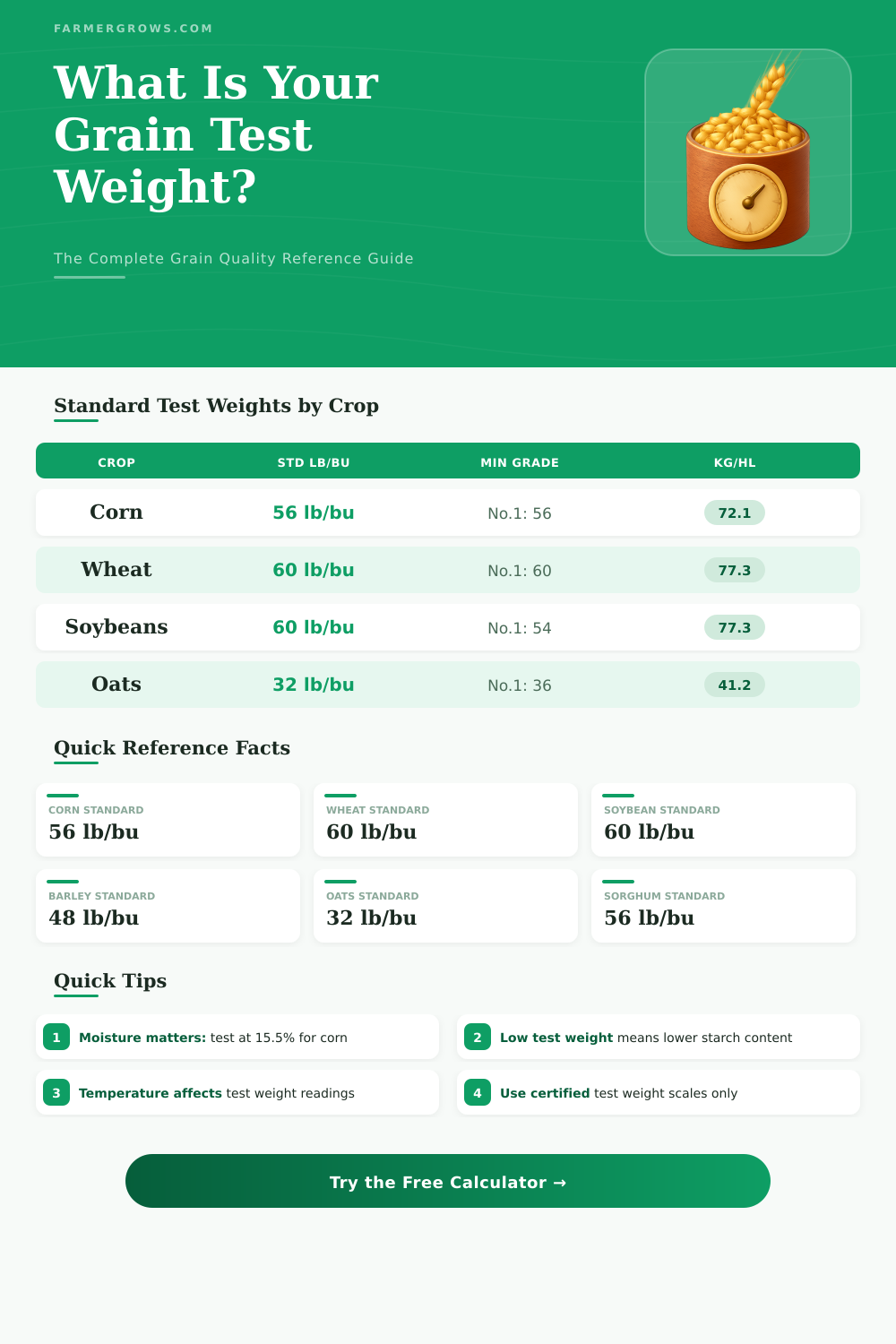
🌾 Grain Test Weight Calculator
Calculate test weight in lb/bu & kg/hL for corn, wheat, soybeans & more — with grade determination
| Crop | Grade No.1 | Grade No.2 | Grade No.3 | Grade No.4 | Standard (lb/bu) |
|---|---|---|---|---|---|
| Corn | ≥56.0 | ≥54.0 | ≥52.0 | ≥49.0 | 56 |
| Hard Red Wheat | ≥60.0 | ≥58.0 | ≥56.0 | ≥54.0 | 60 |
| Soft Red Wheat | ≥60.0 | ≥58.0 | ≥56.0 | ≥54.0 | 60 |
| Soybeans | ≥56.0 | ≥54.0 | ≥52.0 | ≥49.0 | 60 |
| Barley | ≥47.0 | ≥45.0 | ≥43.0 | ≥40.0 | 48 |
| Oats | ≥36.0 | ≥33.0 | ≥30.0 | ≥27.0 | 32 |
| Grain Sorghum | ≥57.0 | ≥55.0 | ≥53.0 | ≥51.0 | 56 |
| Rye | ≥56.0 | ≥54.0 | ≥52.0 | ≥49.0 | 56 |
| Crop | Std lb/bu | kg/hL | lbs/cu ft | Bushel = cu ft |
|---|---|---|---|---|
| Corn | 56 | 72.1 | 45.0 | 1.244 |
| Hard Red Wheat | 60 | 77.3 | 48.2 | 1.244 |
| Soft Red Wheat | 60 | 77.3 | 48.2 | 1.244 |
| Soybeans | 60 | 77.3 | 48.2 | 1.244 |
| Barley | 48 | 61.8 | 38.6 | 1.244 |
| Oats | 32 | 41.2 | 25.7 | 1.244 |
| Grain Sorghum | 56 | 72.1 | 45.0 | 1.244 |
| Rye | 56 | 72.1 | 45.0 | 1.244 |
| Canola | 50 | 64.4 | 40.2 | 1.244 |
| Sunflower | 25 | 32.2 | 20.1 | 1.244 |
| Crop | 1,000 bu (lbs) | 1,000 bu (MT) | Metric Tons/bu | Bushels/MT |
|---|---|---|---|---|
| Corn (56 lb/bu) | 56,000 | 25.40 | 0.02540 | 39.37 |
| Wheat (60 lb/bu) | 60,000 | 27.22 | 0.02722 | 36.74 |
| Soybeans (60 lb/bu) | 60,000 | 27.22 | 0.02722 | 36.74 |
| Barley (48 lb/bu) | 48,000 | 21.77 | 0.02177 | 45.93 |
| Oats (32 lb/bu) | 32,000 | 14.51 | 0.01451 | 68.89 |
| Sorghum (56 lb/bu) | 56,000 | 25.40 | 0.02540 | 39.37 |
| Crop | Standard Moisture | Test Weight Impact | Dry Down Rule |
|---|---|---|---|
| Corn | 15.5% | ~0.3–0.5 lb/bu per 1% moisture | Dries as it loses moisture |
| Wheat | 13.5% | ~0.2–0.4 lb/bu per 1% moisture | Slightly less sensitive |
| Soybeans | 13.0% | ~0.3–0.5 lb/bu per 1% moisture | Hull affects test weight |
| Barley | 14.5% | ~0.2–0.3 lb/bu per 1% moisture | Hull retained variety |
| Oats | 14.0% | ~0.2–0.3 lb/bu per 1% moisture | High hull content |
| Grain Sorghum | 13.0% | ~0.3–0.5 lb/bu per 1% moisture | Susceptible to weathering |
Test weight is a measurement of teh density of the grain. Test weight is measured in pounds per bushel or kilograms per hectoliter. Test weight does not measure the total yield of the field, which is determine by the number of plants per acre in the field and the number of kernels per ear of corn.
Instead, test weight measure the density of the kernels of corn, which indicates how much starch and how much mass is contain within the kernels. If a person has corn kernels that test 56 pounds per bushel, the kernels contain the maximum amount of energy that is required by ethanol plants and livestock feed mill. If the test weight of the corn kernels is less than 56 pounds per bushel, the buyers of the corn may suspect that the starch content is low or that the kernels have some hidden damage; in this case, the buyers will reduce the price for the corn that is purchased.
Test Weight: What It Is and Why It Matters
There are a variety of factors that can impact the test weight of the corn, but one of the most important is the factor of kernel fill. Kernel fill is strong influenced by the number of sunlight hours that the corn plants experience during the grain fill period. Additionally, the amount of water that falls on the crops prior to the black layer stage of the corn plants can also impact the fill of the kernels.
For instance, while too much water during the grain fill period can lead to the kernels swelling with water, that swelling is only temporary, and the true test weight is only revealed after the kernels are dried. The moisture of the corn also impacts the test weight of the corn; corn with 25% moisture will feel heavy due to the water weight of the corn. However, as the moisture in the corn drop to the standard 15.5% moisture, the corn will lose weight.
Therefore, elevators often require samples of corn to be equilibrated to room temperature to allow for accurate measurements of moisture and test weight. Different types of grain contain different standard test weights. For example, corn varieties are engineered to produce test weight in the high 50s. In contrast, open-pollinated corn varieties may only produce 52 lbs per bushel.
Breeding efforts for wheat have created varieties that contain 62 lbs per bushel of hard red spring wheat. However, soft red wheat varieties that contain the proteins necessary for pastries contains 58 lbs per bushel. Soybean varieties maintain approximately 56 lbs per bushel.
Additionally, soybeans will maintain their test weight of 56 lbs per bushel unless the hulls of the soybeans is damaged during the growing process. Oats contain heavy hulls, which results in a lower test weight of only 32 to 36 lbs per bushel; however, this is considered a premium test weight for milling use of the oats. The test weight of the different grains is also used to determine the monetary value of those grains.
For instance, the United States Department of Agriculture (USDA) sets a standard test weight for each type of grain to use in setting the monetary value of that specific grain. For corn, the top grade is awarded to corn that features 56 lbs per bushel; however, if the test weight is 54 lbs per bushel, it is graded as a number two corn; and if the test weight is less than 49 lbs per bushel, it is graded as a number three corn. Additionally, wheat is graded differently; the top grades of wheat must feature 60 lbs per bushel.
For soybeans, the grade features 56 lbs per bushel, even though 60 lbs per bushel is the standard for soybeans. Each test weight is set for a specific reason, mainly that the test weight can help to determine the milling yield of that grain, the extract potential of the soybeans, and the feed value of the corn and soybeans. In addition to the standard test weights, low test weights can also signal other problems with the corn.
For example, if a region experiences drought conditions during the growing period, the corn plants will develop thin kernels. Thin kernels will contain less oil than corn kernels that experienced higher levels of moisture during the grain fill period. Additionally, frost can impact the test weight of the corn; frost can create shattered corn heads that contain little weight when they are harvested.
Furthermore, mistakes during storage can also lead to decreased test weight for corn. For instance, if the stored corn experiences overheating, the starch within the corn kernels will ferment into carbon dioxide gas; this process will reduce the test weight of the corn by two lbs per bushel. Therefore, the person growing the corn should test the corn to ensure that it meets the desired test weights; the corn should also be tested after rainfall.
Aside from the impact that the corn can have upon test weight, management of the corn and the drying process can also improve test weight. For instance, scouting fields for nitrogen deficiency can ensure that corn is fed enough nitrogen to ensure strong kernel fill; insufficient nitrogen will lead to low test weights of the corn varieties. Additionally, phosphorus should be balanced in the soil to ensure that the corn develops strong roots.
When harvesting the corn, it is important to wait until the test weights reach 20% moisture content; however, rolling the corn prior to harvest will ensure that flat spots do not occur on the harvested corn. Finally, when drying the corn, ensure that the drying bins are aerated to allow for even drying of the corn; drying the corn at a rate of one point of moisture per day will allow for the corn to dry without developing stress cracks. Despite the benefits of measuring the test weight of corn, there are some common pitfalls for those that attempt to measure the test weights of corn farms and fields.
For instance, if the corn is hot it will register higher test weight than the corn should register; therefore, the heat in the corn will falsely inflate the test weight. Additionally, if foreign material is not removed from the corn prior to testing, the presence of that foreign material will skew the volume of the corn. Furthermore, handheld meters can provide inaccurate measurements of test weight if they have not been calibrated with certified scale.
Finally, moisture issues with the corn will require the adjustment of the test weight; the corn will have a higher weight if it has high moisture content, but will weigh less as the moisture content drops. Thus, if the test weight of the corn is managed properly from the field to the scale, the test weight will accurately reflect the true value of the corn crop.