🌾 Silo Surface Area Calculator
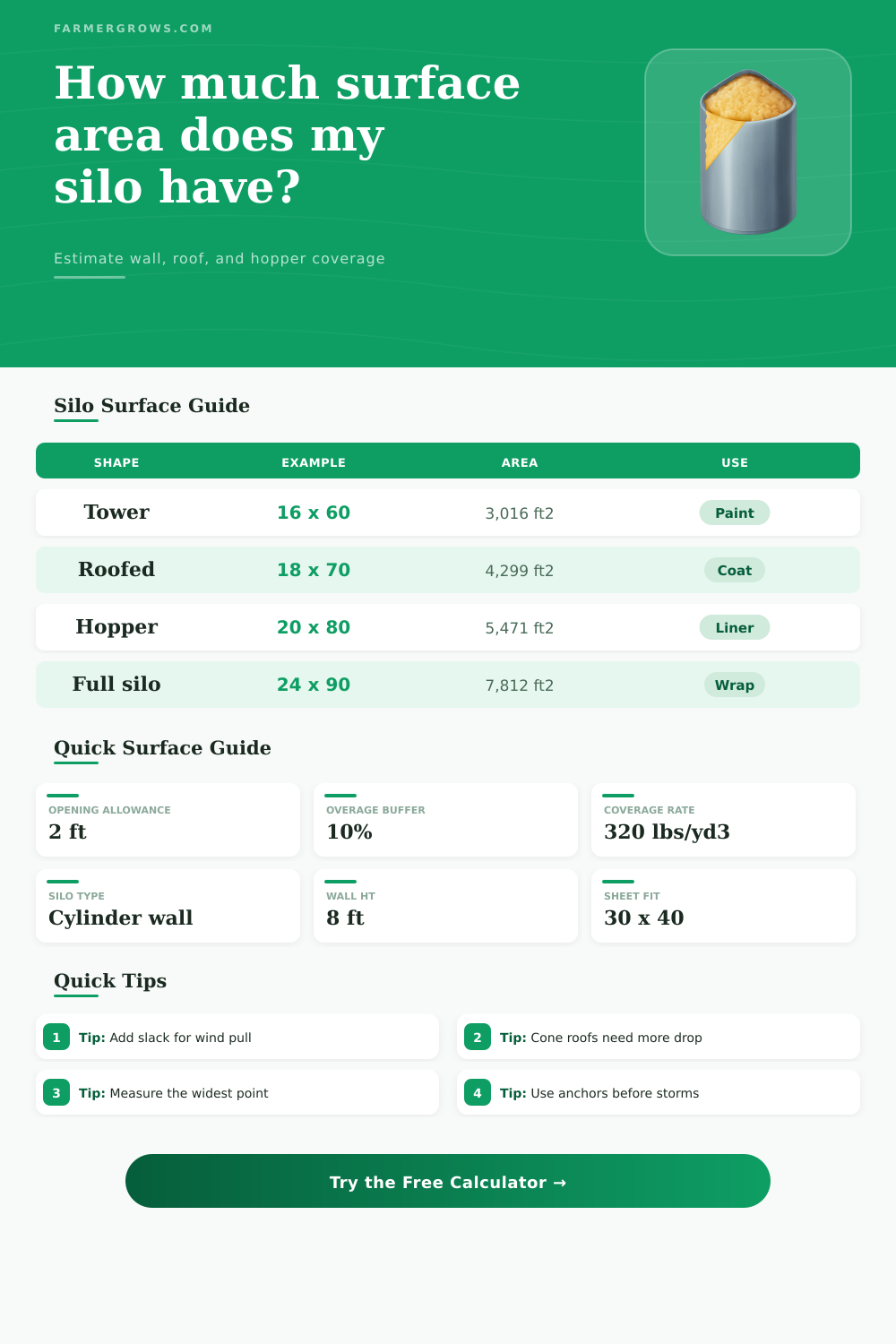
Estimate silo surface area by shape, height, and diameter. Compare wall, roof, hopper, and taper coverage before you paint, clad, or wrap.
📋 Breakdown
| Overhang | Added span | Best for | Note |
|---|---|---|---|
| 1 ft | +2 ft total | Tight stacks | Least slack |
| 2 ft | +4 ft total | Standard rows | Balanced fit |
| 3 ft | +6 ft total | Windy sites | More lead |
| 4 ft | +8 ft total | Round bales | Loose drape |
| Stock tarp | Coverage | Fits | Note |
|---|---|---|---|
| 20 x 20 | 400 sq ft | Small piles | Fast cover |
| 20 x 30 | 600 sq ft | Low rows | Easy anchor |
| 30 x 40 | 1,200 sq ft | Mid stacks | Common size |
| 40 x 60 | 2,400 sq ft | Big yards | Wide margin |
| Project | Gross surface area | Height | Suggested cover |
|---|---|---|---|
| Small tower | 12 x 18 ft | 4-5 ft | 18 x 24 ft |
| Mid tower | 20 x 30 ft | 6-8 ft | 26 x 36 ft |
| Roofed tower | 24 ft dia | 8 ft | 30 x 30 ft |
| Hopper tower | 16 x 42 ft | 5-7 ft | 22 x 48 ft |
Knowing how to calculate the surface area of a grain silo is necesary to ensure that you have an appropriate amount of material to cover the silo. If you dont calculate the surface area of the silo correctly, then you will either have a shortage of the materials necessary to cover the silo or you will waste money by buying excess materials to cover the silo. Most grain silos is more complex than a simple cylinder shaped silo.
The silo may have a conical roof or a hopper bottom. The conical roof will increase the surface area of the silo because the conical roof covers more surface area then a flat roof would cover. Furthermore, the hopper bottom will also play a role in the surface area of the silo because the hopper bottom have a different set of measurement requirements different than a silo that does not have such a feature.
How to Find the Surface Area of a Grain Silo
The shape of the silo will determine the proper way to calculate the surface area. For instance, if the silo has a cylindrical wall, you can calculate the surface area of that wall by multiplying the circumference of the silo by its height. However, if the silo has a conical roof, then you must measure the length of the slant of the conical roof instead of the height of the silo.
Because the slant of the conical roof will be longer than the height of the silo, the conical roof will add to the total surface area of the silo. Similarly, if the silo features a hopper bottom, then you must measure the length of the slant of the hopper bottom and factor into the calculation of the total surface area of the silo. The height and the diameter of the silo are the two main variables to consider when calculating the surface area of the silo.
You must measure the diameter of the silo at its widest point. Measuring the diameter of the silo at its widest point is important because grain silos may swell at certain points due to the weight of the grain that it store. If you measure the diameter of the silo at any point other than its widest point, then the resulting measurement may be too low to reflect the true diameter of the silo.
To find the total surface area of the silo, you must calculate the area of each component separately. The cylindrical walls and the conical roof is two separate components of the silo, so you must calculate the surface area of each of these components individually. Once you have calculated the surface area of each component, you should include a buffer in your measurement.
A buffer ensures that you have enough panels to complete the silo. When calculating the number of panels needed to cover a silo, people often use a ten percent buffer to account for the panels that will be cut when covering the silo. An allowance should also be made for openings in the silo, such as vents or a ladder to access the silo.
A buffer is used to prevent the completion of the silo from being hindered by running out of panels before the silo is completely covered. The environmental elements that affect the silo will influence the use of the surface area calculation. If the paint that is to be used on the silo will be heavy, then the calculation will have to be more precise when measuring the surface area.
This is due to the high cost of the heavy paint. If the panels that are to be used on the silo are made of steel, then the panels must be able to align with the rest of the silos panels. Any misalignment of these panels will lead to gaps in the exterior of the silo.
The temperature at which the silo will be exposed will impact the paint that is used. Because silos contain grain, they expand when exposed to heat and contract when exposed to cold. The paint must be able to handle the expansion and contraction of the silo.
If you perform the calculations with precision and include a buffer, then there will be enough panels to complete the silo without difficulty.