Mowing Acreage Calculator
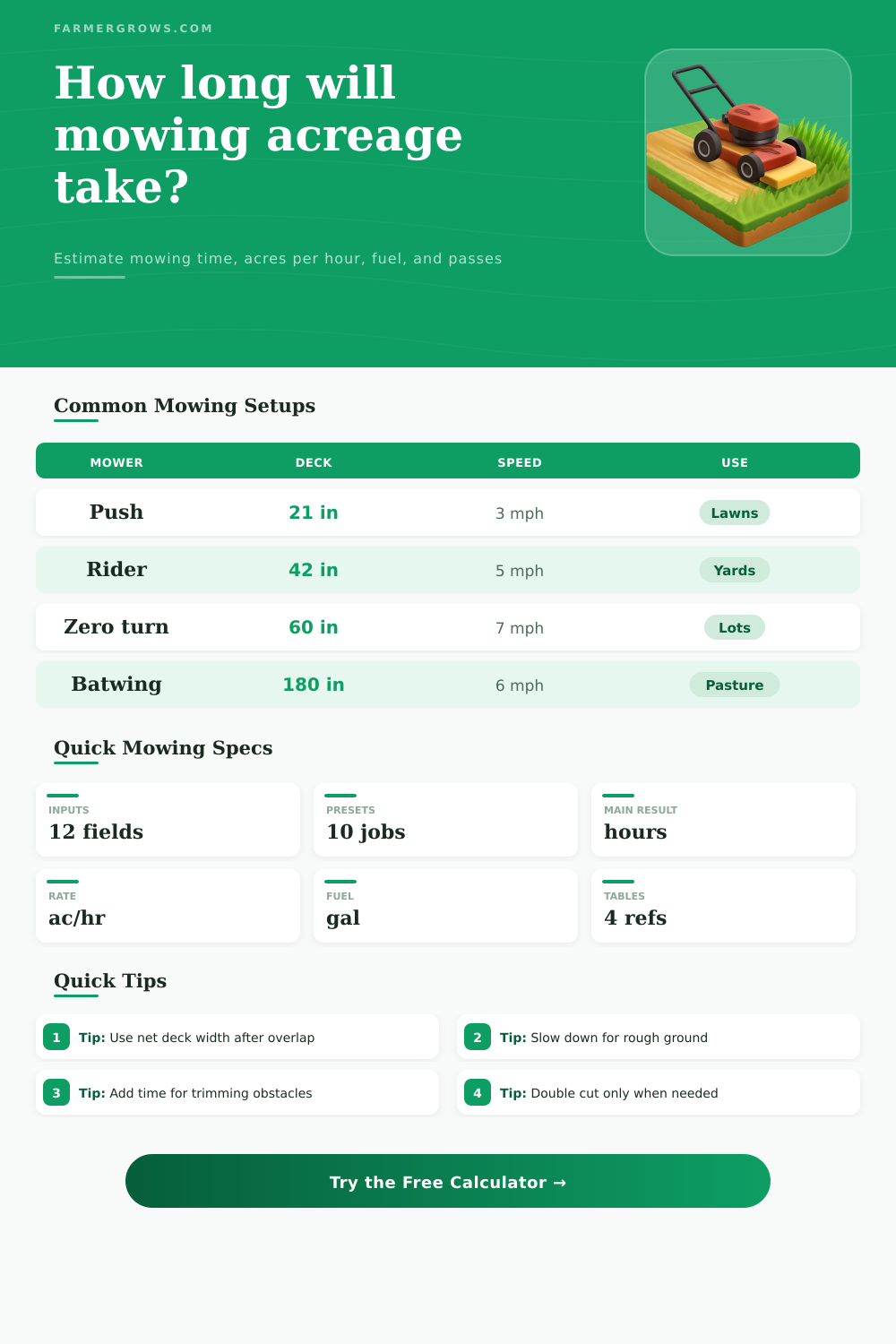
Estimate mowing time, acres per hour, passes, travel distance, and fuel use from field area, mower deck width, speed, overlap, turns, obstacles, slope, and cutting plan.
Use the calculator for planning field time, comparing mower setups, and checking whether overlap, turns, obstacles, or slope are stealing more capacity than expected.
Mowing Estimate
Results combine net deck width, speed, overlap, turn efficiency, obstacle loss, slope loss, cutting plan, and extra cleanup time.
| Mower type | Common deck | Planning speed | Typical efficiency | Best use |
|---|---|---|---|---|
| Push mower | 20 to 22 in | 2.5 to 3.5 mph | 55% to 70% | Small lawns, tight edges, gates, steep detail areas |
| Walk-behind commercial | 32 to 52 in | 3.5 to 5.5 mph | 65% to 78% | Mixed yards, slopes, rentals, narrow access |
| Lawn tractor | 38 to 54 in | 4 to 6 mph | 65% to 80% | Home acreage and open lawns with moderate turns |
| Zero turn | 48 to 72 in | 5.5 to 8 mph | 75% to 88% | Open turf, farmsteads, campuses, sports fields |
| Rotary cutter | 5 to 15 ft | 4 to 7 mph | 70% to 86% | Pasture clipping, roadsides, field lots, rough grass |
| Deck width | Net width at 10% overlap | Speed | Theoretical acres/hr | At 80% efficiency |
|---|---|---|---|---|
| 21 in | 1.58 ft | 3 mph | 0.58 ac/hr | 0.46 ac/hr |
| 42 in | 3.15 ft | 5 mph | 1.91 ac/hr | 1.53 ac/hr |
| 54 in | 4.05 ft | 5.5 mph | 2.70 ac/hr | 2.16 ac/hr |
| 60 in | 4.50 ft | 6.5 mph | 3.55 ac/hr | 2.84 ac/hr |
| 180 in | 13.50 ft | 6 mph | 9.82 ac/hr | 7.85 ac/hr |
| Condition | Planning loss | What it represents | Adjustment note |
|---|---|---|---|
| Clean rectangle | 0% to 5% | Long runs, few turns, little trimming | Use a high turn efficiency and light obstacle loss |
| Scattered trees | 8% to 18% | Looping around trunks, posts, hydrants, buildings | Increase obstacle slowdown before changing speed |
| Wet or tall grass | 10% to 30% | Lower travel speed and occasional recutting | Use a slower speed or cross-cut plan |
| Rolling slope | 8% to 22% | Sidehill caution, traction, extra steering | Add slope loss and keep overlap realistic |
| Rough pasture | 18% to 40% | Uneven ground, hidden debris, heavier growth | Use conservative speed and fuel rate |
| Formula item | Formula used | Purpose | Field check |
|---|---|---|---|
| Net deck width | deck x (1 - overlap) | Accounts for intentional overlap between passes | Measure uncut strips after one lap |
| Theoretical capacity | width ft x mph / 8.25 | Converts swath width and speed to acres per hour | Use average ground speed, not transport speed |
| Effective capacity | capacity x efficiency factors | Applies turn, obstacle, slope, and pass-plan losses | Compare to stopwatch results for one section |
| Pass count | mowed width / net deck width | Estimates back-and-forth runs across a field | Use field width for rectangles when available |
| Fuel use | hours x fuel rate | Plans gallons or liters needed for the job | Adjust from your machine's real tank refill data |
Time check: If the estimate is optimistic, reduce average speed before reducing overlap. Most real acreage loss comes from turns, rough spots, trimming, and slow corners.
Fuel check: Use your last refill to tune the fuel rate. Tall grass, blades needing service, hills, and double cutting can raise hourly fuel use quickly.
To estimate the time it will take to mow a field or lawn, there is several variables to consider. The width of the mower deck is one variable to consider. However, the width of the grass that will actualy be cut is less than the advertised width of the mower deck because the mower must overlap each pass on the field to ensure that all of the grass are cut.
The need to overlap the mower passes reduce the effective cutting width of the mower, thus requiring more passes to mow the field. The second variable to consider is the speed at which the mower travels across the field. The speed of the mower determine the amount of ground that is covered in a certain period of time.
How to Estimate Time to Mow a Field
If the ground to be mowed is rough or sloped, the mower may need to slow its travel speed to maintain traction. Thus, a slower speed will increase both the time required to mow the field, as well as the more amount of fuel that the mower consumes. Thirdly, the efficiency with which the mower can turn is a variable to be considered.
Fields that contains many obstacles may require the mower to make many turns. Fewer turns by the mower mean that the mower can travel longer distance without changing it’s direction. Fewer turns by the mower will reduce the amount of time that it is spending on the field.
Thus, using a percentage value of turn efficiency will allow for adjustments to the estimated time for mow the field. The terrain of the field is a fourth variable that should be considered in the estimation of the time necessary to mow the field. Fields that contain slope in there terrain may require the mower to travel at a slower speed than flat terrain.
Fields with rough terrain may require the mower to travel at a slower speed than even terrain. Each of these variables can impact the time that two individual take to mow the same field. Fuel consumption by the mower is a fifth variable that should be considered.
Grass that is too tall or too wet will require the mower to perform addition passes over the field. Each of these passes will increase the amount of fuel that the mower consumes. Thus, you should monitor fuel levels during mowing of the field.
The total number of passes that the mower will take to mow the field will be the width of the field divided by the effective cutting width of the mower. The effective cutting width is the width of the mowers deck minus the overlap of that width on each pass. If the mower is to perform a double pass, the number of passes will increase.
Thus, an increase in the total number of passes will increase the time and fuel consumption requirement for mowing the field. The amount of time that is required for trimming around obstacles in the field may also be considered. Most individual will find that the time for trimming around obstacles is often forgotten.
However, trimming around gates or tree will require additional time to mow the field. Thus, this time should be accounted for separately from the time that is estimated for mowing the field. By calculating each of these variables, an estimate as to the time required to mow the field can be create.
Using these calculations will allow an individual to understand the time that will be required for mowing the field, as well as the amount of fuel that will be required. Thus, planning the mowing of the field in this way will ensure that the individual has enough time to complete the mowing job altogether.