Maple Syrup Brix Calculator
Estimate maple syrup yield from sap gallons and sap Brix, then compare Rule of 86 yield, reverse osmosis concentration, boil-off, transfer loss, and hot density correction.
Brix is the percent sugar by mass. This calculator conserves sugar solids through sap, RO concentrate, evaporation, and filtering loss, while also showing the familiar Rule of 86 field estimate.
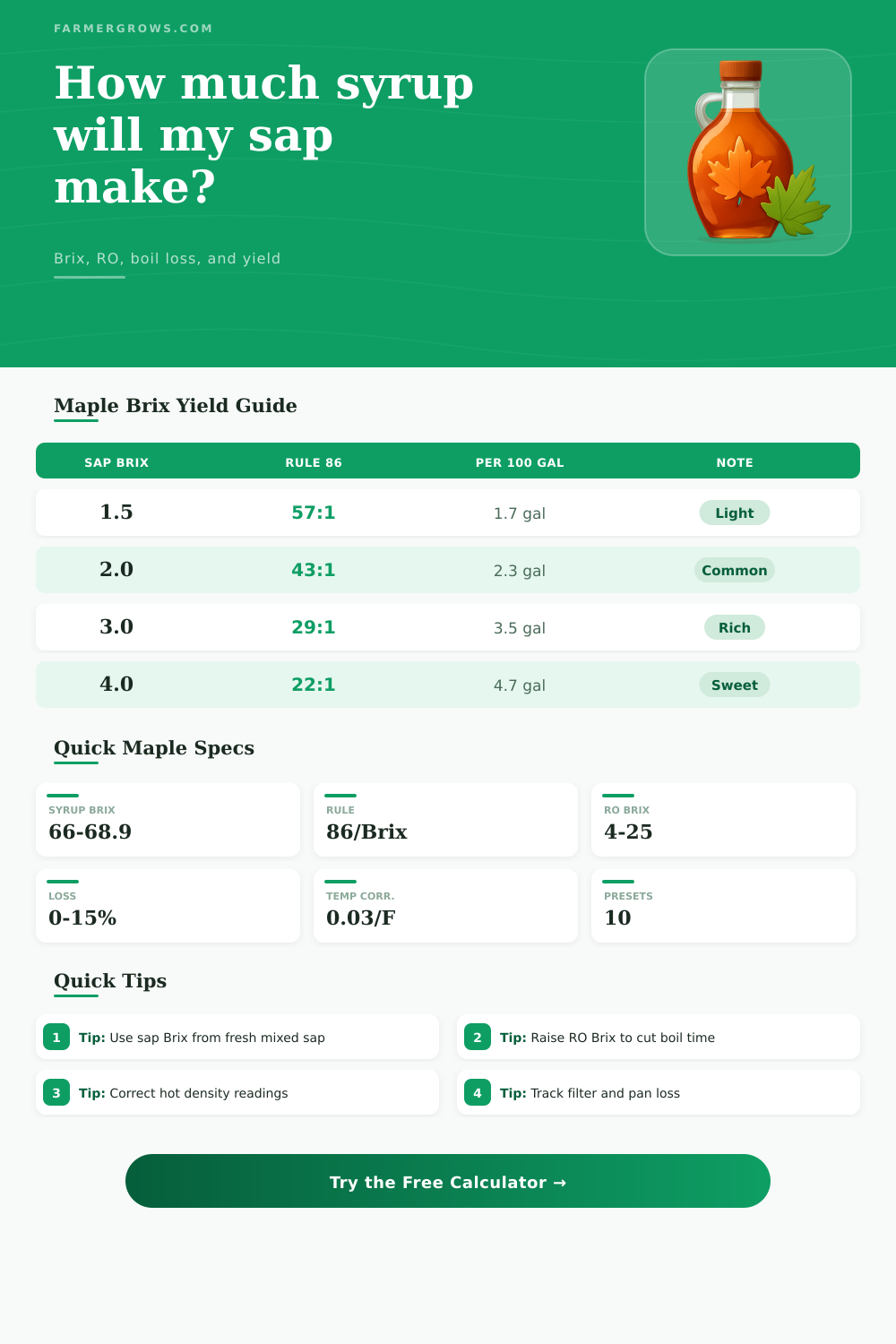
Fresh mixed sap has low sugar density, so small Brix changes strongly affect syrup gallons.
Reverse osmosis removes water before the pan while keeping nearly all sugar solids.
Syrup volume depends on target density, hot reading correction, and draw-off accuracy.
The Rule of 86 estimates sap gallons per gallon of syrup near standard maple density.
Maple Brix Results
Your sap yield estimate will appear here.
Divide 86 by sap Brix for sap gallons per syrup gallon.
Typical finished syrup target for density planning.
Moderate concentrate Brix that sharply reduces boiling.
Approximate correction used for hot density checks.
| Sap Brix | Rule of 86 ratio | Syrup from 40 gal sap | Syrup from 100 gal sap | Field meaning |
|---|---|---|---|---|
| 1.0% | 86 gal sap per 1 gal syrup | 0.47 gal | 1.16 gal | Very light sap, long boil. |
| 1.5% | 57 gal sap per 1 gal syrup | 0.70 gal | 1.74 gal | Thin early run or mixed species sap. |
| 2.0% | 43 gal sap per 1 gal syrup | 0.93 gal | 2.33 gal | Common planning number for sugar maple. |
| 2.5% | 34 gal sap per 1 gal syrup | 1.16 gal | 2.91 gal | Good sugar content and shorter boiling. |
| 3.0% | 29 gal sap per 1 gal syrup | 1.40 gal | 3.49 gal | Rich sap that improves batch yield. |
| 4.0% | 22 gal sap per 1 gal syrup | 1.86 gal | 4.65 gal | Excellent sugar content from sweet trees. |
| Starting sap | RO target | Concentrate from 100 gal sap | Water removed before pan | Practical note |
|---|---|---|---|---|
| 2.0 Brix | 4 Brix | About 50 gal | About 50 gal | Light RO pass halves pan volume. |
| 2.0 Brix | 8 Brix | About 25 gal | About 75 gal | Common hobby target for faster finishing. |
| 2.0 Brix | 12 Brix | About 17 gal | About 83 gal | Requires stronger RO and clean membranes. |
| 2.5 Brix | 10 Brix | About 25 gal | About 75 gal | Good sap reaches useful concentrate quickly. |
| 3.0 Brix | 15 Brix | About 20 gal | About 80 gal | High concentrate can scorch if pan control is poor. |
| Sample temperature | Calibration | Correction at 0.03 Brix per F | Example reading | Corrected reading |
|---|---|---|---|---|
| 180°F | 211°F | Subtract 0.9 Brix | 67.0 Brix | 66.1 Brix |
| 200°F | 211°F | Subtract 0.3 Brix | 67.0 Brix | 66.7 Brix |
| 211°F | 211°F | No correction | 67.0 Brix | 67.0 Brix |
| 68°F | 68°F | No correction | 66.9 Brix | 66.9 Brix |
| 80°F | 68°F | Add 0.4 Brix | 66.5 Brix | 66.9 Brix |
| Batch scale | Sap volume | Typical sap Brix | Helpful RO Brix | Best calculator check |
|---|---|---|---|---|
| Backyard pan | 20 to 60 gal | 1.8 to 2.5 | No RO to 4 Brix | Use loss percent to size finished jars. |
| Hobby evaporator | 80 to 250 gal | 2.0 to 3.0 | 6 to 10 Brix | Compare RO water removed with pan boil-off. |
| Weekend tubing run | 250 to 700 gal | 1.7 to 2.7 | 8 to 15 Brix | Check pan hours against concentrate volume. |
| High-sugar woods | 100 to 500 gal | 3.0 to 4.0 | 8 to 18 Brix | Watch target density because yield changes fast. |
| Late season finish | 40 to 300 gal | 1.5 to 2.4 | 6 to 12 Brix | Track filtering and pan residue loss closely. |
Mix sap before measuring Brix. A refractometer sample from the top of a tank can be misleading after several collection runs. Stir or recirculate, then enter the average sap Brix.
Treat the loss percent as real syrup. Niter, filter papers, draw-off lines, pans, and finishing pans can hold enough syrup to change jar counts on small batches.
Maple syrup begin as a liquid sap that looks like water. The sugar content of the sap will determine the amount of sap that will turn into maple syrup. The sugar content of the sap are measured in Brix.
The Brix will tell you how many gallon of sap you must run through the evaporator to create maple syrup. A small change in the Brix percentage of the sap will have a much greater effect on the amount of syrup produced. It is importance to measure the Brix of the sap before beginning to boil the sap to make maple syrup.
Why Brix Matters for Maple Syrup
The Brix scale is a percentage that shows the amount of sugar in a liquid by weight. The sugar content of sap is between one and four percent so the Brix readings will be low. If the Brix of the sap are low, more water must be boiled away before the sap becomes maple syrup.
It is important to take the Brix measurement of a well-mixed tank of sap. The Brix at the top of the tank may not be the same as the Brix at the bottom of the tank. The top of the tank may register a light Brix reading, but the Brix at the bottom of the tank may be higher.
After you enter the amount of sap that you collected and the Brix percentage of the sap, the calculator will show you how much water will leave the evaporator as well as how long the boiling process will take to create maple syrup. The calculator accounts for the amount of sugar in the batch of sap. There will be some losses in the process of making maple syrup.
Some of the sugar will remain in the filter press, in the pan, and in the draw-off line. Instead of consider this loss of sugar to be waste, treat it as syrup that is still in your equipment and not yet drawn off. The implementation of reverse-osmosis technology change the process of making maple syrup.
Reverse-osmosis technology removes some of the water from the sap before it even reaches the evaporator. The calculator can show you how much water is removed before the maple syrup reaches the evaporator. It can also show you how much water must be boiled away in the evaporator.
The higher the Brix of the sap concentrate before it reaches the evaporator, the less time the evaporator must run to boil the sap to make maple syrup. However, if the Brix level is too high, the risk of scorching the syrup in the evaporator increase. Many producers like to have an evaporator target Brix of eight to twelve percent.
This Brix target will reduce the amount of time that the evaporator must run to boil the sap, without having to maintain the membrane of the reverse-osmosis machines to the highest degree of efficiency. The Brix technology must be corrected for temperature. Once maple syrup is ready to be drawn off, the temperature will be high.
The percentage reading on the Brix tool will register low. You must correct this reading to the true percentage of the maple syrup based off the calibration of the Brix instrument. If you do not apply the temperature correction, you could boil the syrup for too long or draw it off too soon.
Both event will affect the flavor and shelf life of the syrup. The Rule of 86 can be used as a field test of the amount of sap you will get from the amount of maple syrup you will produce. By dividing eighty-six by the Brix of the sap, you can calculate the approximate amount of gallon of sap that will yield one gallon of maple syrup.
This Rule of 86 can be compared to the yield that your calculator determines based on the solid percentage of the sap. If these two number are not close to one another, it is a sign of higher losses of sap during the process of making maple syrup. Or, it may be a sign that your target Brix is not the classic sixty-six point nine percentage.
Although the numbers on the calculator will provide a great estimate of the amount of maple syrup you will produce, the actual batch of syrup that are produced may not match those numbers. Sap can change throughout the season. Late spring sap may contain more mineral than sap produced in the early spring.
The boiling point of the sap will change and the formation of niter changes. Early spring sap might be so light that the evaporator will not reach a rolling boil without supplemental heat. The percentage of losses in the process of making syrup can be adjusted to account for your specific maple syrup evaporator and filter press setup.
If you are short on jars of maple syrup when you process your sap, it is a good idea to increase the percentage of losses by a point or two. This will show you how the change in losses will change the amount of maple syrup that you produce. The density of the sap is important.
If the maple syrup produced is too light, it can ferment. If the syrup becomes too heavy during the evaporation process, it can crystallize within the jar. Using a target Brix percentage of sixty-six to sixty-eight point nine is a good range for the density of the maple syrup that are produced.
The specific percentage of Brix will determine the amount of syrup that will be produced during the evaporation process. A change of only a half-point to the target Brix percentage will change the amount of gallons of maple syrup that is produced. The calculator allow you to adjust this percentage and to see how the change will affect the amount of maple syrup that will be produced.
The maple syrup calculator can help you determine the amount of water that will leave the evaporator and the amount of time that you must boil the sap to create maple syrup. You can use this information to determine if you should fire up the evaporator pan tonight or if you should wait until another collection of the sap. Another use of the calculator is to help you determine if the batch of maple syrup that you just finished drawing off was accurate.
You can measure the hot batch of maple syrup and take note on the temperature of the syrup. Allow the calculator to apply the temperature correction factor to the Brix reading that you just took. If the corrected Brix percentage of your syrup is above your target Brix percentage, you must continue to boil the syrup.
If the Brix percentage is below your target, you should stop the boiling process. This check will prevent you from producing undercooked maple syrup that will not keep well, or it will prevent you from making overcooked syrup that will burn during the boiling process. Each of the small decision you make during the production of maple syrup will have an impact on the total amount of syrup that you produce during the season.
By measuring the sap, accounting for the losses, and monitoring the Brix and density of the syrup, you will minimize the difference between the amount of maple syrup that you calculate you will produce and the amount that you actualy produce. The calculator will remove the need for you to do any arithmetic for these calculation. When the first draw-off batch of maple syrup comes off the evaporator with the exact Brix percentage that you targeted for your target season, your jar will contain the amount of syrup that the calculator indicated that you would produce.