Log Volume Calculator
Estimate cubic log volume plus Doyle, Scribner Decimal C, and International 1/4-inch board-foot scale from small-end diameter, large-end diameter, length, count, taper, bark, defect, and kerf.
●Forestry presets
Start with a real sawlog or woodland inventory situation, then adjust the diameters, length, defect, bark allowance, and mill kerf.
●Log measurements
Metric entries are converted internally to inches, feet, cubic feet, and board feet.
Traditional log scaling often rounds the small-end diameter down to a whole inch.
Cubic volume uses both diameters as a tapered frustum.
Use the same average dimensions for each log in the group.
The class is used to flag whether the entered diameters look unusually tapered.
Deduct rot, crook, sweep, shake, stain, metal, and visible unusable sections.
Subtracts bark from both diameters to estimate inside-bark scaling diameter.
Net recovery is adjusted around a 1/4-inch kerf baseline.
●Quick forestry figures
●Scale comparison grid
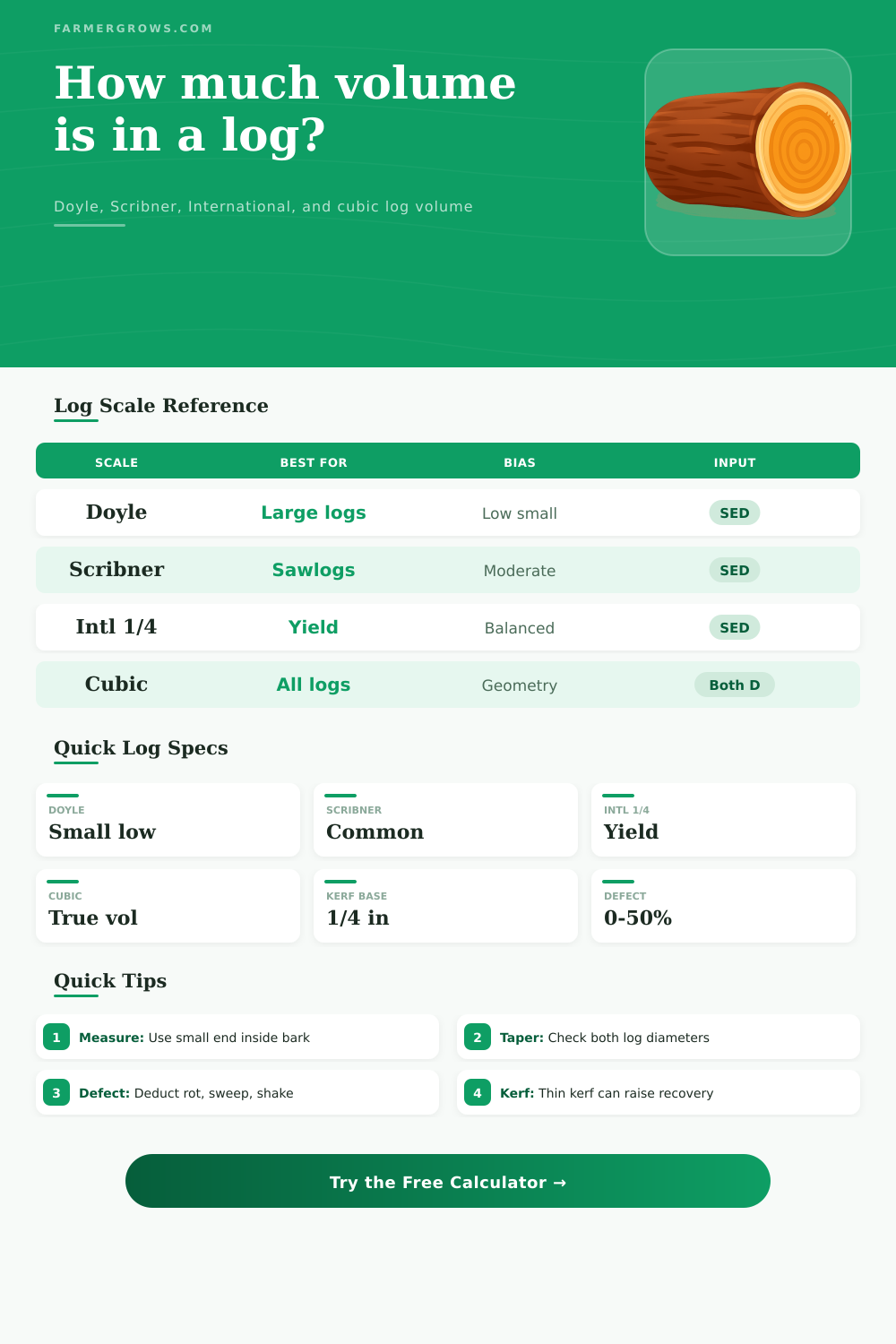
Doyle
Conservative on small logs because it assumes a large slab loss before sawing. Common for hardwood stumpage and older regional contracts.
Scribner Decimal C
Based on diagrammed boards from the small end. It is widely used for sawlogs and usually falls between Doyle and International.
International 1/4
A yield-oriented rule with a 1/4-inch kerf assumption. It often tracks actual lumber recovery better in even, straight logs.
Cubic
Uses the entered small and large diameters to calculate geometric volume. It does not assume a sawing pattern or board thickness.
●Reference table 1: board-foot rules
| Scale | Calculator formula used | Diameter basis | Best use |
|---|---|---|---|
| Doyle | ((D - 4) x (D - 4) x L) / 16 | Small end inside bark | Hardwood logs, buyer comparisons, conservative small-log estimates. |
| Scribner Decimal C | (0.79 x D x D - 2D - 4) x L / 16 | Small end inside bark | Common sawlog scaling where Scribner is the local rule. |
| International 1/4 | (0.22 x D x D - 0.71D) x L / 4 | Small end inside bark | Yield-oriented estimates and mill recovery checks. |
| Cubic frustum | pi x L x (r1 x r1 + r1 x r2 + r2 x r2) / 3 | Both ends inside bark | Inventory volume, biomass, weight, or non-sawlog comparisons. |
D is adjusted small-end diameter in inches and L is log length in feet. Board-foot results are multiplied by log count, then netted for defect and kerf.
●Reference table 2: taper classes
| Taper class | Expected taper | Typical log | Calculator check |
|---|---|---|---|
| Flat | 0.05 in per ft | Straight upper stem, plantation pine, uniform poles. | Entered diameter difference should be small over the log length. |
| Normal | 0.18 in per ft | Most farm woodland sawlogs and mixed hardwood stems. | Used as the default warning range for general scaling. |
| Steep | 0.35 in per ft | Shorter logs, younger trees, or visible sweep and butt swell. | Expect a larger cubic volume gap versus small-end board-foot rules. |
| Butt log | 0.50 in per ft | First log above stump with flare, heavy bark, or root swell. | Check bark allowance and consider scaling above the flare. |
●Reference table 3: bark and defect allowances
| Allowance | Typical value | Use when | Result impact |
|---|---|---|---|
| Thin bark | 0.25 to 0.75 in total diameter | Maple, birch, poplar, young pine, or peeled measurement close to wood. | Small deduction from scale diameter and cubic volume. |
| Average bark | 0.75 to 1.50 in total diameter | Mixed hardwood, oak, ash, and general farm sawlogs. | Common inside-bark adjustment for outside-bark field measurements. |
| Heavy bark | 1.50 to 3.00 in total diameter | Old oak, thick pine, butt logs, and rough-barked stems. | Can sharply reduce small-end board-foot estimates. |
| Defect | 5% to 30% | Rot, crook, sweep, shake, embedded wire, stain, split ends, or forks. | Applied after gross board-foot scale and cubic volume are calculated. |
●Reference table 4: sample 16 ft log comparison
| Small-end DIB | Doyle BF | Scribner BF | International BF |
|---|---|---|---|
| 8 in | 16 BF | 32 BF | 34 BF |
| 12 in | 64 BF | 112 BF | 112 BF |
| 16 in | 144 BF | 244 BF | 250 BF |
| 20 in | 256 BF | 427 BF | 424 BF |
| 24 in | 400 BF | 661 BF | 647 BF |
Sample values are gross scale before defect and kerf. Actual contract scaling may include trim, sweep, local rounding, minimum diameter, and grade rules.
●Scaling notes
When measuring logs to determine how much wood the log will yield at the sawmill, there are a variety of different measurements that must be taken into account. Each log has different measurements associated with it, based off the rules that is used to measure the log. Each buyer of logs will use different rules for different purposes.
For instance, some buyers will use the Doyle scale, others will use the Scribner scale, and others will use an International quarter inch rule. Additionally, the cubic volume of the log is also important. Because the volume of each of these different rules and measurements can be significantly different from each other, the price of the logs can range by several hundred dollars.
How to Measure Logs for the Sawmill
Therefore, it is essential for each logger to understand these different rules and measurements before the trucks that are hauling the logs leave the logging landing. The first of the measurements that must be taken is the small-end diameter of the log, measured inside the bark. The small end of the log is the primary measurement that sawmills use for almost all of the board-foot rules that is used by sawmills.
A calculator can make entries for the outside-bark diameter of the log, but will require the logger to choose a bark allowance. The thickness of the bark of a log varies between the species of log that is being measured, and also can vary according to the age of the tree from which the log was felled. For instance, maple trees have thin bark compared to other tree species, and young trees have thin bark compared to older trees of the same species.
In addition to the diameter of the log, the length of the log is another of the variables that must be taken into account in the measuring of the log. However, in addition to the length of the log, the logger must also consider the taper of the log. The logs that have significant taper will contain more wood than a small-end diameter alone would suggest.
However, most board-foot rules only use the small-end diameter measurements of the logs. Therefore, the difference in volume between the cubic volume measurement of the log and the small-end diameter measurements is another factor in the decision of whether to cut a butt swell into a separate log or to leave it attached to the remainder of the log. Another variable to consider is the percentage of the log that contains defects.
When using the calculator to estimate the volume of the log, a straight percentage will be applied to the gross scale measurements of the logs. For example, if the log contains a defect such as a crook or a stain, the logger will need to make a decision of whether to scale that log out, as the calculator cant make such a decision itself. However, if the logger decides to scale the defect out of the logs, the log will have a lower gross volume than the net volume that is provided by the calculator.
Another entry field on the calculator is for the kerf width of the sawmill that is using the calculations of the logs. The baseline kerf width for most sawmills is a quarter-inch. If a sawmill that uses a thinner kerf than a quarter-inch saws the logs, the net recovery of the logs will be higher.
Conversely, if the sawmill uses a wider kerf, the net recovery of the logs will be lower. This field is entered after the scale rules are entered for the logs, so that the logger can compare the volume of logs that would be produced by different sawmills. There are reference tables on the page that indicate the different variables of the logs.
One table displays the different volume estimates for the same log depending upon the scale rules that are used. Another table displays the typical bark allowances for the different species groups of logs. A third table displays the differences in the board-foot estimates for the same logs depending upon the diameter of the logs.
Each of these tables does not replace the logger’s judgment in the woods, but it does eliminate the need for manual calculations by the logger. In measuring the logs, many common mistakes are made by those that know how to calculate the volume of logs. For instance, many individuals that know how to calculate the volume of logs will take the diameter of the tree at “chest height”, which is approximately four feet from the ground.
The diameter of the felled log at its small end will often be smaller than the diameter of the standing tree at chest height. Additionally, another common mistake is that many individuals will use the large-end diameter of the felled log. The diameter at the large end of a log may contain a flare that the sawmill will trim off when the logs are sawed into lumber; therefore, the sawmill will not recieve as much lumber from such a log as the cubic volume equations suggest.
It is essential, therefore, for each logger to walk the length of the log with a tape measure to ensure that the measurements that are used to calculate the volume of logs are accurate. In addition to the sawmills calculations of the logs, another consideration is in the use of the logs. For example, sawmills that purchase logs to produce veneer will pay a premium for logs that contain no knots and other defects.
Other sawmills that purchase logs to produce pulpwood may not care about defects and may only care about the total cubic volume of the logs. The calculator can calculate the logs for any intended use, but the interpretation of the logs changes according to the use of the logs. This is the reason that the fields for defects and kerf are included next to the scale rules choices in the calculator.
After entering the measurements of the logs into the calculator, both gross and net figures will be displayed for each rule. The gross figures will indicate the volume of the logs if there were no defects in the logs. The net figures will indicate the volume of logs if the defects are also accounted for.
Comparing the gross figures to the net figures will indicate the percentage of logs that is lost to those defects. For instance, if the logs contain very few defects, the difference between the gross and net measurements may be one percent. However, if the logs contain significant defects, the logs may lose thirty percent or more of their volume due to those defects.
In addition to the gross and net figures for each rule, the use of the calculator allows for testing of different assumptions prior to the logs leaving the woods. For instance, the logger can change the bark allowance to match the species of the logs, and the percentage of logs that contain defects can be adjusted after the logs are inspected. Thus, the logger has the ability to adjust each of these variables without having to re-enter each of the diameter measurements of the logs.
Finally, the accuracy of the logs calculated by the calculator will again rely upon the accuracy of the logger’s measurements of the logs. Therefore, the accuracy of the calculator is only as accurate as the logger’s attention to detail regarding the logs. However, the calculator for the logs removes the arithmetic difficulty for the logger, allowing the logger to focus on the log itself.
It’s important to remember that logs is different than other materials. The logger should of checked the measurements twice. You’re going to want to make sure that you dont miss any small details.
One small error can cause alot of problems with the math. Most people think the rules is easy, but they’re harder than they look. The size of the logs matter more then people realize.
All the furnitures must be measured correctly.