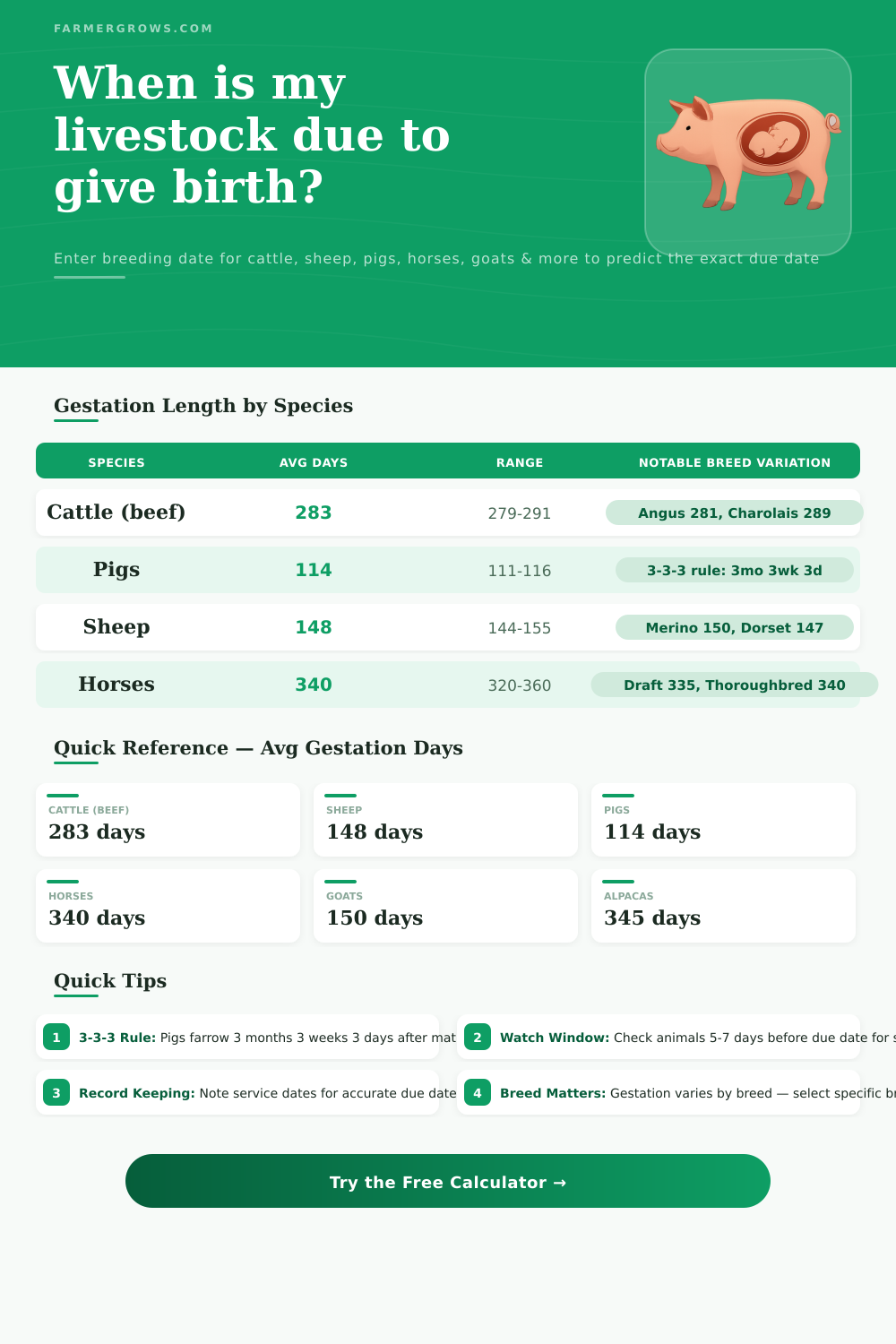
🐮 Livestock Gestation Calculator
Predict due dates for cattle, pigs, sheep, goats, horses & more from any breeding date
Gestation Progress
| Species | Avg Days | Range | Notable Breed Variation |
|---|---|---|---|
| Cattle (Beef) | 283 | 279-291 | Angus 281, Charolais 289, Simmental 287 |
| Cattle (Dairy) | 280 | 278-288 | Holstein 279, Jersey 279 |
| Sheep | 148 | 144-155 | Merino 150, Dorset 147, Suffolk 147 |
| Goats | 150 | 145-155 | Boer 150, Nubian 150, Alpine 150 |
| Pigs | 114 | 111-116 | All breeds ~ 114 days (3-3-3 rule) |
| Horses | 340 | 320-360 | Thoroughbred 340, Draft 335, QH 341 |
| Rabbits | 31 | 28-33 | Minimal breed variation |
| Llamas | 350 | 335-360 | Standard 350 |
| Alpacas | 345 | 335-355 | Huacaya/Suri ~345 |
| Dogs | 63 | 58-68 | Counted from ovulation, not mating |
| Cats | 64 | 61-72 | Average 64-66 days |
| Breeding Month | Cattle Due Month | Pig Due Month | Sheep Due Month |
|---|---|---|---|
| January | November | May | June |
| February | December | June | July |
| March | January | July | August |
| April | February | July | September |
| May | March | August | October |
| June | April | September | November |
| July | May | October | December |
| August | June | November | January |
| September | July | December | February |
| October | August | January | March |
| November | September | February | April |
| December | October | March | May |
| Species | Stage | Week / Day | Key Management Action |
|---|---|---|---|
| Cattle | Early | Day 1-90 | Confirm pregnancy, maintain BCS 5-6 |
| Cattle | Mid | Day 90-210 | Nutritional boost, vaccinations |
| Cattle | Late | Day 210-283 | Pre-calving ration, move to calving pen |
| Sheep | Early | Day 1-60 | Pregnancy scan, flushing on good pasture |
| Sheep | Late | Day 100-148 | Steaming up — increase feed for twins/triplets |
| Pigs | Early | Day 1-35 | Confirm pregnancy, limit stress and heat |
| Pigs | Late | Day 100-114 | Move to farrowing crate, increase fibre |
| Horses | Early | Day 1-120 | Ultrasound at day 14, vaccination review |
| Horses | Late | Day 300-340 | Foaling kit ready, monitor wax on teats |
The gestation period is the time from conception to birth. Every species of livestock has its own gestation duration that differs from the others. Knowing the basics helps you plan the work on the farm.
Livestock, like humans, have a pregnancy of about nine months, which matches to roughly 283 days. Actually, for cows the pregnancy ranges between 279 and 287 days. Record cases showed periods from 262 to 289 days, so the range is quite broad.
How Long Are Farm Animals Pregnant?
Different breeds of livestock have slightly different gestation times. Angus cows usually have a gestation of about 283 days, but Limousin breeds commonly go to 291 days. Simmental, because of its larger size, also have longer pregnancy.
The genetics of the breed decide the duration of the pregnancy. Breeds with low birth weight have shorter periods, and they fall into categories of low birthweight and ease of calving.
For dairy cows, Holstein-Friesian breeds have relatively short gestation duration, while Jerseys and Ayrshire breeds have longer pregnancies. That distinctly shows in herds with many breeds and their crossings.
The standard cow pregnancy lasts 283 days, but older and big cows calve usually 10 days later. Younger and small cows commonly give birth 10 days sooner. Calves decide more the birth date and weight than the cow itself.
So on both sides of the expected birth date there exists a three-week grace period.
Among other livestock, sheep and goats give birth after 150 days of pregnancy. Sows have piglets after only 114 days. The pregnancy of sows matches to three months, three weeks and three days so around 112 to 115 days.
All those dates base on breed averages. Every animal has its own gestation length and heat cycles that vary slightly. Gestation calculators allow farmers to choose the species, enter the breeding date and immediately see the approximate due date.
They use species-specific averages. For cows you enter the service date and count the 283 days to find the due date. Managing birth times in grazing systems can be difficult, but noting breeding dates and breed-specific lengths help you plan ahead.