🐑 Lambing Date Calculator
Estimate lambing dates from ewe breeding date, sheep gestation days, breed profile, lambing window, marking age, weaning age, flock size, conception rate, litter size, and lamb survival assumptions.
Load a realistic breed and flock pattern, then change any date, rate, or age. Gestation defaults use a practical 147-day sheep average with breed-specific adjustments.
Lambing plan results
Enter the breeding date and flock assumptions to calculate the due date, lambing window, marking date, weaning date, and expected lamb numbers.
The grid updates from your selected breed and flock assumptions so you can compare timing, crop potential, and replacement planning at a glance.
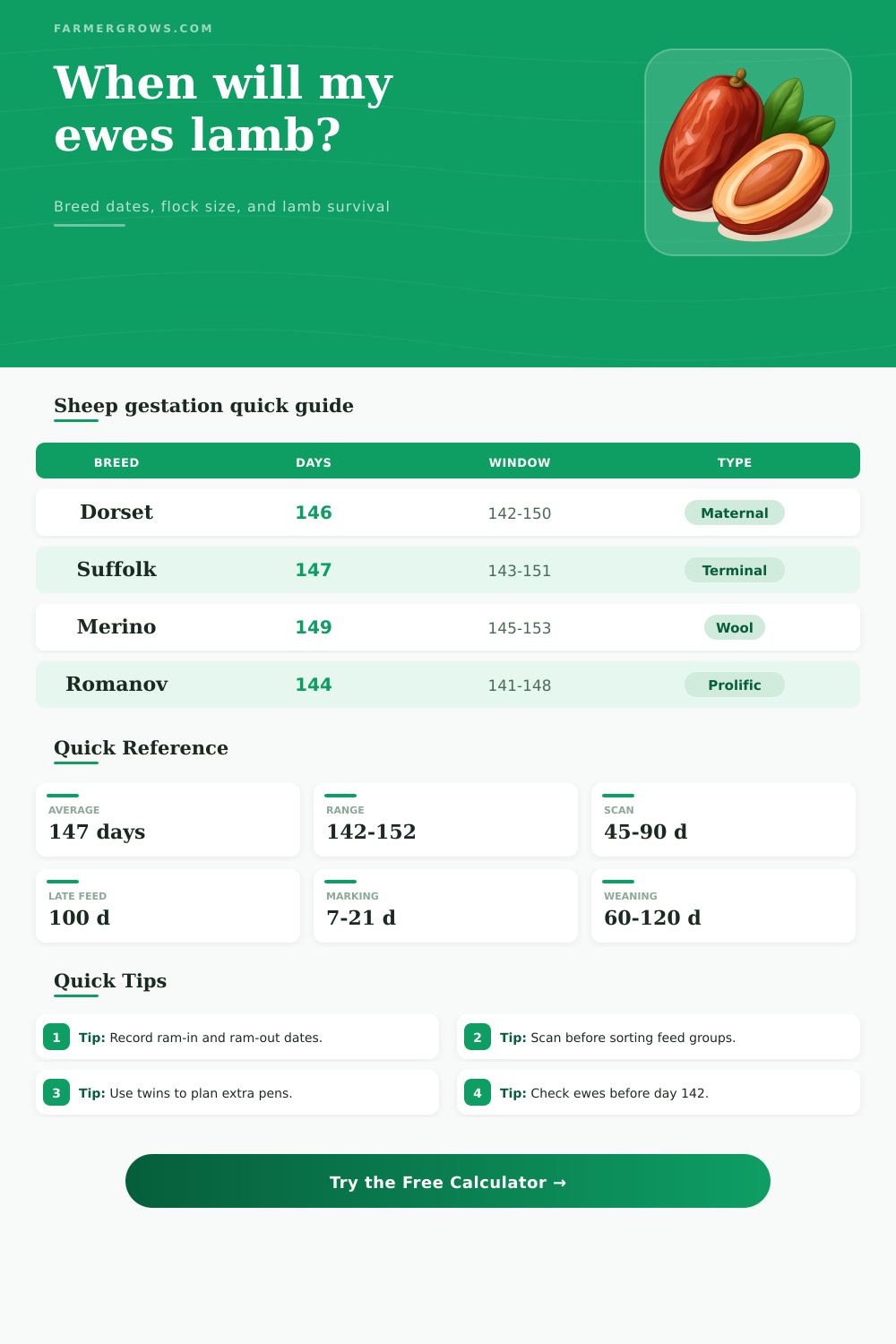
| Breed or type | Planning days | Common range | Typical litter assumption | Planning note |
|---|---|---|---|---|
| Mixed commercial | 147 | 142 to 152 | 1.55 lambs/ewe | Useful default when sire and dam types vary. |
| Suffolk | 147 | 143 to 151 | 1.50 lambs/ewe | Terminal meat type with strong singles and twins. |
| Dorset | 146 | 142 to 150 | 1.65 lambs/ewe | Often used for out-of-season or accelerated lambing. |
| Merino | 149 | 145 to 153 | 1.35 lambs/ewe | Fine-wool systems may plan a slightly longer date. |
| Katahdin | 147 | 143 to 151 | 1.70 lambs/ewe | Hair sheep maternal type for pasture lambing. |
| Finnsheep | 145 | 141 to 149 | 2.20 lambs/ewe | High-prolific breed; pen and colostrum planning matter. |
| Texel | 147 | 143 to 151 | 1.45 lambs/ewe | Terminal sire system with moderate lamb crop. |
| Romanov | 144 | 141 to 148 | 2.40 lambs/ewe | Very prolific; expect larger litter management demand. |
| East Friesian | 146 | 142 to 150 | 1.85 lambs/ewe | Dairy sheep often need close lamb and milk planning. |
| Shetland | 150 | 146 to 154 | 1.35 lambs/ewe | Heritage and primitive types can be later than average. |
| Checkpoint | Day formula | Date output | Why it matters |
|---|---|---|---|
| Pregnancy scan | Breeding + 45 days | - | Confirm pregnant ewes and sort litter groups. |
| Late gestation feed | Due date - 50 days | - | Start stronger nutrition for fetal growth. |
| Pre-lambing vaccine | Due date - 28 days | - | Common timing for clostridial booster programs. |
| Lambing window | Due date +/- window | - | Staff pens, pasture checks, and lambing kit. |
| Marking | Birth + marking age | - | Plan tags, docking, castration, and records. |
| Weaning | Birth + weaning age | - | Plan feed, pasture moves, and sale groups. |
| Scenario | Conception | Lamb survival | Pregnant ewes | Lambs weaned |
|---|---|---|---|---|
| Conservative | - | - | - | - |
| Entered plan | - | - | - | - |
| Good season | - | - | - | - |
| Excellent season | - | - | - | - |
| Management event | Common age | Date formula | Use in calculator |
|---|---|---|---|
| Early ID or tagging | 1 to 3 days | Lambing + age | Separate from marking if you tag at birth. |
| Marking and docking | 7 to 21 days | Lambing + marking age | Default is 14 days for planning labor. |
| Early weaning | 45 to 60 days | Lambing + weaning age | Useful for dairy or intensive systems. |
| Pasture weaning | 90 to 120 days | Lambing + weaning age | Common for grass-based meat lamb systems. |
| Value | Formula | Example | Planning use |
|---|---|---|---|
| Due date | Breeding date + gestation days | Oct 1 + 147 days | Main expected lambing date. |
| Lambing window | Due date +/- window days | 147 days +/- 3 | Early and late lambing watch period. |
| Pregnant ewes | Ewes exposed x conception rate | 100 x 90% | Expected ewes to lamb. |
| Lambs born | Pregnant ewes x lambs per ewe | 90 x 1.55 | Born lamb crop forecast. |
| Lambs weaned | Lambs born x survival rate | 140 x 88% | Expected sale or retention crop. |
A lambing date calculator are a tool that utilizes the known dates and rate for a farm to create a plan for the sheep operation. The planning of when to lamb is a task that includes a variety of variable to consider. Variables to consider may include the breed of the sheep, the conception rate, and the gestation length of the ewes.
The calculator is a tool that transform these estimates into a workable schedule. The breeding date is the most important date in establishing a plan for lambing. When establishing a plan with the lambing date calculator, the user enters the breeding date into the calculator.
How to Use a Lambing Date Calculator
The calculator will then add the gestation length to the breeding date to establish the date when the lambs will be delivered. The calculator will also use a window of variation to establish both an early date and a late date for the lambs to be delivered. These dates helps to establish when to begin checking the pen for the ewes.
The breed of the sheep is one of the variables that can be entered into the calculator. Because different breed of sheep may have different gestation length, the calculator will adjust the gestation length based on the breed that is entered. The owner of the farm can also manually change the gestation length.
The conception rate and the litter size for the ewes are two variable that can be entered into the calculator in conjunction with one another. The conception rate is the percentage of ewes that is pregnant. The litter size is the number of lambs that the pregnant ewes deliver.
By entering these two variables into the calculator, the calculator can calculate the total number of lambs that will be born from the flock. Additionally, a survival rate to weaning can also be entered into the calculator so that the calculator can calculate the number of lambs that the farmer will keep. Additional tools that can be entered into the calculator are the marking age of the lambs and the weaning age of the lambs.
The marking age is the age of the lambs when additional task are performed, such as docking and tagging their names. The weaning age is the age when the lambs are moved from the ewes. Each of these ages can be entered into the calculator.
The calculator will then add each of these ages to the due date for the lambs to determine when each of these tasks will occur. A range of potential date can be displayed from the calculator due to the variables within lambing itself. For instance, the calculator can be used to calculate the number of lambs that would be born if the survival rate to weaning was high, but also calculate the number of lambs that would survive only at a low survival rate to weaning.
These potential number of lambs will help the farmer to determine how many pen to prepare for the lambs, and how much milk replacer to have on hand. Additionally, a lambing date calculator can help farmers calculate the number of ewe lambs that will be born that can be used for future replacement of ewes in the flock. That percentage of lambs that will be retained is referred to as the retain percentage.
Thus, farmers can use the calculator to determine how many ewes they will have in total for future needs. The primary use of a lambing date calculator is to establish the dates that surround the date of when the lambs will be delivered. By knowing the date by which the late-gestation feeding is to occur, the farmers can order the supplements necessary before the supplies are busy with the lambs.
By knowing the marking age and date, the farmers can ensure that they have enough labor to perform the necessary tasks. By knowing the weaning age and date, the farmers can begin to plan their sales of the lambs. Through the ability to calculate each of these variables, the farmers are able to manage their operation more effective.