Lamb Carcass Yield Calculator
Estimate hot carcass weight, chilled carcass weight, retail cut yield, bone and trim loss, and aging shrink from a lamb's live weight and finish.
1Choose a lamb yield preset
Use a preset as a starting point, then adjust live weight, dressing percent, fat cover, carcass class, bone loss, trim loss, retail mix, and shrink for your processor's cutting style.
2Lamb and cutting inputs
Lamb yield estimate
Adjust the inputs to see carcass yield, retail cut weight, and take-home percentage.
Yield breakdown
3Lamb cut comparison grid
The grid divides the estimated retail weight into the selected package style. Actual cut labels vary by processor, carcass size, cutting thickness, and bone-in choices.
4Reference tables
Yield stage formulas
| Stage | Formula | What it means | Watch point |
|---|---|---|---|
| Hot carcass | Live weight × dressing % | Weight before chilling | Hide, head, feet, viscera removed |
| Chilled carcass | Hot carcass × (1 - shrink) | Cooler weight | Aging time and airflow matter |
| Retail cuts | Chilled × (1 - bone - trim) | Take-home package weight | Cut instructions drive loss |
| Live yield | Retail cuts / live weight | Retail percent of live lamb | Best for freezer planning |
Dressing percent guide
| Lamb type | Typical range | Best use | Adjustment clue |
|---|---|---|---|
| Light lamb | 44-48% | Small freezer orders | Higher bone share |
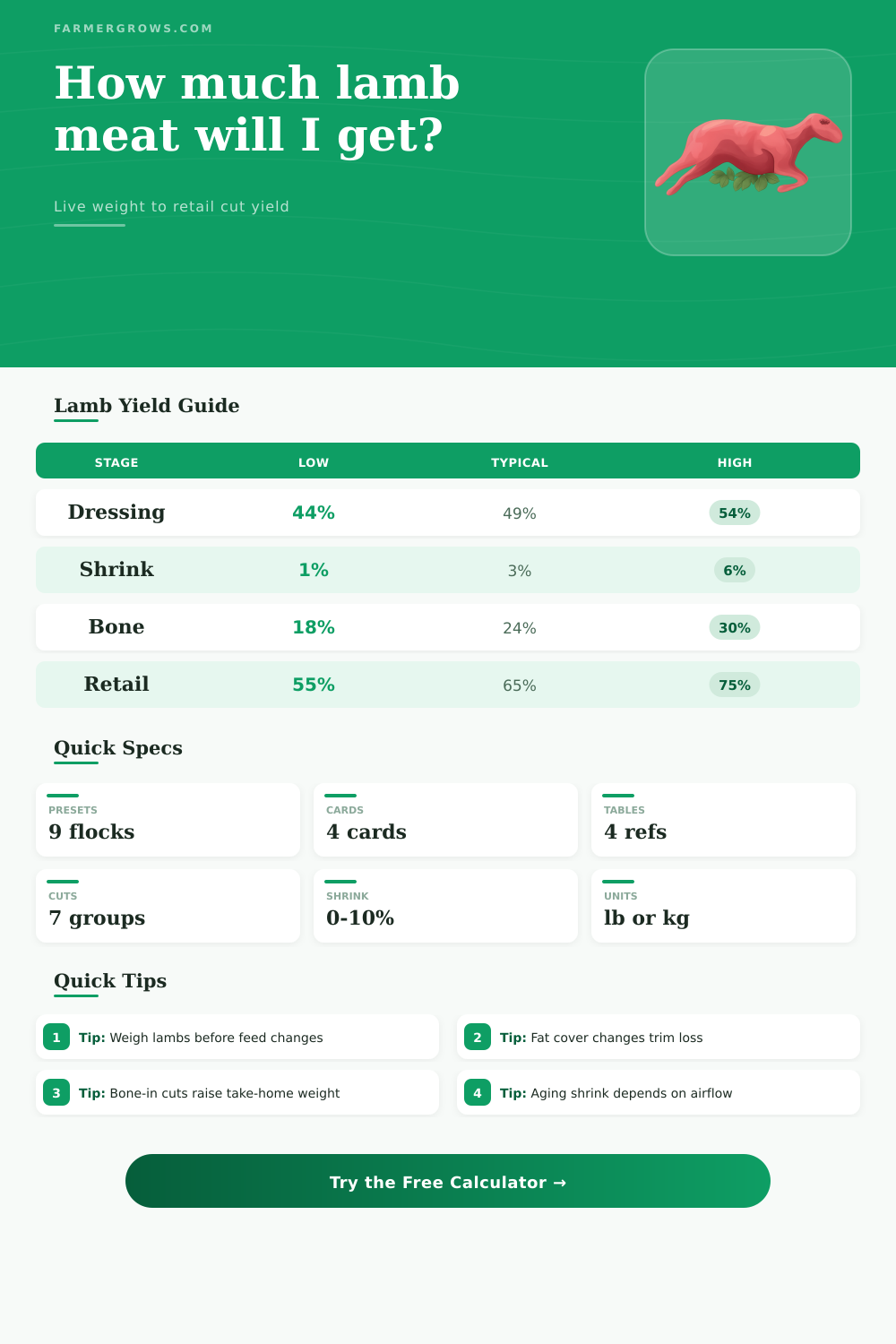
| Market lamb | 48-52% | Most retail planning | Balanced finish |
| Prime finish | 51-54% | Premium chops and rack | Watch trim loss |
| Mature ewe | 43-49% | Stew, grind, sausage | More bone and trim variation |
Bone and trim guide
| Cut style | Bone loss | Trim loss | Result pattern |
|---|---|---|---|
| Bone-in traditional | 17-22% | 9-13% | More package weight |
| Standard freezer | 21-27% | 10-15% | Balanced chops and roasts |
| Premium chops | 22-29% | 12-18% | More rack and loin finish |
| Mostly boneless | 28-36% | 12-20% | Lower weight, easier cooking |
Shrink and aging guide
| Cooler plan | Shrink range | When used | Note |
|---|---|---|---|
| Overnight chill | 1-2% | Fast fabrication | Mild moisture loss |
| 2-4 day chill | 2-4% | Common small plant flow | Good default range |
| 5-7 day age | 4-6% | Flavor and tenderness focus | More surface drying |
| Dry age longer | 6-10% | Specialty orders | Needs close trim tracking |
5Practical yield tips
This calculator is a planning estimate for flock records, freezer space, customer communication, and cut-sheet comparison. Final weights depend on actual scale weights, plant procedures, inspection trim, and requested package style.
Many who raise and slaughter lamb, or those who purchase lambs from farmers, are surprised at the amount of weight that is lost between the time when the lambs are on the farm and when the meat are in packages in the freezer. While the lambs may weigh 110 pounds on the farm, the weight of the meat that is obtained from the lambs may be closer to 55 pounds, as a number of different part of the lambs are removed. Such a difference between the weight of the live lambs and the weight of the cuts of lamb that are sold is the result of a number of different processes that occur between the time when the lambs are slaughtered and when the packages of meat are prepared for sale.
A yield calculator can help to determine each of these steps, and the yield calculator that is provided on this page allows for the determination of the weight of the meat that will come from the lambs before the lambs are slaughtered. The first step is to determine the dressing percent for the lambs. The dressing percent is a factor that indicates the percentage of the weight of the live lambs that will become the hot carcass after the hide, the head, the feet, and the internal organ are removed from the carcass.
How a Lamb Yield Calculator Works
The dressing percent will change for a variety of different reasons, such as the weight of the fat on the lambs, the muscling of the lambs, and how the lambs were fed. Lambs with more fat will have a higher dressing percent, but the fat will also contribute to the trim loss of the carcass. The yield calculator allow for the dressing percent to be adjusted, as well as for the class of the lambs to be selected to determine the expected weight of the carcass.
After the lambs are slaughtered, the carcasses is chilled, and the carcasses are aged. During these processes, the moisture from the lambs will evaporate. The longer the carcass is aged, the more moisture will be lost from the carcass.
For instance, if a carcass is aged for only a few days, it may lose only one or two percent of its weight, but if the carcass is aged for five or seven days, it can lose five or six percent of its weight. The rate at which the carcass loses moisture during the chilling and aging process is affected by the humidity of the area in which the lambs are aged, how long they are aged, and how the carcasses are hung when they are aged. The loss of the weight of the moisture from the carcass will impact each of the calculations that occur after the carcass is slaughtered.
The yield calculator accounts for the loss of moisture in the carcass to calculate the weights of the individual cuts of lamb. After the carcass is chilled, different decision must be made regarding the lambs bones and the weight of the carcass after the removal of the individual cuts of lamb. For instance, decisions can be made as to whether the lambs will be cut into bone-in meats, or whether they will be cut into boneless lambs.
The percentages that are lost due to the removal of the bones from the carcass will change depending on the type of lambs that are prepared. The yield calculator allows for the percent of weight that is lost due to the removal of the bones from the carcass to be adjusted, as well as for the percentage of weight that is lost due to the trimming of the carcass. Additionally, the type of retail mix of the lambs can be selected with the yield calculator, as well.
For instance, retail cuts of lamb may include the leg, the loin, the rack, the shoulder, and ground lamb. The fat cover of the lambs will also impact the weight calculations. Lambs with thin fat cover will have a lower initial weight than lambs with thick fat cover.
However, lambs with thick fat cover will lose more weight during the trimming process. A yield calculator accounts for these variables, as well, in that the dressing percentage and the trim loss can be adjusted according to the fat measurement of the lambs. Such adjustments are also made by the selection of the different class of lambs, such as prime finished or mature ewe lambs.
The yield calculator will output the weight of each of the different stage of the process. For instance, it will output the weight of the hot carcass, the chilled carcass, and the retail cuts of lamb that are packed into the packages of meat. Additionally, the yield calculator can calculate the percentage of the initial weight of the live lambs that will become the retail lamb meats.
This percentage, referred to as the overall yield percentage, is an important parameter for those who plan to place order for lambs to be slaughtered, as this percentage will explain how many lambs will be required to obtain the amount of meat that is desired. Additionally, the yield calculator will indicate from which stage of the process weight was lost. For instance, the weight of the lambs can be lost due to the hide and organs that are removed from the carcass, the moisture that evaporates during the chilling of the lambs, or the bones and fat that are removed from the carcass when the lambs are cut into individual cuts.
Each of these individual loss of weight can be evaluated by the yield calculator to indicate whether any changes to the cutting or aging process of the lambs will impact the amount of meat that is obtained from each lamb. Finally, the outcome of the yield calculator is merely an estimate for the weights of the individual types of lambs. While each carcass can be processed by the same butcher, the outcome of the carcass can differ between butchers.
For instance, one butcher may remove more fat than another butcher from the carcass. Therefore, while the outcome of the process cannot be relied upon as a determination of the actual weight that will be obtained from each lamb, the outcome can be used to compare the different cutting processes of various butchers. Additionally, the outcome of the process can provide an overview of the differences between bone-in lambs and boneless lambs.
Thus, the yield calculator is a helpful tool for those who raise or purchase lambs. For instance, the tool allows for the evaluation of the different types of lambs and the tradeoffs for each of the different types. Additionally, the tool can be used to determine how many lambs should of been ordered to satisfy the amount of meat that will be needed.
Thus, those who raise or purchase lambs can adjust each of the percentages in the process, but the process itself is fixed.