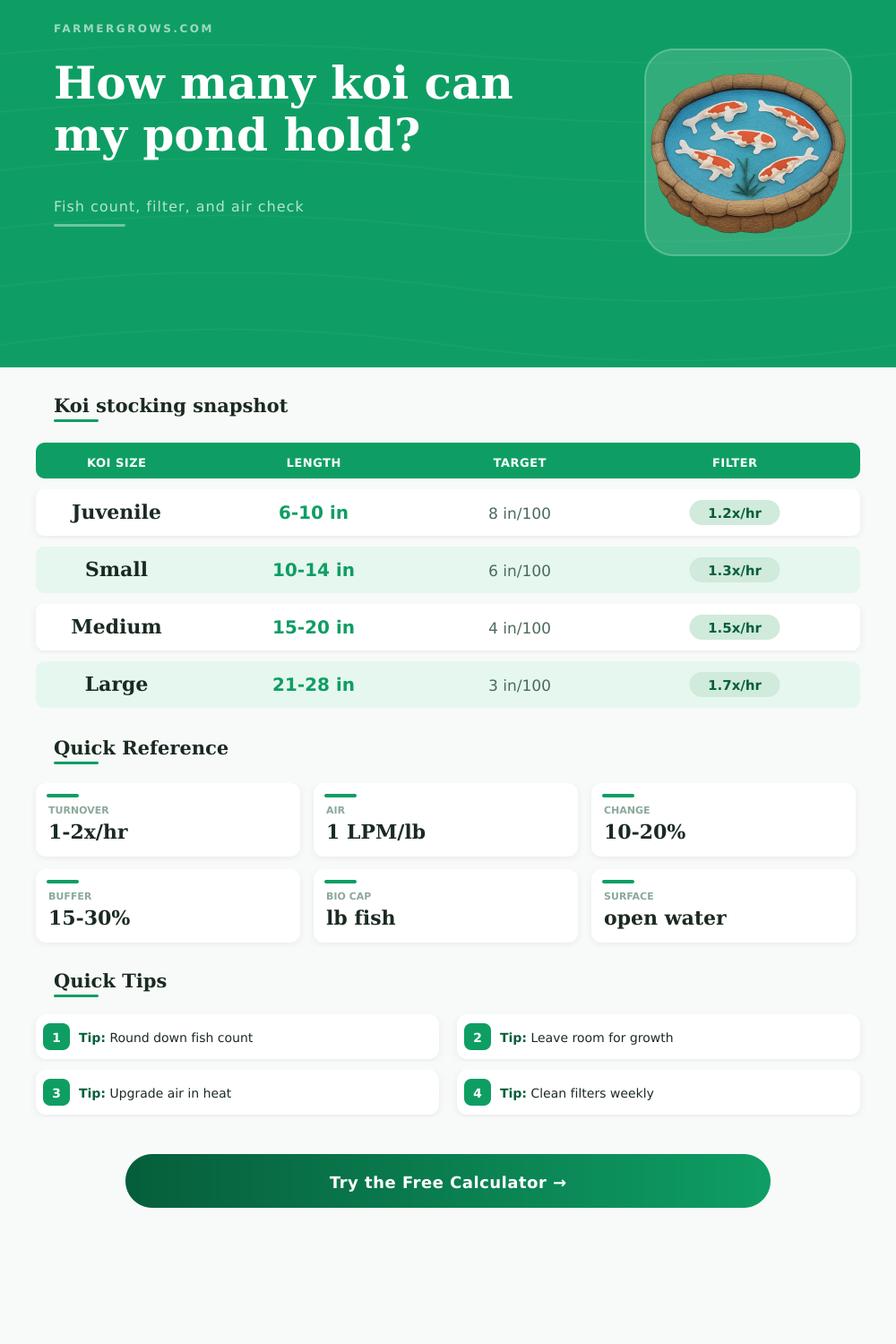
Koi Pond Stocking Calculator
Estimate a safer koi count from pond gallons, surface area, filter flow, aeration, size class, biofilter capacity, weekly water change, and growth buffer.
Koi Pond Stocking Output
The result rounds down because koi stocking should leave headroom for growth, summer oxygen demand, filter cleaning gaps, and feeding spikes.
Length: 4 in average.
Filter: 1.0 pond turn per hour.
Use: nursery or grow-out tubs.
Length: 8 in average.
Filter: 1.2 pond turns per hour.
Use: new ponds with growth room.
Length: 12 in average.
Filter: 1.3 pond turns per hour.
Use: lightly stocked garden ponds.
Length: 18 in average.
Filter: 1.5 pond turns per hour.
Use: mature backyard ponds.
Length: 24 in average.
Filter: 1.7 pond turns per hour.
Use: display ponds with strong air.
Length: 30 in average.
Filter: 2.0 pond turns per hour.
Use: show ponds and deep systems.
| Koi size class | Average length | Average weight used | Suggested target inches | Growth note |
|---|---|---|---|---|
| Fingerling | 4 in | 0.08 lb | 10-12 in per 100 gal | Do not stock to final count |
| Juvenile | 8 in | 0.45 lb | 7-9 in per 100 gal | Growth buffer matters most |
| Small koi | 12 in | 1.2 lb | 5-7 in per 100 gal | Watch summer oxygen |
| Medium koi | 18 in | 4.0 lb | 3-5 in per 100 gal | Filter cleaning load rises |
| Large koi | 24 in | 9.0 lb | 2.5-4 in per 100 gal | Needs strong biofilter |
| Jumbo koi | 30 in | 16.0 lb | 2-3 in per 100 gal | Stock very conservatively |
| System level | Turnover target | Aeration guide | Biofilter guide | Best use |
|---|---|---|---|---|
| Light garden pond | 1.0x per hour | 0.8 LPM per lb | Low to moderate load | Small koi and plants |
| Standard koi pond | 1.3-1.5x per hour | 1.0-1.3 LPM per lb | Rated for actual biomass | Mixed koi sizes |
| Heavy display pond | 1.7x per hour | 1.5 LPM per lb | Extra media and prefilter | Large koi feeding |
| Show or jumbo pond | 2.0x per hour | 2.0 LPM per lb | Oversized moving bed | High oxygen demand |
| Weekly water change | Calculator factor | Stocking interpretation | Best for | Caution |
|---|---|---|---|---|
| Under 8% | 0.70x | Reduced count | Temporary low feeding | Nitrate can climb |
| 8-12% | 0.85x | Conservative count | Lightly stocked ponds | Test water often |
| 13-20% | 1.00x | Normal count | Most koi ponds | Match dechlorination |
| Over 20% | 1.00x cap | No count bonus | High feed seasons | Do not mask weak bio |
| Pond example | Volume | Typical surface | Likely koi class | Planning note |
|---|---|---|---|---|
| Patio water garden | 300-600 gal | 25-55 sq ft | Juvenile | Use as grow-out, not final home |
| Raised garden pond | 700-1,200 gal | 55-95 sq ft | Small koi | Limit adult count early |
| Backyard koi pond | 1,500-3,000 gal | 100-220 sq ft | Medium koi | Good fit for balanced stocking |
| Large display pond | 4,000-8,000 gal | 250-520 sq ft | Large koi | Filter and air set the limit |
This koi pond stocking calculator estimates koi count, biomass, filtration flow, aeration demand, water change volume, and growth buffer so your pond plan stays balanced.
Koi ponds are not simple system. When establishing a koi pond, careful planning is necessary because koi fish will alter the environments of the pond. When koi are placed in a pond, the koi fish will alter the chemistry of the pond water, they will increase the amount of oxygens that is required in the water, and the filter in the pond will have to work more harder to clean the pond water.
Most people believe that all that is necessary for a pond is a hole dug into the ground and water added to the pond. However, a pond require a balance in its environment to support the koi fish in the pond. Furthermore, because koi fish grow larger over time, it is necessary to plan for the size that the koi will reach in the future, rather than the present.
How to Plan and Care for a Koi Pond
One of the factors to consider when establishing a koi pond is the volume of water that can be present in the pond. The volume of water in the pond is not the only factor to consider in how many koi live in the pond. For example, the number of gallons of water in the pond may be large enough to support several koi fish when the koi are young and small in size.
However, the same number of gallons may not be able to support those same fish when they have matured to their maximum size. Additionally, the surface area of the pond is another factor to consider. Gas exchange occurs between the pond water and the atmosphere in the pond.
Therefore, the surface area of the pond is important. A pond with a large surface area but small depth will allow for more gas exchange then a pond with a smaller surface area but depth. Thus, a pond with a large surface area may be able to contain more koi than a pond with a smaller surface area.
Filtration and aeration are other factors to consider in how many koi live in the pond. The filtration system for the pond must be strong enough to remove ammonia from the water that the koi fish produce. Similarly, the aeration system for the pond must be strong enough to provide the amount of dissolved oxygen that the koi requires.
If the stocking rate for the pond increases, the filtration system may not be able to efficiently remove the ammonia from the pond water. Additionally, if the temperature of the pond water increases, the amount of dissolved oxygen that can be contained in the pond water will decrease. Thus, the aeration system will have to be able to supply enough oxygen to the pond to support the number of koi when the water is warm.
The size of the koi to be contained in the pond is another major variable in establishing the pond environment. The young koi will produce less waste and require less oxygen in the pond than the adult koi. Therefore, a pond can contain more young koi than adult koi.
However, as the koi age, they will produce more waste and require more oxygen from the water in the pond. Therefore, it is best to stock a pond with the adult size of the koi in it to avoid poor water quality in the pond. If there is too many koi in the pond, they will have to be removed.
Ponds require regular water changes to maintain their environment and health. The reason that water changes are necessary is due to the ability of the water to naturally dilute the nitrates in the pond water and to refresh the minerals in the water. The more powerful the biofilter in the pond, the less often the pond water will have to be changed to maintain the same number of koi in the pond.
Thus, another factor to consider in the number of koi that live in the pond is the strength of the ponds biofilter. The temperature to which the pond water is maintained is another factor that will affect how many koi can live in the pond. Warm water will contain less dissolved oxygen than cold water.
Additionally, the koi will be active in warmer water and will eat more food when the water temperatures are higher. Thus, a pond that is stable at seventy degrees may become unstable at eighty degrees and the water may not be able to support the same number of koi. Therefore, the stocking rate for the pond should of been established in a way that accounts for high temperatures of the pond water.
It is common for individuals to make the mistake of establishing the stocking rate for the pond to be the target number of koi that will live in the pond. Instead, the stocking rate for the pond should be considered a ceiling for the number of koi in the pond. For example, if the stocking rate for the pond is established based off the current size of the koi in the pond, then when the koi grow the stocking rate will become an issue for the ponds water quality.
Furthermore, another common mistake is to upgrade only one element of the pond to support more koi. For instance, if only the pump for the pond is upgraded to allow for more water movement, but the aeration system is not upgraded, then the system will still not be able to support the increased number of koi to the pond. External factors in the pond may impact the carrying capacity of the pond to support koi fish.
For instance, plants in the pond may absorb some of the nutrients from the waste that the koi produce. In this way, the pond with plants may be able to support more koi than a pond without plants. Therefore, another factor to consider is the presence or lack of plants in the pond.
If a pond contains no plants and is exposed to high levels of sunlight, the amount of koi that can live in the pond may be less than a pond with plants. The goal of the pond and its management is to create a stable environment in which the water in the pond remains clear and the koi remain healthy. Creating such a stable system may require the intentional reduction of the number of koi in the pond and the dedication of the pond owner to maintain the system in which the koi are kept.
Actualy, making a moddern pond is alot harder than it looks. Youll need to make sure the furnitures in the yard dont block teh view. Its important to recieve help if you cant do it alone.