🌱 Hydroponics Yield Calculator
Estimate plants, harvest mass, and annual output by combining footprint, density, light, and crop timing for common hydroponic systems.
Pick a real production pattern. Each preset loads area, density, crop cycle, DLI target, and harvest mass, then runs the calculator.
The calculator handles rectangular, circular, triangular, and custom footprints, then adjusts yield for usable canopy, light, and crop turnover.
Projected harvest
Plants, cycles, cycle yield, and annual yield update together as you change area, density, light, and turnover timing.
Lettuce and herbs
Best for 33 to 36 lettuce plants per square meter, quick 30-day turns, and tight use of shallow channel space.
Baby spinach
Handles very high spinach density, often 1000 to 3000 plants per square meter in baby-leaf systems.
Tomato and cucumber
Lower density but higher plant mass, with long cycles and DLI near 20 to 30 for fruiting quality.
Strawberry tables
Uses about 8 to 10 plants per square meter and rewards good light, airflow, and steady picking.
Benchmarks below come from extension guides, CEA handbooks, and controlled-environment research. Use them as planning anchors rather than fixed outcomes.
| Crop | Density | DLI | Cycle | Yield cue |
|---|---|---|---|---|
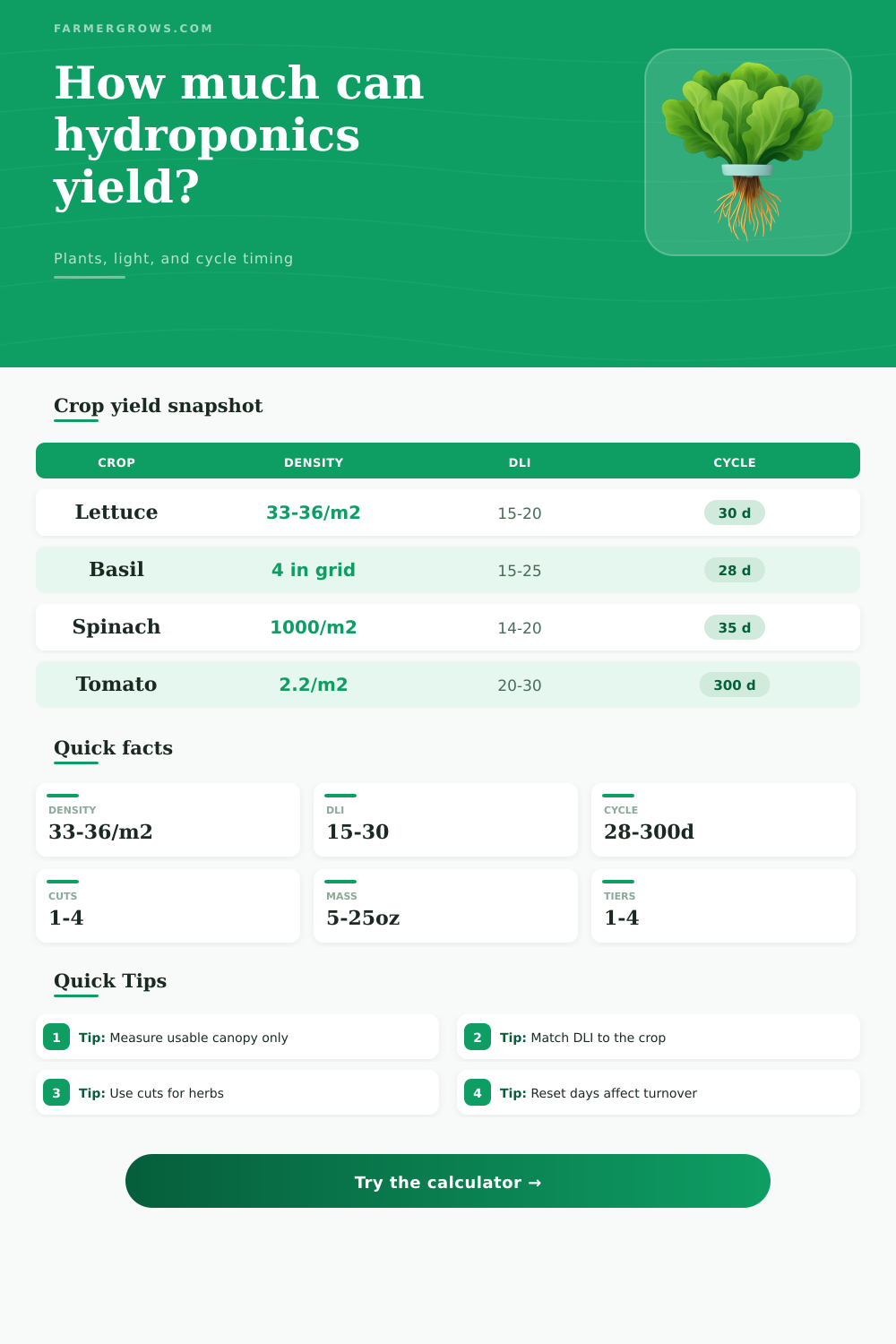
| Lettuce | 33-36/m2 | 15-20 | 30 d | 5-6 oz/head |
| Basil | 4 in grid | 15-25 | 28 d | 3-5 cuts/yr |
| Spinach | 1000/m2 | 14-20 | 3-4 wks | Baby leaf |
| Strawberry | 8-10/m2 | 20-30 | 10 mo | 5-10 kg/m2 |
| Tomato | 2.1-2.7/m2 | 20-30 | 16 wks | 20-25 lb/plant |
| Cucumber | 1.5-2.1/m2 | 20-30 | 12 wks | 20-25 lb/plant |
| Crop | First pick | Harvest pattern | Annual rhythm | Note |
|---|---|---|---|---|
| Lettuce | About 30 d | Single head | Fast turns | Head sells fast |
| Basil | 21-28 d | Repeat cuts | 3-5 cuts/yr | Trim the tips |
| Spinach | 3-4 wks | Baby leaf | Short cycles | Bolting risk |
| Strawberry | Seasonal | Pick often | 8 mo fruit | Long crop |
| Tomato | 16 wks | Weekly harvest | 10 mo crop | High-wire set |
| Cucumber | 12 wks | 3-4 picks/wk | 12 wk window | Rapid fruit set |
| System | Typical spacing | Plants / m2 | Crop fit | Why it works |
|---|---|---|---|---|
| Leafy NFT | 6.5 in | 33-36 | Lettuce | Fast, shallow roots |
| Herb grid | 4 in | 96-97 | Basil | Smaller cut leaves |
| Baby spinach DWC | Tray dense | 1000-3000 | Spinach | Very short crop |
| Berry table | 8-10/m2 | 8-10 | Strawberry | Air and light access |
| High-wire tomato | 4-5 sq ft | 2.1-2.7 | Tomato | Training space |
| Cucumber cordon | 5-7 sq ft | 1.5-2.1 | Cucumber | Large leaves |
| Crop group | Target DLI | Low-light cue | High-light cue | Note |
|---|---|---|---|---|
| Micro-greens | 9-12 | Slow color | Shorten stems | Very short crop |
| Lettuce | 12-17 | Stretching | Tip burn risk | Leaf crop |
| Spinach | 14-20 | Weak leaf mass | Bolting risk | Cool season |
| Basil | 15-25 | Soft growth | Flowering | Cut and regrow |
| Tomato | 20-30 | Few fruit | Stress above 30 | Fruiting crop |
| Cucumber | 20-30 | Small fruit | Leaf stress | High-wire crop |
| Strawberry | 20-30 | Weak fruit load | Stress above 30 | Keep it steady |
When you begin to establish a hydroponic system within a room, you cant establish your expected harvest yield. Your expected harvest yield is based on many different factors regarding your system and the plants you will grow. The total area of the room you plan to use for your system wont account for how much of that area will actualy have a usable canopy to grow your plants.
If you do not account for the usable canopy, your expected yield will be incorrect. Therefore, you must find a way to differentiate between the total area of the grow room and the usable canopy that will actualy be used to grow your plants. Another factor to consider is the density of the plants that you will grow within your system.
How to Estimate Your Hydroponic Harvest
Your plant density will determine the balance between the number of plants you grow and the quality of those plants. If you use high plant densities within your system, your grow area will have a high humidity rate, which can lead to issues like powdery mildew. If you use low plant densities, you may waste some of the electricity that powers the grow lights for your plants.
Your chosen plant density should correlate with the needs of the types of plants that you will grow; baby spinach plants requires more space then a tomato vine plant. Another factor to consider within your hydroponic system is the amount of light that your plants will be exposed to. As the primary energy source for your plants, light will be measured in terms of the daily light integral (DLI).
The DLI indicates how many light photon will hit the leaves of your plants each twenty-four hour period. If there are not enough light photons provided to your plants, they will stretch for the light and become leggy as they try to obtain the energy that they require to perform the processes necessary for growth. If there is too much light provided to the plants, the plants may develop tip burn.
To determine the proper amount of light that your plants require, you can use a DLI calculator to compare the actual DLI to the target DLI for the plants that you will grow in your system. If the actual DLI is less than the target DLI for your plants, your growing yield will be less than the theoretical yield that you calculate for your system. Another factor that will play a role in your expected yield is the turnover speed of your hydroponic system.
The turnover speed of your system accounts for the amount of time that you spend on reset days within your system. The growth cycle of your plants is the time that elapses between planting the seeds and harvesting the grow. Reset days are the amount of time that you clean the channels within your system and replace the water in the reservoirs.
By not accounting for the number of days that you spend on resets each year, you will not have an accurate number for the number of times that your system can be turned over in a year. You must account for reset days within the turnover speed of your system to determine how many grow cycle you can complete each year. The type of plants that you grow will play a role in the way that you calculate the yield of your system.
For instance, if you are growing herbs like basil, you may be able to harvest these herbs multiple times from each plant. Using the same plant multiple harvests will increase the total amount of herbs that you harvest from your system. Additionally, you could increase your total growing area by implementing verticality in your system; verticality would allow you to grow plants on different tiers of a structure.
However, using verticality may cause some of the lower plants to recieve less light than those on the upper parts of the system. Therefore, you would have to account for this potential problem in the setup of your vertical hydroponic system. Finally, you should account for the marketable percentage of your plants within your system.
Not every plant will be healthy enough to sell. If something happens to one of your plants that prevents it from being sold, such as changing the pH of the water or if there is a pump failure in the system, the lost plant will impact the total amount of plants that you can sell. Therefore, you have to account for the possibility of plant failure in order to determine your final yield.
If you account for each of these factors, your system will become more predictable in terms of it’s growing and harvesting cycle.