🧰 Hydraulic Accumulator Calculator
Size usable oil, gas volume, precharge, and energy for hydraulic circuits
Calculated Output
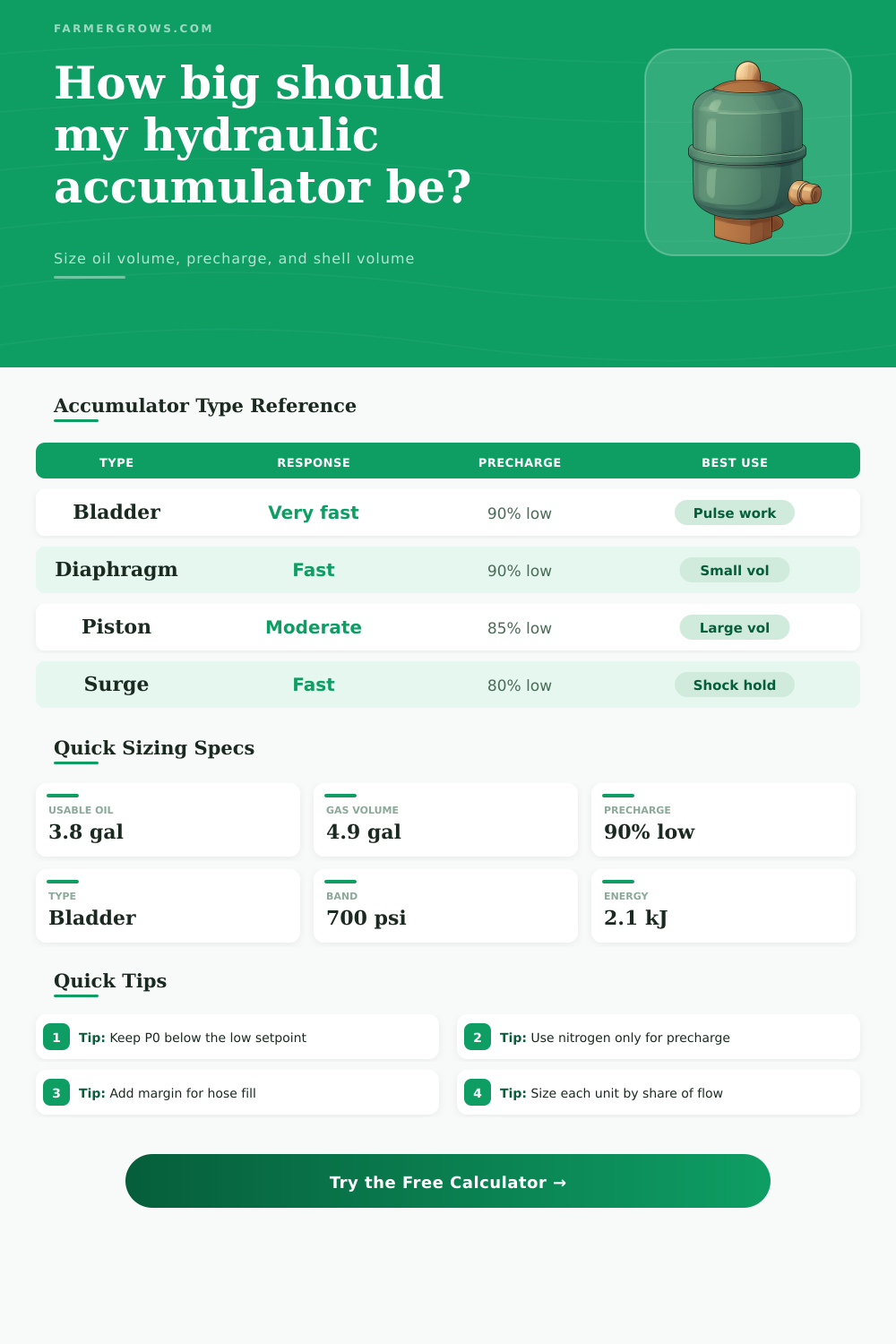
| Type | n-factor | P0 / P1 | Best use |
|---|---|---|---|
| Bladder | 1.4 | 90% | Fast pulse |
| Diaphragm | 1.4 | 90% | Small vol |
| Piston | 1.2 | 85% | Large vol |
| Surge | 1.0 | 80% | Shock hold |
| Shell | Liters | Typical role | Note |
|---|---|---|---|
| 0.5 gal | 2 L | Tiny reserve | Short pulse |
| 1 gal | 3.8 L | Compact | Small clamp |
| 2 gal | 7.6 L | Mid | Boom damp |
| 5 gal | 18.9 L | Workhorse | Loader hold |
| PSI | Bar | kPa | Band |
|---|---|---|---|
| 300 psi | 20.7 bar | 2070 kPa | Low band |
| 1000 psi | 68.9 bar | 6895 kPa | Common |
| 2000 psi | 137.9 bar | 13790 kPa | Heavy duty |
| 3000 psi | 206.8 bar | 20685 kPa | High duty |
| Flow | Time | Oil | Liters |
|---|---|---|---|
| 5 GPM | 10 sec | 0.83 gal | 3.1 L |
| 10 GPM | 15 sec | 2.50 gal | 9.5 L |
| 15 GPM | 20 sec | 5.00 gal | 18.9 L |
| 20 GPM | 30 sec | 10.00 gal | 37.9 L |
A hydraulic accumulator is a device that store energy within a hydraulic circuit. In some cases, a hydraulic accumulator is necessary in order to hold hydraulic fluid under pressure to the system even if the pump that provide that fluid stops working. Should a hydraulic accumulator not be present within the system, components like a loaders bucket may drop if the engine of the loader is stopped.
However, if the hydraulic accumulator is present, the hydraulic accumulator will hold the bucket in place, providing time for the loader to perform troubleshooting on the system. There are several type of hydraulic accumulators, each with a different intended use for that type of hydraulic accumulator. For instance, a bladder-type hydraulic accumulator use a flexible bladder to separate the hydraulic fluid from the gas within the accumulator.
Hydraulic Accumulators: Types, How to Size Them, and How to Care for Them
Hydraulic accumulators of this type absorb sharp pulses in the fluid. Additionally, another type of hydraulic accumulator use a diaphragm to separate the fluid from the gas within the hydraulic system, and is used when space within which the hydraulic accumulator will be placed is limited. Another type of hydraulic accumulator employs a piston to separate the fluid from the gas within the hydraulic system, and is typically used with large volumes of hydraulic fluid, with wide swings in the fluid pressures within the system.
Another type of hydraulic accumulator is known as a surge dampener, which reduce the shock waves that are created within the system due to the closing of valves or the stopping of hydraulic system components. To size a hydraulic accumulator, it is important to consider the flow rate of the hydraulic system and the length of time that the system should be able to hold the fluid without a pump. To determine the volume of hydraulic fluid that is necessary for the hydraulic accumulator, you can multiply the flow rate by the amount of time that the system should run.
The result of this calculation is the volume of fluid that should be within the hydraulic accumulator. In addition to calculating the fluid volume, it is also important to calculate the volume of gas within the hydraulic accumulator using polytropic expansion formula. The amount of gas that is precharged within the hydraulic accumulator is referred to as the gas precharge.
The precharge should be between 85 and 90% of the low-pressure setpoint of the hydraulic system. If the gas precharge is set to a level that is too low, the hydraulic accumulator may not be able to perform its intended function of providing hydraulic fluid in the necessary amounts. If the gas precharge is set to a level that is too high, the hydraulic accumulator may cease to provide fluid to the hydraulic circuit too early.
The type of gas that is typically used within the hydraulic accumulator is nitrogen. Nitrogen gas is used because nitrogen gas is stable, and will not ignite within the system when being compressed as another gas like oxygen could potentially do. Additionally, the operator should deplete the hydraulic system of fluid prior to performing the nitrogen precharge, and the system should be cold prior to performing the precharge.
Furthermore, due to the possibility of oil remaining within the systems hoses, it is recommended to add 10% to the calculated amount of nitrogen gas that will be precharged within the hydraulic accumulator. Should there be the use of multiple hydraulic accumulators, each of the hydraulic accumulators should be sized to the next standard size for that system. For instance, if the calculations indicate that each hydraulic accumulator should contain 120 liters of hydraulic fluid, the standard sizes for hydraulic accumulators are often 1-gallon or 2-gallon sized shells.
Thus, each hydraulic accumulator should be rounded up to the next standard shell size in order to ensure that the system will still be able to function in the case of one hydraulic accumulator failing within the hydraulic circuit. Due to the laws of thermodynamics, changes in the temperature of the fluid within the hydraulic circuit will impact the pressure within the hydraulic accumulator. Thus, prior to placing the loader or other implement that use the hydraulic system into the field to perform its tasks, the hydraulic system should be tested to ensure that the hydraulic accumulator has the proper gas precharge.
The hydraulic system also should be periodically inspected to ensure that the components within the hydraulic accumulator are in good working order. For instance, if the oil passes through the seal that separate the gas from the fluid within a bladder-type hydraulic accumulator, the bladder will eventually be damaged. Additionally, if the diaphragm within a diaphragm-type hydraulic accumulator is overfilled with fluid, it may burst.
Additionally, if the piston that separates the fluid from the gas within a piston-type hydraulic accumulator is not mounted in a straight position, the seals will wear with time. To troubleshoot a hydraulic accumulator, one approach is to measure the gas precharge of the hydraulic accumulator with a pressure gauge. To do this, connect a pressure gauge to the gas valve of the hydraulic accumulator while the hydraulic circuit is turned off and has been drained of its hydraulic fluid.
If the pressure that is read on the gauge is higher then the gas precharge that is specified for the hydraulic accumulator, then the nitrogen gas within the hydraulic accumulator has likely leaked. If the pressure that is measured with the gauge is lower than the gas precharge that is specified for the hydraulic circuit, then either the bladder of a bladder-type hydraulic accumulator has ruptured, or the piston seal of a piston-type hydraulic accumulator has worn with time. Prior to making any adjustments to the hydraulic accumulator regarding the gas precharge, you should of completely vent any oil from the hydraulic accumulator that may remain in its circuits.
If the gas volume and the gas precharge are set up appropriately, the hydraulic accumulator will function in the way that it is designed to, and the hydraulic circuit will remain stable.