Hoop House Bow Calculator
Estimate bow arc length, hoop count, stock pipe segments, bend marks, ground post length, and ridge purlin runs for rounded, gothic, and oval hoop houses.
Use centerline dimensions for the bow. The calculator adds insertion length at both legs, counts hoops from house length and bow spacing, and includes ridge purlin rows in the pipe takeoff.
| Formula | Expression | What it estimates | Planning note |
|---|---|---|---|
| Circular radius | R = (h² + (w/2)²) / (2h) | Radius for a round bow from width and height | Works when height is less than, equal to, or greater than a semicircle |
| Round arc | arc = R x 2asin((w/2)/R) | Centerline bow length above grade | Add insertion length after the arc is calculated |
| Hoop count | ceil(house length / bow spacing) + 1 | Number of bows including both end bows | Actual bay spacing becomes length divided by bay count |
| Pipe takeoff | (bow cut x hoops + purlins x length) x allowance | Total conduit or pipe length to order | Couplers depend on stock length and splice layout |
| Bow shape | Arc method | Best fit | Watch point |
|---|---|---|---|
| Round circular segment | Exact circle from width and height | Simple hoop houses and repeatable conduit bends | Very flat spans need more side bracing |
| True semicircle check | Half circle from width | Quick sanity check for classic low hoops | Height is forced to half the width |
| Oval or elliptical bow | Half ellipse using Ramanujan perimeter | Wider tunnels needing shoulder headroom | Bend marks are an approximation |
| Gothic high tunnel bow | Round arc plus crown allowance | Snow-shedding houses and taller crops | Peak splice and symmetry matter |
| Low caterpillar bow | Flattened oval factor | Temporary row cover tunnels | Use close spacing in wind |
| Material | Typical stock | Approx weight | Bow use |
|---|---|---|---|
| 3/4 in EMT conduit | 10 ft sticks | 0.46 lb/ft | Small and low seasonal bows |
| 1 in EMT conduit | 10 ft sticks | 0.67 lb/ft | Backyard houses with closer spacing |
| 1-3/8 in fence top rail | 21 ft sticks | 1.15 lb/ft | Common DIY hoop houses |
| 1.315 in greenhouse steel | 21 to 24 ft sticks | 1.35 lb/ft | Market tunnels and purlin frames |
| 1.660 in heavy steel | 21 to 24 ft sticks | 1.85 lb/ft | Wide bays and heavier covers |
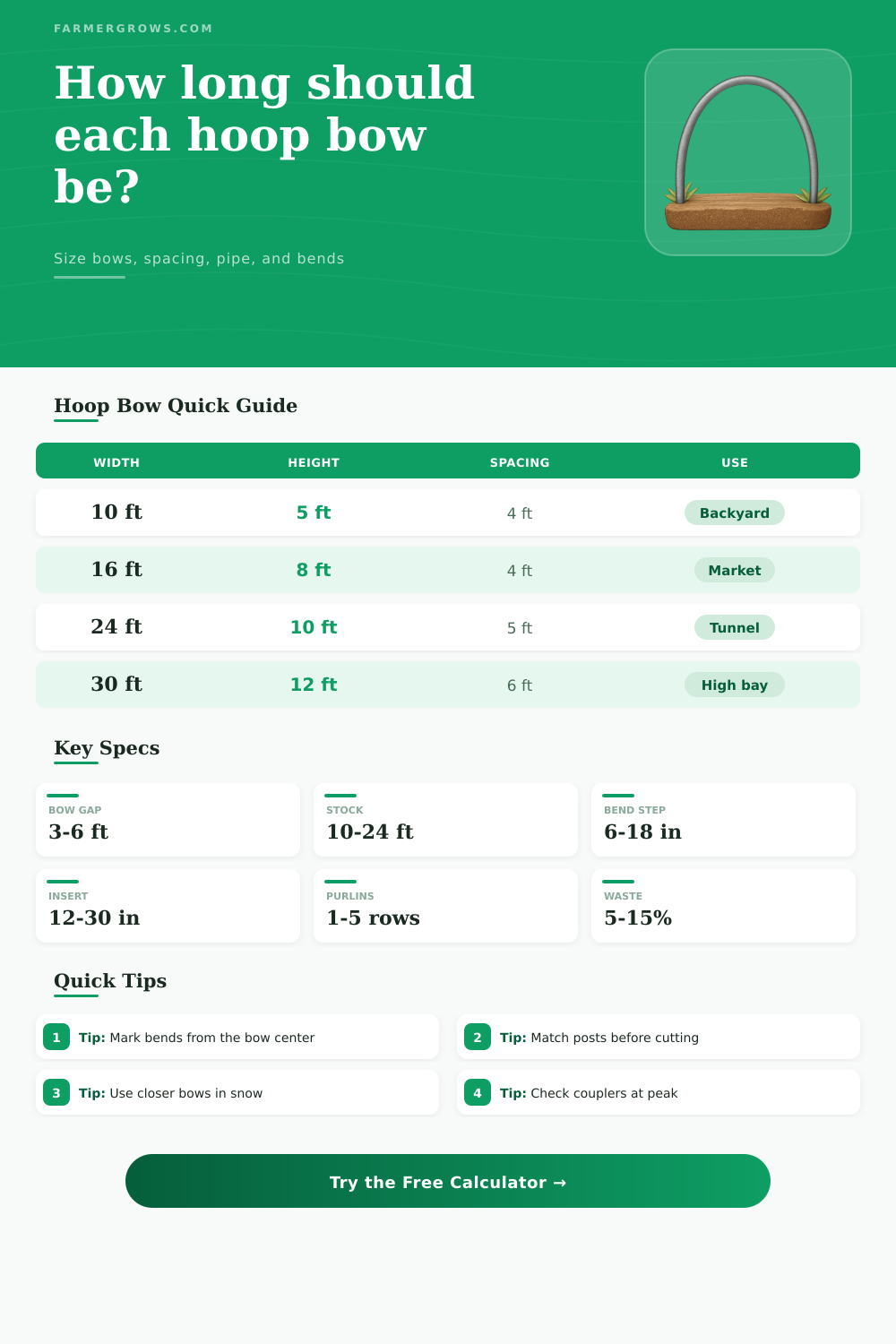
| Bow spacing | Typical structure | Hoops on 48 ft | Planning note |
|---|---|---|---|
| 3 ft | Snow area, nursery cover, rigid panels | 17 bows | Higher frame density with more purlin ties |
| 4 ft | Backyard and market poly houses | 13 bows | Common balance of strength and material |
| 5 ft | Moderate tunnel with strong steel | 11 bows | Check wind load and plastic pull tension |
| 6 ft | Light cover, mild climate, engineered kits | 9 bows | Needs good purlins and anchors |
Before bending: Make one test bow and measure the real peak height after springback. Then adjust bend spacing or insertion before cutting every bow.
Before ordering pipe: Lay out where splices land. Stagger couplers away from every peak line so one row of bows does not create a weak hinge.
Building a hoop house require a decision to be made about the bow that will make up the structure of the hoop house. The bows will determine the structure of the hoop house, the headroom within the hoop house, and how the snow will slide off of the structure of the hoop house. The choice of the bows will determine how much pipe is requiring for constructing the hoop house.
Choosing the correct geometry for the bows will make for a structure that is easy to construct. Choosing the incorrect geometry will result in bow that are difficult to bend in the desired way. Each of the various inputs into the calculator will affect the dimension of the resulting hoop house.
How to Choose Bows for Your Hoop House
The width and peak height will determine the bows that will be used, the length of the hoop house will dictate how many bows is required to construct the hoops, and the stock length of the pipe will affect how many coupler are required to construct the hoop house. Each of these measurements can be seen in the constructed hoop house and will be used in measuring the hoop house for the length of year that the hoop house is constructed. The bows that are chosen for the hoop house are an important decision that the individual that build these structures must make.
The most common bows for backyard hoop house are round segment bows. However, gothic bows are often used in region that receive heavy snowfalls because the sharper bows shed the snow more efficiently. Elliptical bows are used in hoop houses that contain tall crops since there is more room for the shoulder of those crops within the hoop house.
Bow shapes like low caterpillar bows are used to create a flat profile for covers for the hoop house. Each of these bows have an arc length that the calculator can calculate. The type of material that is used to construct the bows will affect the strength of the resulting hoop house and the way in which the bows must be bent from the pipe.
Some common materials for bows include EMT conduit, fence top rail, greenhouse steel, and other form of tubing. The choice of EMT conduit is common for those who wish to minimize the cost of construction of the bows. However, EMT conduit comes in standard lengths that will affect the number of coupler that are needed to construct the hoop house.
Fence top rail comes in long stick that are 21 feet in length, which can also reduce the number of couplings required to build the bows. Greenhouse steel and other heavier form of tubing can allow for bows to be spaced further apart from each other, but these materials cost more money to purchase and require a stronger bender to cut the materials to the necessary length. The calculator will not choose the material for the bows, but it can calculate the total length of pipe that is required for the bows of each of these material.
The spacing between the bows can have an impact on the strength of the structure of the hoop house and the number of bend that are required to construct the hoop house. Many individuals underbuild the spacing between the bows. For market agriculture tunnel, four-foot spacing between bows is common and effective.
Three-foot spacing is used in locations with heavy snowfalls or for those who wish to hang irrigation system from the bows. Four-foot spacing of bows save money on the purchase of pipe but requires stronger bows to support the spacing between the bows. The spacing that the calculator calculates may not be the same than the spacing that is entered into the calculator, but it will be rounded to create whole bays of bows.
The difference between the two spacings is important to know when stretching the plastic cover over the bows. Bend marks are used for reference when using a conduit Bender. The spacing of the bows that the calculator calculates will allow for the bows to remain smooth without being over-stressed.
The markings for the bows should be made from the center of the pipe outward to ensure that the bows are symmetrical when constructed. Additionally, a test bow should be constructed to account for the springback that can occur in the pipe due to changes in the temperature of the pipe. Purlins are used to hold the plastic to the bows and transform each individual bow into a hoop house structure.
Using a single ridge of purlin is the minimum number of purlins that can be used in constructing a hoop house. However, three row of purlins can be used to add more strength to the hoops if they are being constructed as a hobby hoop house. The length of pipe that is required to purchase for the purlins is included in the calculations to avoid buying too little pipe for the bows and purlins.
The use of ground posts is important in constructing a hoop house. The insertion depth that is selected will allow for the amount of pipe to be buried into the ground. If the insertion depth is too shallow, the bows may rock in the wind.
If the insertion depth is too deep, pipe will be wasted. The length of the posts should be selected before purchasing pipe so that every bow is create at the same height. Using a hoop house calculator will aid in the understanding of how to build the bows.
It will allow the individual to calculate how many stick of pipe are required to construct the bows. The calculator will show how many coupler are required. The calculator will allow the individual to see if the hoop house that is to be constructed will fit the individuals existing pipe.
Additionally, using the calculator will allow individuals to adjust the dimension of the hoop house to match the length of pipe that they have purchased. The first hoop house that is constructed will teach the individual more than the calculator. However, the second hoop house will be easier to construct because the numbers will be as obvious as the individual can make them.
Each of the dimension of the hoop house will work together to form a single decision for the hoop house dimensions. Once understood, the construction of the bows will be easier and the hoops will be easier to construct.