🌾 Hay Yield Calculator
Estimate expected hay yield per acre and total field production for any hay type and growing conditions
| Cutting # | Typical Timing | Quality | Recovery Days |
|---|---|---|---|
| 1st cutting | Early boot to 10% bloom | Highest protein & TDN | 30-45 days |
| 2nd cutting | 35-45 days after 1st | Very high quality | 28-40 days |
| 3rd cutting | 35-45 days after 2nd | High quality, lower yield | 30-40 days |
| 4th cutting | Late summer, 35+ days | Moderate, allow regrowth | 35-45 days |
| 5th cutting | Early fall, warm climates | Lower yield, good quality | Winterization needed |
| Factor | Impact on Yield | Example | Management Response |
|---|---|---|---|
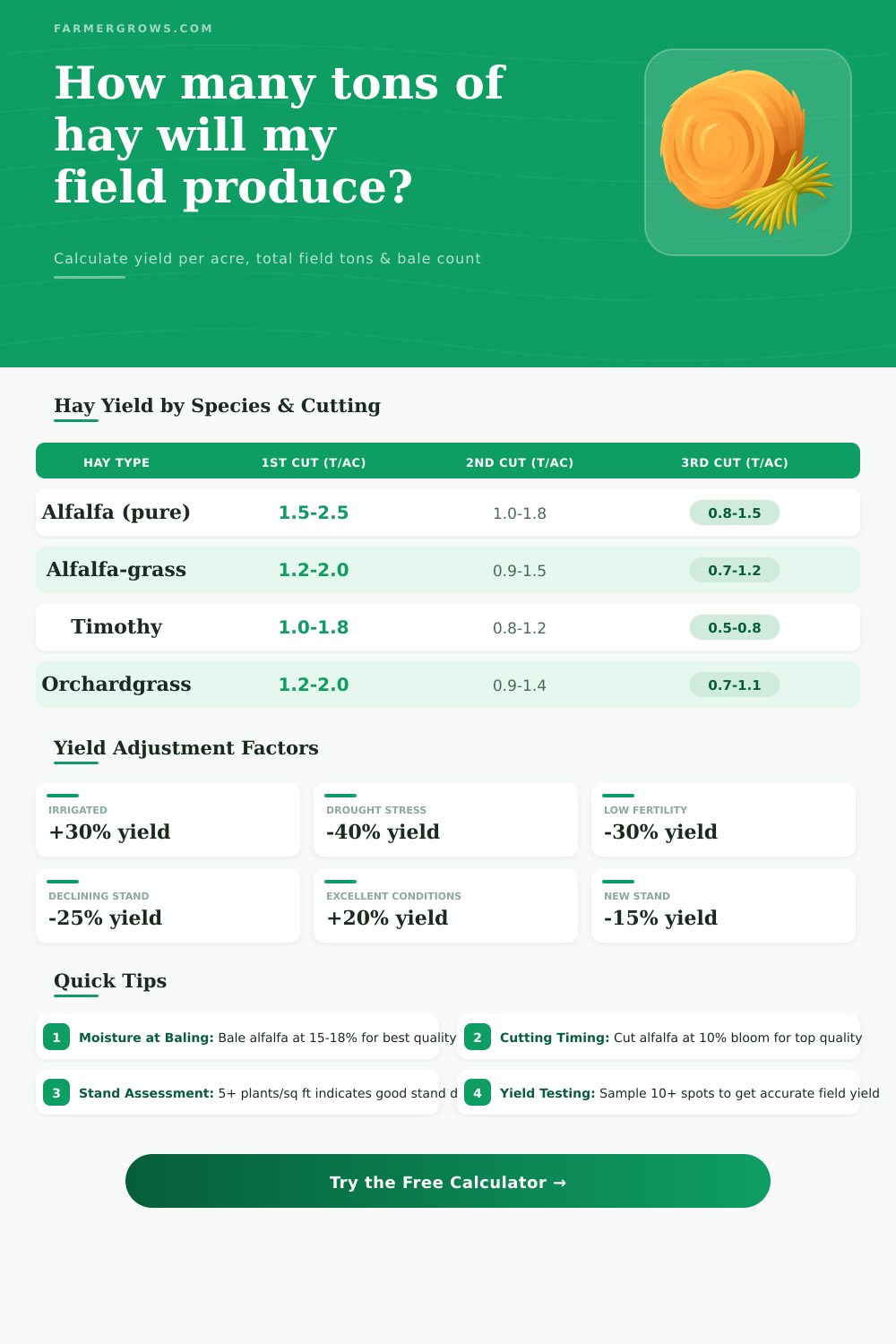
| Irrigation | +30% yield | 2.0 tons becomes 2.6 tons | Maintain consistent moisture |
| Excellent conditions | +20% yield | 2.0 tons becomes 2.4 tons | Optimize all inputs |
| Low fertility / no fertilizer | -30% yield | 2.0 tons becomes 1.4 tons | Soil test & fertilize |
| Declining stand (5+ yrs) | -25% yield | 2.0 tons becomes 1.5 tons | Consider renovation |
| Drought stress | -40% yield | 2.0 tons becomes 1.2 tons | Irrigate or wait for rain |
| New stand (yr 1-2) | -15% yield | 2.0 tons becomes 1.7 tons | Protect during establishment |
The amount of hay you receive varies a lot based on the region, the type of soil and the kind of grass being grown. In the Midwest region, mixed grass or legume hay gives from one to five tons per acre for a whole season. Average yields for all hay kinds grew by 10% to 2.48 tons per acre in 2024.
Even so, the American dry hay yield dropped from 2.52 tons per acre in 2016 to 2.44 tons per acre in 2017. For temperate growing hay ranges between 2 and 6 tons per acre.
How Much Hay Does One Acre Produce
To produce one ton of hay requires 4 to 5 inches of water pumped through the roots. In a system with three cuts, the first cycle until July 1st delivers around 35 to 45% of the whole amount. The second cycle adds 30 to 35%.
For instance, if you expect 4 tons per acre for three cuts, the first cut estimates to 1.6 tons, so around 40% of the whole.
Also the number of bales ranges a lot. Per acre you can receive from 60 to 120 little square bales depending on quality, moisture and soil fertility. For the first cut 90 to 100 square bales are considered a good result.
On bad soil with old meadow or many weedy plants, expect only 60 to 80. In a good year in Midwest, an acre gives around 100 square bales of each 45 pounds. Orchard grass weighs normally 50 to 60 pounds per bale, timothy around 45, and mixed grass 42 to 48 depending on the amount of bluegrass.
Costs matter just as much as the amount. Per acre they range from under 200 to 500 dollars for production of 1.5 to 5 tons. Inputs cost around 350 dollars per acre, but more if you use fertilizers.
The break even works out to around 80 dollars per ton. With three cuts on 600 hay acres it is possible 1200 dollars per acre. Pure alfalfa can reach the hiest price.
Production of alfalfa decreases because of low irrigation after the first cut, and it suffers from abiotic and biotic stress that causes big yield declines. Well made and stored round bales help to reduce losses during storage and preserve the quality. Healthy soil provides more hay, fewer diseases and fewer weeds.
In New England, hay field rent is around 100 dollars per acre per year, with amounts that range a lot. Coastal bermuda hay in North Alabama reaches around 1.8 tons per acre for the first cut, with possibility for 5.4 tons across three cutsper acre.