Ham Brine Calculator
Calculate equilibrium wet-cure water, kosher salt, sugar, Cure #1, nitrite ppm, pump target, and curing time for fresh ham.
This calculator sizes equilibrium brine from total ham plus water mass. It is not for bacon, Cure #2, dry-cured country ham, or shelf-stable fermented products.
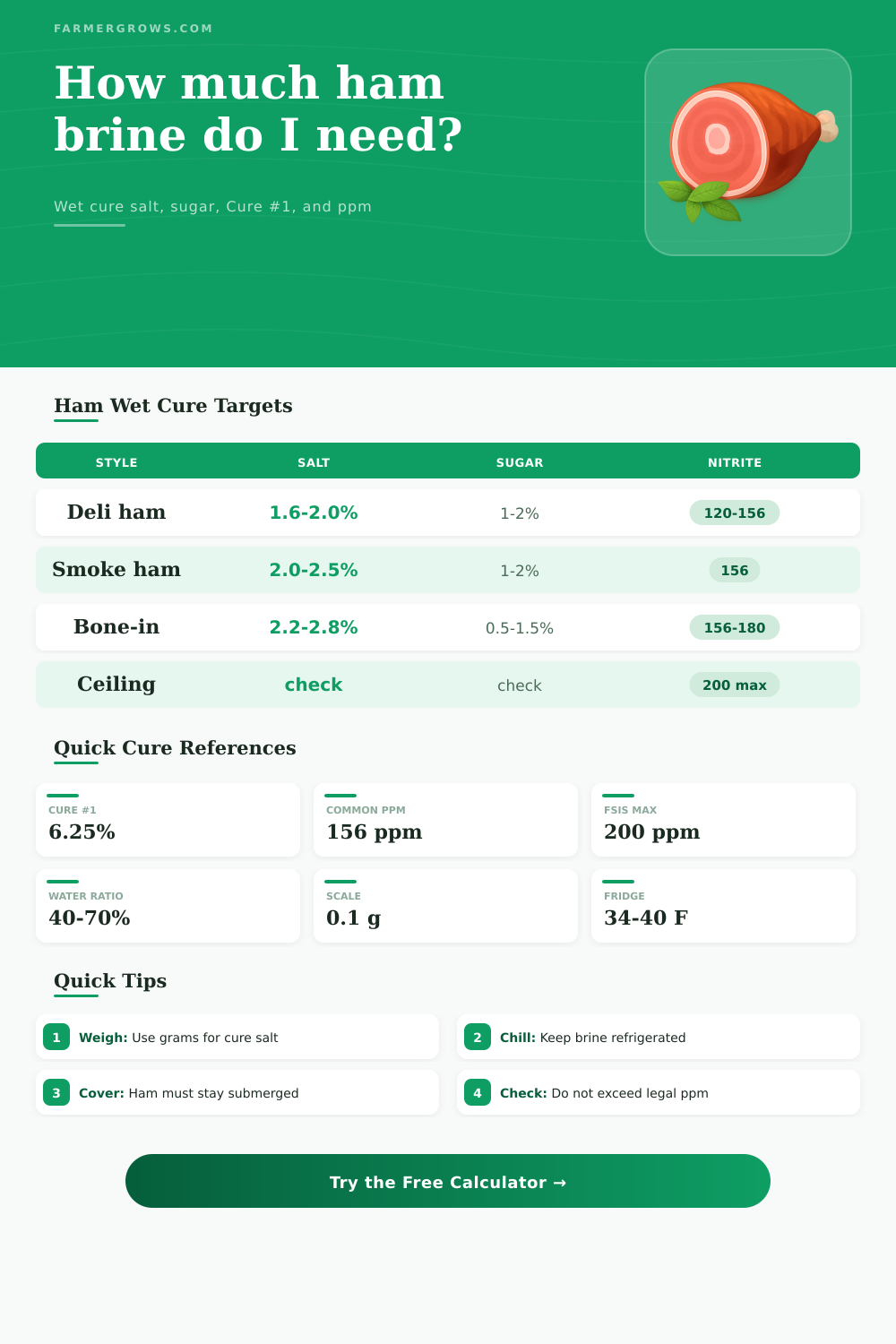
| Ham style | Salt target | Sugar target | Nitrite ppm | Best use |
|---|---|---|---|---|
| Low-salt deli ham | 1.5% to 1.9% | 1.0% to 2.0% | 120 to 140 ppm | Boneless roast, sliced cold after full cooking |
| Classic smoked ham | 2.0% to 2.4% | 0.8% to 1.8% | 150 to 156 ppm | Balanced cure flavor for most home wet hams |
| Bone-in holiday ham | 2.2% to 2.8% | 0.5% to 1.5% | 156 to 180 ppm | Thicker muscles, long chilled cure, optional injection |
| Sweet maple ham | 1.8% to 2.3% | 1.5% to 3.0% | 150 to 156 ppm | Breakfast ham, glazed ham, lightly smoked roasts |
| Regulatory ceiling check | Recipe dependent | Recipe dependent | Do not exceed 200 ppm | Immersion or pumped cured meat; bacon has separate limits |
| Ingredient | Calculation base | Example target | For each 1 kg system | Notes |
|---|---|---|---|---|
| Kosher salt | Ham weight + water weight | 2.2% | 22 g | Weigh salt; cup volume changes by crystal size. |
| Sugar or maple sugar | Ham weight + water weight | 1.2% | 12 g | Honey can be weighed as the same grams, with flavor changes. |
| Cure #1 at 6.25% | Target ppm across ham + water | 156 ppm | 2.50 g | Provides 156 mg sodium nitrite per 1 kg system. |
| EU cure at 5.67% | Target ppm across ham + water | 156 ppm | 2.75 g | Lower nitrite strength requires more cure mix by weight. |
| Ready-mix 0.60% | Target ppm across ham + water | 120 ppm | 20.00 g | Often already contains salt; reduce added salt accordingly. |
| Water ratio | Water per 10 lb ham | Water per 5 kg ham | Container fit | When to use |
|---|---|---|---|---|
| 40% of ham weight | 1.8 L / 1.9 qt | 2.0 L / 2.1 qt | Vacuum pouch or narrow bin | Boneless roast with little headspace |
| 50% of ham weight | 2.3 L / 2.4 qt | 2.5 L / 2.6 qt | Small food tub | Most picnic hams and half hams |
| 60% of ham weight | 2.7 L / 2.9 qt | 3.0 L / 3.2 qt | Deeper crock | Bone-in shank, uneven surface |
| 70% of ham weight | 3.2 L / 3.4 qt | 3.5 L / 3.7 qt | Wide curing vessel | Whole fresh leg or very irregular trim |
| Ham piece | Typical weight | Approx. thickest point | Chilled cure range | Injection note |
|---|---|---|---|---|
| Boneless picnic roast | 3 to 5 lb / 1.4 to 2.3 kg | 3 to 4 in / 8 to 10 cm | 4 to 6 days | Pump optional; rotate daily. |
| Half ham or shank | 7 to 10 lb / 3.2 to 4.5 kg | 4 to 5 in / 10 to 13 cm | 7 to 10 days | 10% pump improves center cure. |
| Bone-in fresh leg | 12 to 18 lb / 5.4 to 8.2 kg | 5 to 7 in / 13 to 18 cm | 10 to 14 days | Pump around bone and dense muscles. |
| Large whole leg | 20 to 24 lb / 9.1 to 10.9 kg | 7 to 8 in / 18 to 20 cm | 14 to 18 days | Use multiple injection points and turn often. |
Equilibrium Cover Brine
Salt, sugar, and cure are calculated from ham plus water mass, so the final balance is predictable after enough time.
Pump + Cover Brine
Injecting 8% to 12% of ham weight helps thick muscles cure evenly while the remaining ham rests submerged.
Traditional Strong Pickle
Older brines use a strong salt solution and timing control; this calculator does not model that style.
Dry Country Cure
Country ham uses dry salt, long drying, and different control points; use a specialized dry-curing formula instead.
Wet curing a ham require you to calculate an amount of salt, sugar, and nitrite that you need to use in brine. The brine that you use in the wet curing process contains salt, sugar, and nitrite by mass, and the brine will diffuse into the ham. The more concentrated the brine, the more flavorful and safe the ham will be.
To ensure that the ham is correctly flavored and safe to eat, you must use a calculator to determine the amount of salt, sugar, and nitrite that you must use in your brine. To calculate the amount of brine that you will use in your ham, you will need to determine the total mass of your curing system. The total mass of your curing system is the weight of the ham that you are curing multiply by the weight of the water that you will use in the brine.
How to Calculate Brine for Curing a Ham
The weight of the water impact the strength of the brine that will diffuse into the ham. A smaller amount of water will allow the brine to become stronger, and the stronger the brine, the more quickly it will reach equilibrium with the ham. A larger amount of water will allow for a weaker brine, but more coverage of the ham.
You must make sure that the water covers the ham, so you may have to add a percentage of water to the total calculated amount to ensure complete coverage of the ham. The first ingredient that you will use in your brine is salt. Salt provide flavor and preservation to the ham.
Most recipes call for a target salt level of 2-2.5%. A lower percentage of salt will result in a ham with a mild flavor, while a higher percentage of salt will result in a ham with a more assertive flavor. The second ingredient that you will use in your brine is sugar.
Sugar balance the saltiness of the brine and causes the ham to brown when cooked. The third ingredient in your brine is nitrite. Nitrite provide color to the ham and protects it against bacteria.
A nitrite calculator will allow you to calculate the weight of curing salt to reach your target level of nitrite in parts per million (ppm). Most recipes calls for a nitrite target of 150-160 ppm. However, you should not use a target level higher than 200 ppm, as levels higher than 200 ppm are outside the accepted range of nitrite for immersion curing processes.
You must use a gram scale to measure nitrite, as measuring it by volume instead of weight may lead to incorrect levels of nitrite in the brine. You can use either a pump or an injection to introduce the brine into the ham. Using an injection will speed up the process of the ham reaching the same equilibrium as the brine.
An injection is especially useful for ham that has bone in it, as you can inject the brine directly into the muscle. Your calculator will determine the amount of brine in milliliters or ounces that you can inject. You must be careful not to add too much brine with the injection, as this will change the amount of salt and nitrite that will reach the ham.
You will have to adjust the amount of cover brine accordingly. The amount of time that the ham will be in the brine for is referred to as the cure time. The cure time will depend upon the size of the ham that you are using, as well as the temperature of the environment in which the ham is cured.
Small boneless hams may require 5-6 days to cure, while large boned in hams may require 2 weeks or more to reach the same level of equilibrium between the ham and the brine. The ham should be stored in between 34 and 40 degrees F during the curing process. If your refrigerator is set to a temperature higher than 40 degrees F, the cure time may have to be increased.
After the ham is cured to your desired length of time, you may choose to soak the ham in cold water. Soaking the ham in cold water will reduce the saltiness of the ham, but is not required to achieve the desired flavor. However, you should always ensure that the ham was cured to the proper level of nitrite, regardless of whether you soak the ham in cold water.
The ham calculator will allow you to adjust one variable and see how it may impact the other variables in the curing process. For instance, if you adjust the target of sugar percentage in the ham, you can see how the weight of the sugar will change. Similarly, if you adjust the percentage of the brine that you will inject into the ham with a pump or injection, the calculator will show you how the amount of brine will have to change.
Using such a calculator will ensure that you dont make any mathematical error in the curing process, as well as ensure that the ham that is produced will have the flavor and safety level that you may desired.