Grow Light Calculator
Size indoor garden lighting from canopy area, crop stage, target PPFD, fixture PPF, mounting height, photoperiod, fixture efficacy, light loss, and dimmer setting.
Use manufacturer PPF for fixture output, then add losses for distance, wall absorption, lens aging, and non-uniform coverage. Final placement still benefits from a PAR meter or mapped PPFD readings.
Grow Light Sizing Estimate
The estimate converts canopy area into photon demand, adjusts fixture output for dimming and losses, then checks PPFD, DLI, fixture count, and watts.
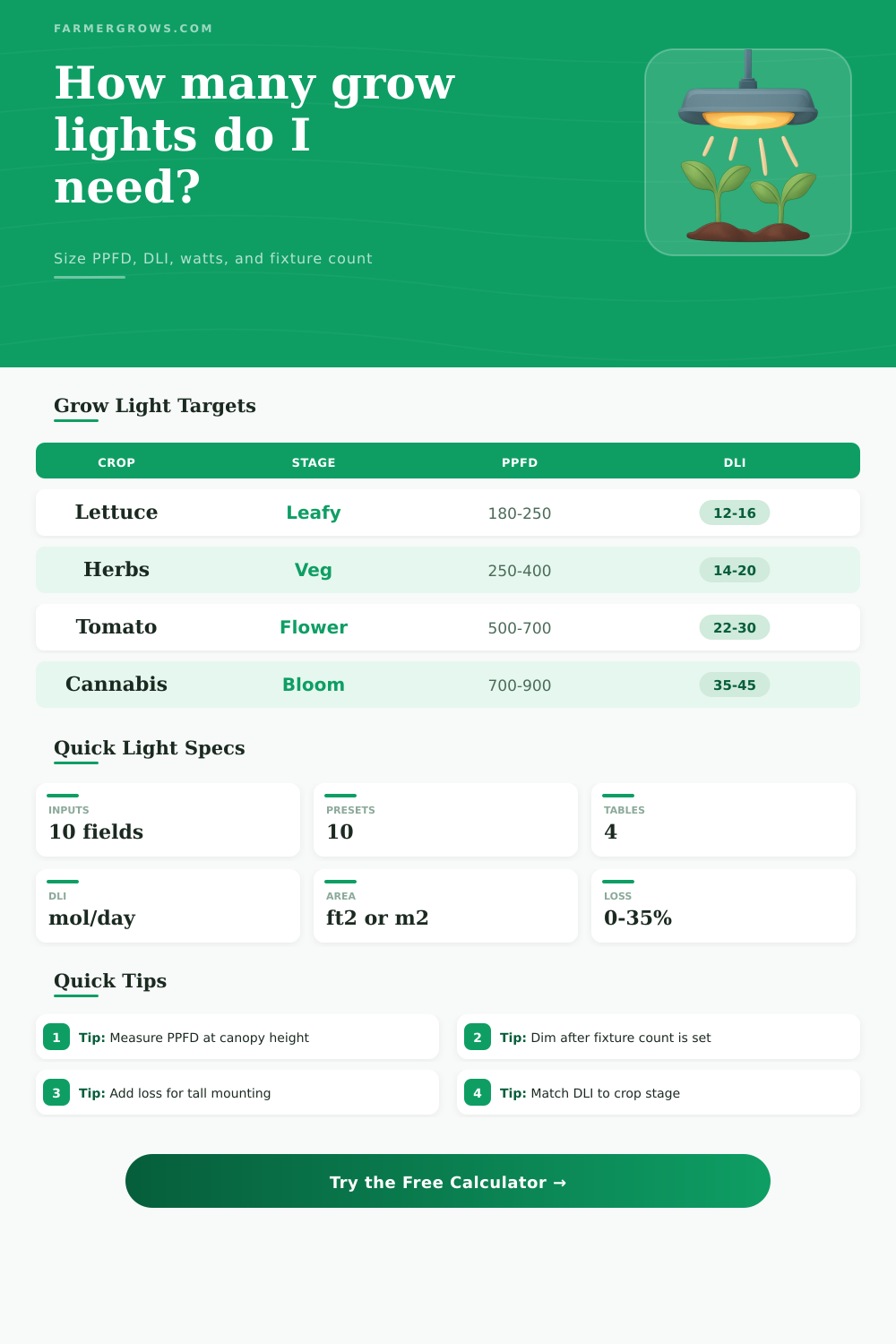
| Crop or Stage | Typical PPFD | Common Photoperiod | DLI Range |
|---|---|---|---|
| Seedlings and clones | 100-250 umol/m²/s | 14-18 hr/day | 6-14 mol/m²/day |
| Lettuce and leafy greens | 180-350 umol/m²/s | 14-18 hr/day | 10-20 mol/m²/day |
| Basil and culinary herbs | 250-450 umol/m²/s | 14-18 hr/day | 14-25 mol/m²/day |
| Tomato, pepper, cucumber | 450-750 umol/m²/s | 12-18 hr/day | 22-35 mol/m²/day |
| High-light bloom crops | 700-950 umol/m²/s | 11-12 hr/day | 28-41 mol/m²/day |
| Canopy Size | Area | PPF for 300 PPFD | PPF for 700 PPFD |
|---|---|---|---|
| 2 ft x 2 ft | 4 ft² / 0.37 m² | 111 umol/s | 260 umol/s |
| 2 ft x 4 ft | 8 ft² / 0.74 m² | 223 umol/s | 520 umol/s |
| 4 ft x 4 ft | 16 ft² / 1.49 m² | 446 umol/s | 1041 umol/s |
| 4 ft x 8 ft | 32 ft² / 2.97 m² | 892 umol/s | 2081 umol/s |
| 1 m x 2 m | 21.5 ft² / 2.00 m² | 600 umol/s | 1400 umol/s |
| Fixture Class | Efficacy Range | Watts for 800 PPF | Use Case |
|---|---|---|---|
| Older blurple LED | 1.4-1.9 umol/J | 421-571 W | Legacy tents and backups |
| Entry white LED board | 2.0-2.4 umol/J | 333-400 W | Small benches and tents |
| Modern full-spectrum LED | 2.5-2.9 umol/J | 276-320 W | General crop production |
| High-efficiency bar fixture | 3.0-3.5 umol/J | 229-267 W | Uniform commercial racks |
| Mounting Situation | Starting Loss | Uniformity Note | Best Adjustment |
|---|---|---|---|
| Close shelf, reflective sides | 5-10% | Strong center, low spill | Use dimmer for seedlings |
| Typical tent or rack | 10-18% | Good blend at 12-24 in | Map corners after hanging |
| Open bench, high fixture | 18-30% | More edge and aisle spill | Add fixtures or side reflection |
| Tall greenhouse supplement | 25-35% | Large spread, seasonal daylight | Use DLI controls if available |
Canopy mapping: Calculate fixture count first, then verify with a grid of PPFD readings at crop height. Corners commonly sit lower than the center.
DLI tuning: When plants stretch, raise PPFD or shorten hanging distance. When leaves bleach or taco, reduce dimmer output before changing the whole schedule.
Lighting is the most important factor within an indoor growing space. The lighting within the grow house will determine how well the plants will grow. If the lighting is too weakly, for example, a tomato plant may stop growing after week six.
If the lighting is too intense, lettuce plants may begin to flower too early. Each of these outcome are the result of small differences in lighting intensity that affect the plants. To determine the amount of light that is required for the crops that will be grown, you will have to perform calculations.
How to Set Up Lights for Indoor Plants
The variables to consider in these calculations include the area that will be lit, the intensity of light that the crop requires, and the amount of light that will be lost before it reach the plants. The amount of light that will be lost can occur due to the distance between the light and the plants, the absorption of light by the walls of the grow house instead of the reflection of that light, and the spread of the light as it move away from the grow light fixture. A calculator can help manage these variables to determine the amount of light that will reach the plants.
Many growers use a target PPFD value for the amount of light that the plants require. PPFD is a value in micromoles per square meter per second, and is the value that the plants being grown prefer. For example, seedlings have a lower PPFD requirement because the leaf of the seedlings are thin, and the roots of the young plants are establishing themselves.
In contrast, flowering plants requires higher levels of light after the plants begin to set fruit. These target PPFD values are used in relation to the number of hours that the lights will remain on. Twelve hours of light at 700 PPFD will deliver a different amount of light than sixteen hours of light at 450 PPFD.
The total amount of light that is delivered to the plants during a 24 hour period is referred to as the daily light integral, or the daily light integral is the factor that plants use to perform their growing processes. The output of the light fixtures can change from the wattage of the lights and the LED lights that the growers manufacture. The rating of the light fixtures is the PPF (photosynthetic photon flux) rating.
This value is the number of photons that leave the light fixtures after the light fixtures have lost some of that energy. Once the growers use the PPF rating to calculate the number of light fixtures that are required for the grow room, the calculator will provide information regarding the wattage of those light fixtures when they are used with a dimmer switch. Most growers will use their growing light fixtures at eighty or ninety percent of their potential growing light capacity.
Using the light fixtures at a level below the maximum wattage will save energy for the grower while still allowing the plants to grow. Another variable that growers must consider is the height at which the grow lights are hung from the plants. If the lights are too close to the plants, the center of the plants will receive too much light (a hot spot), while the leaves at the outer edges of the plants will receive less light.
If the light fixtures are too high above the plants, too much of the light will miss the plants. The grower can use the “loss allowance” variable within the calculator to account for this issue. For example, if the grow house uses a tent to contain the grow lights, fifteen percent of the light may be lost due to absorption by the walls of the tent.
However, in an open grow room or a greenhouse, twenty-five or thirty percent of the light may be lost due to absorption by the walls of the grow house. Different types of plants has different requirements for light and time for the plants to grow. For instance, leafy greens may reach the end of their growth cycle within four or five weeks, which means that the grower will not spend much energy (in relation to the grow period) lighting these crops.
However, the fruiting plants will be within the grow space for many months, so the wattage of the lights is a more important factor in these grow rooms. For example, a grow light fixture may draw three hundred watts of light when it is running at full capacity, but only draw two hundred and fifty watts if it is being dimmed. Thus, the use of a dimmer switch can lead to the grower saving money on electricity.
Tables within the lighting calculator can help the grower to understand to what level of light intensity different types of crops prefer to grow. For instance, crops that require high levels of light will be harmed if that type of high level of light is provided to seedlings. Basil plants, for instance, require more than 200 PPFD to encourage strong stems and leaves; if the plants are grown at 200 PPFD, their stems will be weak and their leaves will be pale.
Preset stages of plants within the lighting calculator will allow the grower to avoid remembering the different levels of light that each type of plant requires. In addition to the factors mentioned above, there are other variables within the grow room that can affect the growth of the plants. For instance, if the plants are exposed to air movement, the temperature of the leaves, and the conditions of the root zone, those factors will interact with the light intensity that reaches those plants.
For instance, the plants may reach leaf temperatures that are too hot for the plants if the leaves receive 700 PPFD of light from the grow lights, yet there is no air movement within the grow house. However, if that same amount of light is provided, but the plants are exposed to strong air movement, the plants may remain within their comfortable temperature range. Therefore, measurements of light intensity should be taken at the canopy of the plants after the calculations are performed.
The light intensity at the corners and outer edges of the plants may differ from the center of the plant’s canopy, so it is important to measure the light at those areas as well. To manage the light for the grow room, there are some steps that can be taken. First, the grower should set a target for the amount of light that will be provided to the plants.
Second, enter the specifications of the light fixtures that will be used within the grow house. Third, apply an allowance for the loss of light as the light leaves the fixtures. Finally, allow the lighting calculator to indicate the number of light fixtures that will be required, and the wattage of those lights.
After the grower establishes the light fixtures in the grow house, measurements should be taken of the amount of light that reaches the plants. The amount of light that is measured should be within ten or fifteen percent of the target light level. Any amount outside of that range indicates that adjustments should be made to the grow room setup, perhaps in the loss allowance, the height of the lights, or the setting of the dimmer switch that controls the lights.
You’ll need to be careful about how much light you use because its easy to overdo it. It would of been better to check the wattage earlier. Most people find that the plants grows better when the lighting is moddern and consistent.
It is actualy alot easier to manage than you might think. Dont forget to check the plants height too.