🌱 Greenhouse Exhaust Fan Calculator
Estimate greenhouse exhaust airflow, fan quantity, intake shutter area, staged ventilation, and crop heat margin from greenhouse volume, glazing heat gain, shade, static pressure, and climate zone.
Choose a greenhouse scenario to load realistic starting values for dimensions, glazing heat gain, shade, crop tolerance, static pressure, shutters, stages, and climate.
Greenhouse Exhaust Fan Results
Enter greenhouse details to calculate airflow, fans, shutters, and stages.
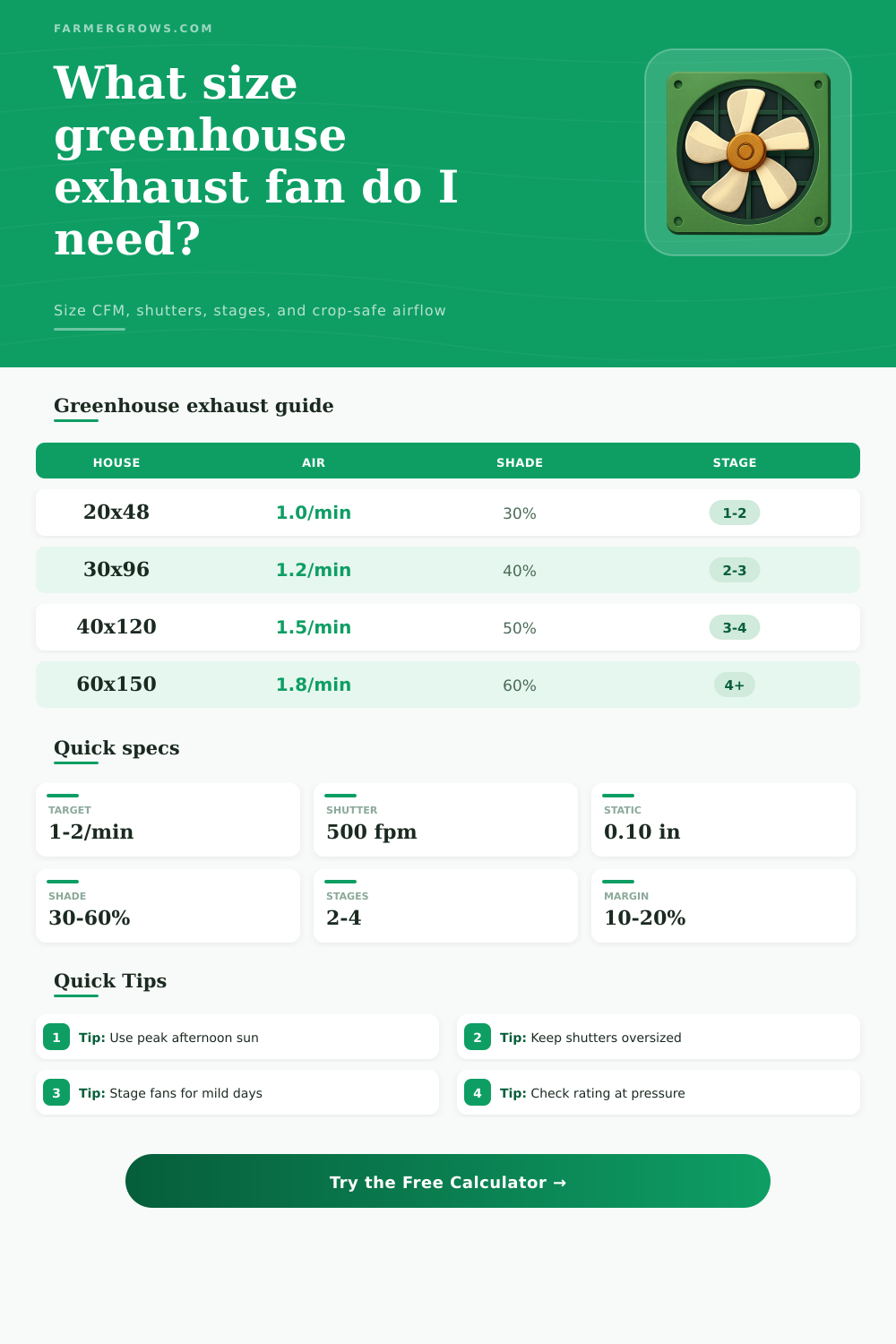
| Greenhouse use | Exchange target | Best stage plan | Notes |
|---|---|---|---|
| Seedlings and propagation | 0.75-1.0 per min | 1-2 stages | Avoid hard drafts |
| General vegetables | 1.0-1.3 per min | 2-3 stages | Strong default |
| Tomatoes and cucumbers | 1.2-1.6 per min | 3 stages | Tall canopy heat |
| Retail or nursery benches | 1.4-1.8 per min | 3-4 stages | High plant density |
| Glazing | BTU/hr ft2 | W/m2 | Use |
|---|---|---|---|
| Single poly | 190-230 | 600-725 | Bright farm tunnels |
| Double poly inflated | 160-200 | 505-630 | Common heated houses |
| Twin-wall polycarbonate | 140-180 | 440-570 | Rigid panels |
| Clear glass | 210-260 | 660-820 | High transmission |
| Static pressure | Approx delivery | Common cause | Action |
|---|---|---|---|
| 0.05 in wc | 95% | Clean shutter | Normal rating |
| 0.10 in wc | 88% | Screen or louver | Check fan curve |
| 0.15 in wc | 80% | Pad or tight intake | Add inlet area |
| 0.20 in wc | 72% | Restricted wall | Reduce resistance |
| Item | Target | Metric | Why it matters |
|---|---|---|---|
| Intake shutter face speed | 400-600 fpm | 2.0-3.0 m/s | Limits pressure loss |
| Sidewall inlet area | CFM / 500 | m3/h / 9180 | Fast field estimate |
| First fan stage | 25-40% | 25-40% | Mild-day control |
| Final fan stage | 100% | 100% | Peak sun purge |
An exhaust fan remove heat from the greenhouse by pulling hot air out of the greenhouse and pulling cooler air into the greenhouse. The heat that enters a greenhouse come from the sun’s sunlight passing through the greenhouse glazing into the greenhouse. Unless the exhaust fan removes that heat from the greenhouse, the heat will remain within the greenhouse.
When air dont move within the greenhouse, the plants leaves will become more hotter than the air within the greenhouse. High temperatures reduce the plant’s ability to perform photosynthesis and can cause the plants to reach a point of heat stress. Therefore, the exhaust fan that is installed in the greenhouse must have the correct amount of airflow to ensure that the plants within the greenhouse dont experiences heat stress.
Choosing and using exhaust fans for a greenhouse
The amount of airflow that is required to provide adequate ventilation for the greenhouse is dependent upon the air volume within the greenhouse and the amount of heat that enter the greenhouse. The grower must decide how quickly the grower should replace the air within the greenhouse. The amount of heat that enters the greenhouse through the walls and the roof will also impact the size of the exhaust fan.
The type of shade cloth that is use in the greenhouse and the outside air temperature affect the amount of heat that enters the greenhouse through the glazing material. The exhaust fan should be sized to handle the maximum amount of heat load during the hottest and sunniest days of the year. The glazing material for the greenhouse will affect the amount of solar energy that enters the greenhouse.
Greenhouses that use single layer poly film will allow more solar energy into the greenhouse compared to greenhouses that use double inflated layers or twin wall polycarbonate. Greenhouses that use single-layer poly film will require more airflow than greenhouses that use twin-wall polycarbonate. Shade cloth will also reduce the amount of solar energy that enters the greenhouse; however, it will also reduce the amount of light that enters the greenhouse and reaches the plants.
An appropriate amount of shade cloth should be used to reduce the temperature within the greenhouse to a manageable level and to allow enough light for the plants to perform the photosynthesis process. The static pressure within the greenhouse will also impact the amount of air that the exhaust fan can move. Static pressure refers to the resistance that the exhaust fan encounter as the air moves through the greenhouse, such as shutters, screens, or louvers.
As the resistance from the shutters or screens increase, the performance of the exhaust fan will decrease. The exhaust fan may be able to move a great deal of air when no shutters is installed in the greenhouse. However, if shutters are installed, the amount of air that can move through the greenhouse will be less than the capacity of the exhaust fan when all shutters is open.
By using staged exhaust fans, the grower can have better control over the amount of air that moves in and out of the greenhouse. By staging the exhaust fans, it is possible to divide the total amount of capacity of the exhaust fans into two or three stages. By placing the exhaust fans at full power on a mild morning, the grower may waste energy using the exhaust fans and create drafts that stress young plants within the greenhouse.
By staging the exhaust fans, the grower can control the amount of airflow that exit the greenhouse according to the amount of heat load within the greenhouse at any given time of day. For instance, the first stage of the exhaust fans may handle the amount of airflow for the rest of the plants during the daytime, and the last stage of the exhaust fans can be turned on only during the hours when the plants recieve the most sunlight. Another consideration for greenhouse ventilation is the size of the intake area for the greenhouse.
The intake area is just as important as the exhaust fan. If the intake shutters or vents dont allow air into the greenhouse at the same rate as the exhaust fans remove air from the greenhouse, negative pressure will form within the greenhouse. If the exhaust fans within the greenhouse are moving air faster than air can enter the greenhouse, the performance of the exhaust fans will suffer.
It is crucial to ensure that the intake area is of a size that allow the air to enter the greenhouse. For example, if many exhaust fans are installed in the greenhouse, but there is not enough intake area, the exhaust fans will not function as they are designed to function. The tolerance of the plants to high temperatures within the greenhouse will also determine the size of the exhaust fan system.
Some crops can tolerate higher temperatures than others. The temperature difference between the outside and inside of the greenhouse can have a significant impact on the crops within the greenhouse. For crops that are sensitive to high temperatures, the exhaust fan system must be designed to remove enough heat from the greenhouse so that the temperature within the greenhouse does not exceed the temperature that the crops can tolerate.
Additionally, a safety margin should of been added to the exhaust fan calculations for conditions beyond the average high temperature within the greenhouse and for the performance capabilities of the exhaust fans. Many greenhouse managers make mistakes when sizing the exhaust fan system that will be installed within the greenhouse. Some greenhouse managers size the exhaust fans so that they can remove all of the heat that is generate on the hottest recorded day within the greenhouse.
However, this will result in exhaust fans that continuously remove air from the greenhouse. These fans may also create drafts that stress the young plants within the greenhouse. Other greenhouse managers may focus exclusively on the number of exhaust fans that they purchase.
They may not consider providing an adequate intake area for the greenhouse. Additionally, many managers will ignore the impact that screens placed on the greenhouse exhaust fans have upon the static pressure of the exhaust fans until they experience problems with the exhaust fans functioning at high temperatures. To avoid these mistakes, greenhouse managers should use a calculator to determine the size of the shutters and the number of exhaust fans required to provide adequate ventilation for their greenhouse based off the dimensions of the greenhouse and the type of glazing material that their greenhouse use.