🍇 Grape Vine Spacing Calculator
Calculate exactly how much space your grape vines need based on type, training system, and available area
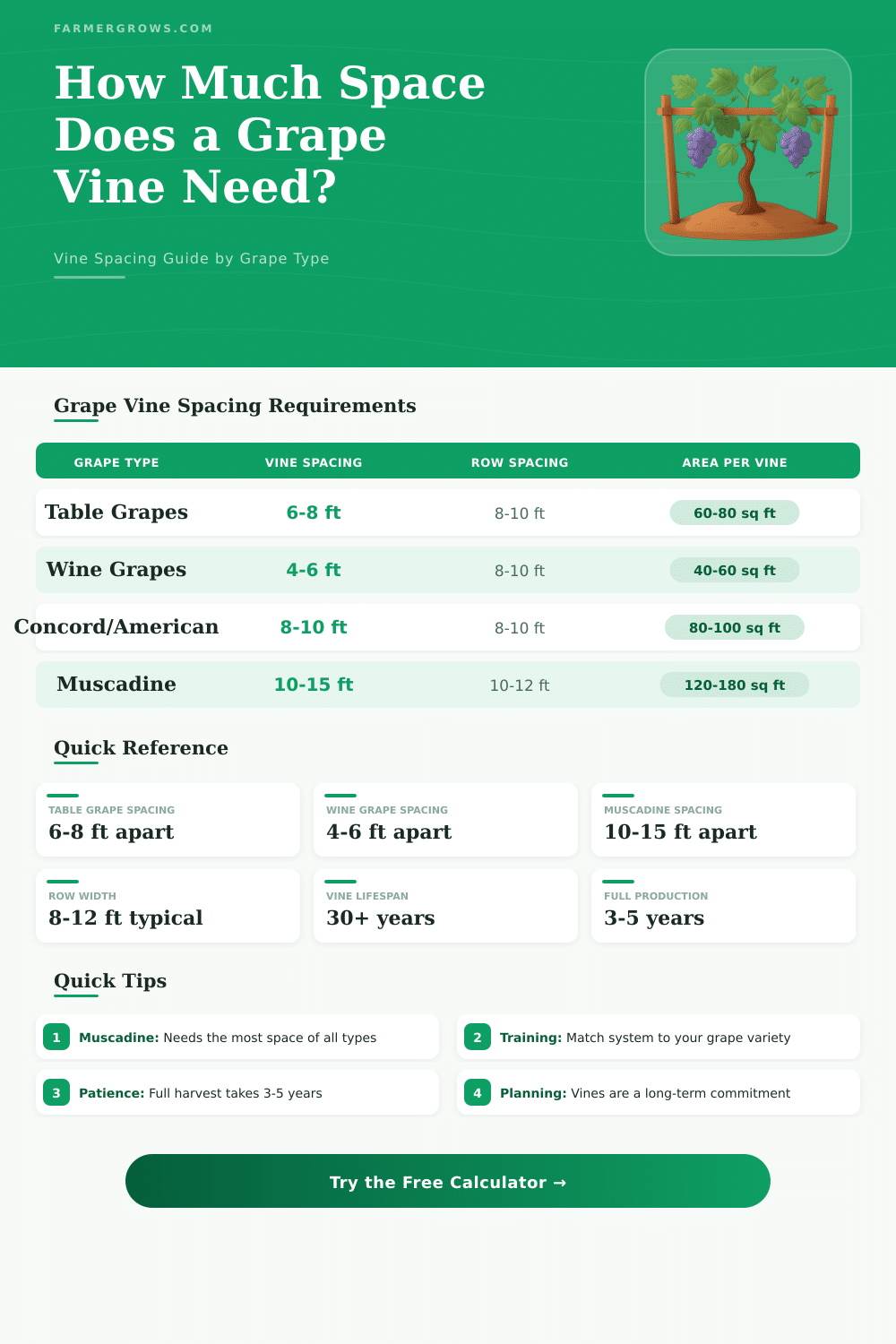
| Grape Type | Vine Spacing | Row Spacing | Area Per Vine |
|---|---|---|---|
| Table Grapes | 6–8 ft (1.8–2.4 m) | 8–10 ft (2.4–3 m) | 60–80 ft² |
| Wine Grapes | 4–6 ft (1.2–1.8 m) | 8–10 ft (2.4–3 m) | 40–60 ft² |
| Concord / American | 8–10 ft (2.4–3 m) | 8–10 ft (2.4–3 m) | 80–100 ft² |
| Muscadine | 10–15 ft (3–4.6 m) | 10–12 ft (3–3.7 m) | 120–180 ft² |
| Seedless Table | 6–8 ft (1.8–2.4 m) | 8–10 ft (2.4–3 m) | 60–80 ft² |
| Training System | Best For | Wire Height | Vine Spacing Along Row |
|---|---|---|---|
| Single Wire | Wine grapes, Concord | 5–6 ft (1.5–1.8 m) | Standard for type |
| Double Wire | Table grapes, vigorous vines | 3 ft + 6 ft (0.9 + 1.8 m) | Standard for type |
| Geneva Double Curtain | Vigorous wine grapes | 6 ft (1.8 m), 4 ft apart | Can reduce 10–15% |
| Arbor / Pergola | Table grapes, shade | 7–8 ft (2.1–2.4 m) | 4–6 ft along structure |
| Fence | Small gardens, borders | Fence height (4–6 ft) | Standard for type |
| Grape Type | Mature Canopy Spread | Yield Per Vine | Years to Full Production |
|---|---|---|---|
| Table Grapes | 6–8 ft (1.8–2.4 m) | 15–20 lbs (6.8–9 kg) | 3–4 years |
| Wine Grapes | 4–6 ft (1.2–1.8 m) | 8–12 lbs (3.6–5.4 kg) | 3–5 years |
| Concord / American | 8–10 ft (2.4–3 m) | 15–25 lbs (6.8–11.3 kg) | 3–4 years |
| Muscadine | 10–15 ft (3–4.6 m) | 20–40 lbs (9–18 kg) | 3–5 years |
| Seedless Table | 6–8 ft (1.8–2.4 m) | 15–20 lbs (6.8–9 kg) | 3–4 years |
| Area Size | Table Grape Vines | Wine Grape Vines | Expected Yield Range |
|---|---|---|---|
| 10 × 20 ft (3 × 6 m) | 2–3 | 3–5 | 30–80 lbs |
| 20 × 30 ft (6 × 9 m) | 6–8 | 8–15 | 90–250 lbs |
| 30 × 50 ft (9 × 15 m) | 15–20 | 20–35 | 225–550 lbs |
| 50 × 100 ft (15 × 30 m) | 50–70 | 80–125 | 750–2000 lbs |
| 100 × 200 ft (30 × 60 m) | 200–280 | 330–500 | 3000–8000 lbs |
| 1 acre (208 × 208 ft) | 450–600 | 700–1100 | 6750–17000 lbs |
| Grape Type | Training System | Vine Spacing | Row Spacing |
|---|---|---|---|
| Table Grapes | Double Wire | 6–8 ft | 8–10 ft |
| Table Grapes | Arbor / Pergola | 4–6 ft | Along structure |
| Wine Grapes | Single Wire | 4–6 ft | 8–10 ft |
| Wine Grapes | GDC | 4–5 ft | 8–10 ft |
| Concord | Single Wire | 8–10 ft | 8–10 ft |
| Concord | Fence | 8–10 ft | N/A |
| Muscadine | Single Wire | 10–15 ft | 10–12 ft |
| Muscadine | Arbor / Pergola | 10–12 ft | Along structure |
| Seedless Table | Double Wire | 6–8 ft | 8–10 ft |
| Seedless Table | Fence | 6–8 ft | N/A |
Choosing the right grape vine space is really important. One must consider some things, like the sunlight, the available place for growth, the strength of the soil and the right amount of plants for one acre. More vines require more effort.
The plants require enough grape vine space so that they do not feel cramped in something like a trellis.
How Far Apart to Plant Grape Vines
For most setups, one space vines 6 to 10 feet one from the other. Muscadines require 16 feet between every plant. Before the crop, it helps to soak the roots in water for two or three hours.
If one plants them beside a fence or pergola, European species stand 6 feet apart. American species and hybrids grow stonger, so they need 8 feet between plants.
A common mistake is to stand vines too closely one too the other. Plant them about 12 feet apart for a reliable solution. On a 50-foot trellis that allows only four plants.
Some vines require 6 feet between trellises, while others require 12 feet or even more. The production of vines ranges from half a ton each acre to 15 tons each acre, according to the layout.
The gap between rows depends on the kind of machines that one uses, and on the height at which one trains the vines. Practical advice says that the ratio between the height of vine and the gap should be about 1:1. So, if the plants reach 4 feet, the rows stand 4 feet apart.
Also one space the rows at least 3 feet wider than the widest tool in the vineyard. Tractors with front sprayers require at least 30 feet to turn at the end of rows.
One option for density of 3,000 to 4,000 plants each hectare is to set the rows 2 to 2.5 metres apart and the plants 1.25 to 1.35 metres inside them. Other popular layout means 8 feet inside rows and 10 feet between them.
In a strong vineyard, where the shoots grow more than 10 to 12 feet yearly, one space vines at least 6 to 8 feet. The rows should be as broad as the height of the vines. For places with low strength, VSP systems work well, using horizontal wires to fold the shoots in a vertical curtain of leaves.
Such areas handle dense crops well. Vines that one trains to one head, one prunes yearly, and they require separate grape vine space so that the shoots can spread without touching neighbours.
Too close planting of vines causes hard air flow, which forms the main problem. Usually one sets the rows north-south, so that both sides of the leaves receive equal sunshine through the day. The right grape vine space for planting depends on the place, the ground state, the species of grape and the type of wine that one makes.
A simple home trellis from posts and wires one should design with gapbetween rows equal to the height of a full grown vine.
For muscadine grapes one digs holes broad and deep at 0.6 metre, spaced 3 metres apart. Other species require holes of 1 metre in every direction. With good pruning even less grape vine space between vines can work well.