Glyphosate Herbicide Dosage Per Litre Calculator
Size glyphosate mix by litre, estimate total product volume, water volume, tank loads, and active ingredient totals for sample spray plans.
✅ Glyphosate Mix Results
| Formulation | Strength | Dose range | Notes |
|---|---|---|---|
| Light mix | 360 g/L | 5 mL/L | Spot jobs |
| Standard | 480 g/L | 6-10 mL/L | General use |
| Strong | 540 g/L | 10-12 mL/L | Brush work |
| High | 680-720 g/L | 3-6 mL/L | Compact mixes |
| Metric | Imperial | Result | Use |
|---|---|---|---|
| mL/ha | fl oz/acre | mL/L | Product ratio |
| L/ha | gal/acre | Water rate | Batch size |
| ha | acres | Area | Coverage |
| L | gal | Tank size | Refills |
| Job | Area | Mix volume | Note |
|---|---|---|---|
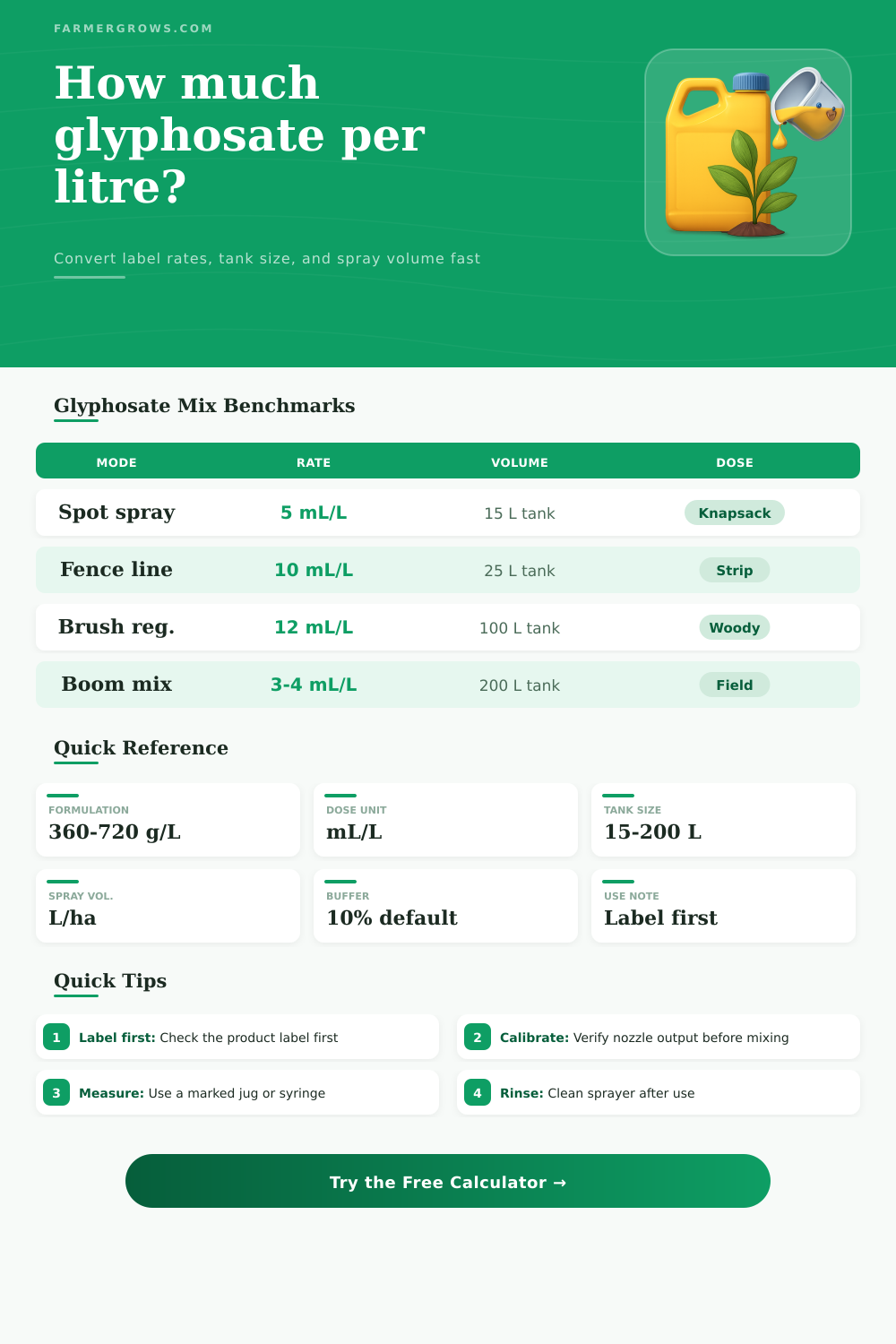
| Spot spray | Small patch | 5-15 L | Knapsack |
| Fence line | Narrow strip | 15-25 L | Hand spray |
| Orchard row | Long block | 50-200 L | Tank load |
| Boom spray | Field acres | 200+ L | Rig or ATV |
| Container | 5 mL/L | 10 mL/L | Notes |
|---|---|---|---|
| 500 mL | 100 L | 50 L | Small bottle |
| 1 L | 200 L | 100 L | Common bottle |
| 5 L | 1000 L | 500 L | Bulk jug |
| 10 L | 2000 L | 1000 L | Large pack |
Glyphosate is an herbicide that works by stopping a synthesis of proteins in weeds. To use glyphosate, you has to determine the proper amount of glyphosate to add to a specific amount of water. Using too little glyphosate wont kill the weed.
Using too much glyphosate will waste the herbicide and may damage nearby crop. To calculate the proper amount of glyphosate to add to water, you need to understand the relationship between the concentration of the glyphosate and the total amount of water to be use. The concentration of glyphosate is often measured in milliliters of glyphosate per liter of water.
How to Mix and Use Glyphosate
The label on glyphosate containers will indicate the amount of glyphosate in milliliters per liter of water. However, these label will not always indicate the total amount of glyphosate that is needed for a specific area. The type of weed that is to be treated will determine the amount of glyphosate per liter of water that are used.
For example, young grasses might only require 5 milliliter of glyphosate per liter of water. Woody plant and thick regrowth may require 10 or 12 milliliters of glyphosate per liter of water. Therefore, the type of plant that is to be treated will determine the concentration of glyphosate that is use.
The volume of water that is used will impact the total area that is treat with glyphosate. Using a high concentration of glyphosate will allow for few liters of the glyphosate solution to treat an area. Using a low concentration will require more water to treat an area.
For instance, a sprayer with a 15-liter capacity can treat small areas with glyphosate. However, using such a sprayer will require many refills to treat a large area. For large field, a sprayer with a 200-liter tank might be used.
The size of the field will impact the total amount of glyphosate and water that will be needed to treat that field. Glyphosate products has a total amount of active ingredient that is manufactured. Glyphosate products are sold with specific strength, such as 480 grams of active ingredient per liter of glyphosate solution.
Using 10 milliliters of glyphosate per liter of water will introduce 4.8 grams of active ingredient into the water. Using many liters of this solution will introduce a large amount of active ingredient in the weeds. Therefore, the total kilogram of glyphosate active ingredient will need to be purchased to treat the area that is to be treat.
Sprayers often make errors when applying glyphosate and water mix solutions. For instance, the nozzle on the sprayer may not be correctly calibrate to the total volume of the tank. If the nozzles output the wrong amount of water, then the concentration of glyphosate will be incorrect.
Thus, prior to using the glyphosate solution, calibrate the sprayer. Additionally, read the glyphosate product label instructions careful. Glyphosate products contain legal requirements that will impact the growth of the treated plants.
For instance, the label may state that glyphosate should of be withheld from certain plants for specific period of time. The time of glyphosate application can have an impact on the success of the glyphosate. Glyphosate works best on plants that are actively growing.
Glyphosate may be applied during specific stage of the plant’s growth cycle. Weather condition will also impact glyphosate success. For instance, if glyphosate is applied to plants after a period of rain, the glyphosate may be washed from the plants before it can be absorb by the plants.
Additionally, glyphosate may volatilize (turn to gas) on hot day before it can be absorb by the plants. Glyphosate must be mix with water in a specific order to ensure that the concentration of glyphosate is correct. First, fill the sprayer to the halfway mark with water.
Agitate the water in the sprayer. Add the glyphosate slow to the water. Fill the remainder of the sprayer with water.
Glyphosate can be measured with syringe and jug to ensure that the proper amount is add to the water. Finally, after the glyphosate has been used to treat the weeds, the sprayer should be clean. Glyphosate crystals may build up in the sprayer and the nozzles may become clogged if the sprayer is not thoroughly clean after its use.