
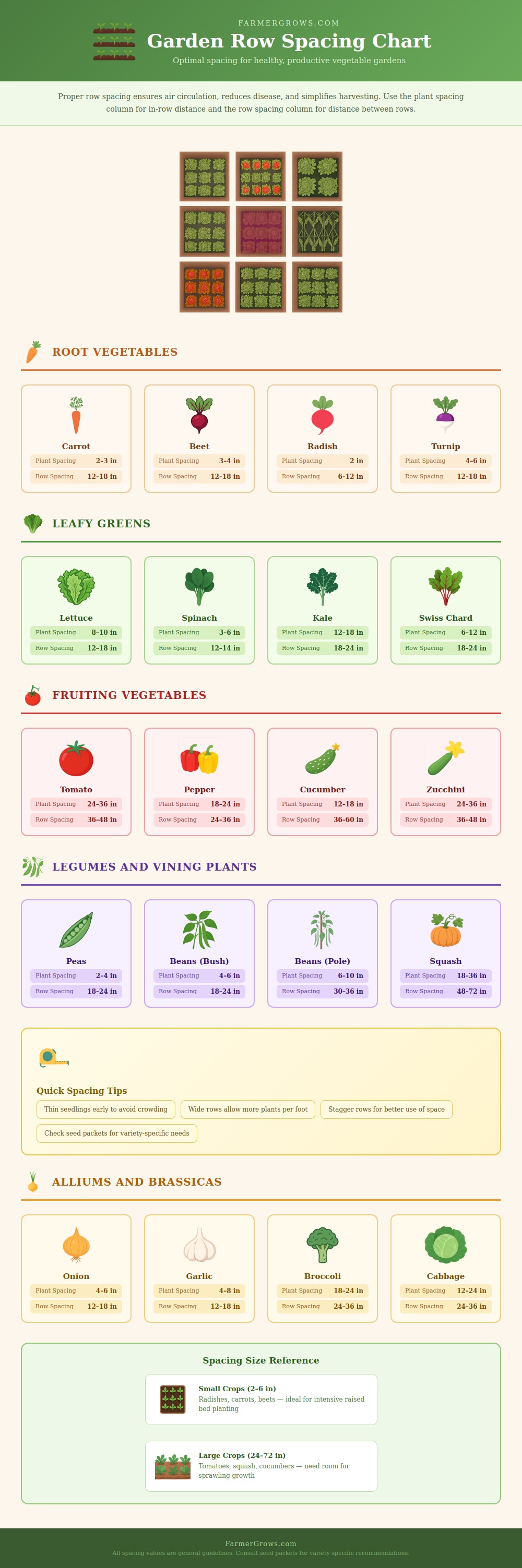
Garden row spacing is about how much space to leave between rows of plants. The fast answer for how far apart to space garden rows is it depends. Many plans for vegetable garden layouts exist, and there are various ways to arrange vegetables in a garden.
In traditional market garden spacing is 30 inches for produce and 18 inches for walkways. Some growers make walkways 12 inches, while others set rows 4 feet apart to fit a tractor. For many crops as beans, corn, tomatoes, eggplant, peppers, okra, peas and squash, 36-inch row spacing is best.
How Far to Space Garden Rows and Plants
Instructions for sowing almost always require bigger row spacing than plant spacing. Seed packets commonly say: “12 inches between plants, 30 inches between rows.” The row spacing is based on the height of plants, so that sun reaches them well in large rows. That also eases farming, as adding fertilizer or mulch.
Plants have more room to grow, compete less for light and nutrients from soil. Good air flow maters likewise.
Row spacing is really useful in big farming, where machines must enter between them for weeding. In a garden rows are not always needed, if you reach all parts of the beds. Planting in rows assumes the need to walk between them.
One good method is 30-inch rows with 12 to 18-inch paths, which allows you to straddle the row instead of reaching from the sides. This lets a garden cart enter easily for picking or spreading compost.
In raised beds only the spacing between plants matters. It must be equal around every side. For instance, for onions with a label “8 inches between plants”, leave 8 inches of space everywhere.
Square foot gardening ignores traditional rules, vegetables grow much more closely to one another.
Root crops as carrots, beets and radishes require wider rows, usually 18 to 24 inches, for their roots. Winter squash requires 24 to 36 inches between plants and 60 to 72 inches between rows. Trellised cucumbers do fine in a 12-inch bed, but ground or bush types want a 3 to 4 feet wide bed.
Grouping crops by height helps: tall plants as tomatoes north, medium as peppers in the middle, and low fast crops as greens along the south edge. Extra spaces fill with valuable minis as lettuce, basil or scallions. Many gardeners initially crowd everything, but with experience they leave more roombetween plants.