Planting Calculator
Estimate how many rows, planting stations, seeds, transplants, and expected plants fit in a garden bed, raised bed block, field strip, or custom plot area.
Use this planner for vegetable spacing and seed ordering before you plant. Adjust for your variety, equipment, paths, trellis style, and local extension recommendations.
Tight plant spacing and frequent succession planting.
High seed count, lower germination, and careful thinning.
Few plants per area, usually started as transplants.
Needs row blocks for pollination and wind support.
Good for repeat sowings and short harvest windows.
Planting Plan Results
Spacing, germination, and succession plan are ready.
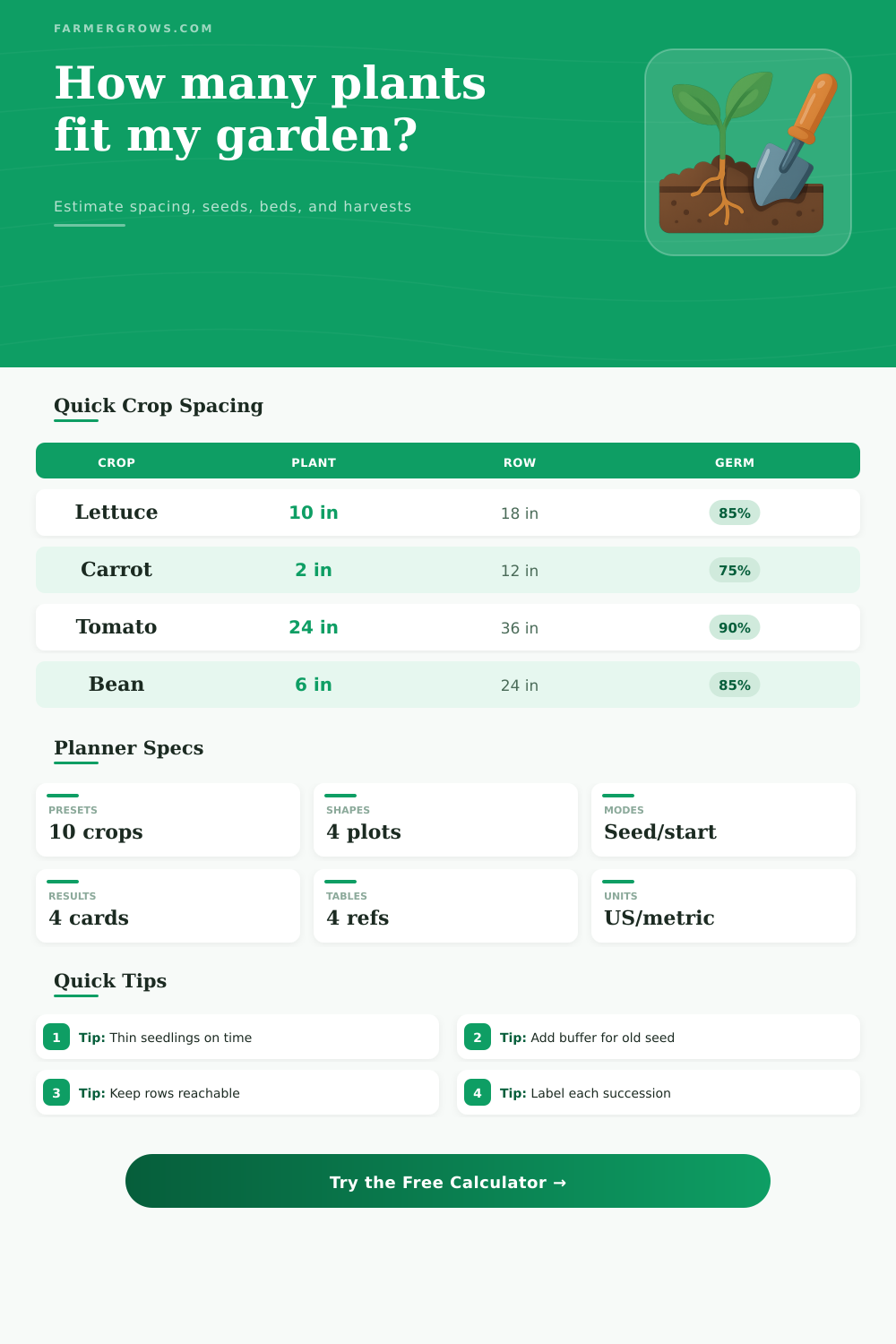
| Crop | In-row spacing | Dense option | Planning note |
|---|---|---|---|
| Lettuce | 8 to 12 in | 6 in baby leaf | Closer spacing gives smaller heads and faster turnover. |
| Carrot | 1.5 to 3 in | 1 in baby carrot | Seed heavier, then thin to final stand. |
| Tomato | 18 to 30 in | 18 in trellised | Pruning and trellis style decide usable spacing. |
| Bean | 4 to 8 in | 4 in small bush | Repeat sowing often matters more than one large block. |
| Use case | Row spacing | Rows per 48 in bed | Best fit |
|---|---|---|---|
| Intensive greens | 6 to 12 in | 4 to 7 rows | Hand weeding, drip tape, and cut-and-come-again crops. |
| Roots and onions | 10 to 15 in | 3 to 4 rows | Dense beds with easy thinning and harvest access. |
| Medium vegetables | 18 to 24 in | 2 to 3 rows | Kale, peppers, beans, and compact brassicas. |
| Large or trellised | 30 to 48 in | 1 row | Tomatoes, cucumbers, squash, and staked crops. |
| Seed age or crop | Typical germination | Buffer idea | Planner adjustment |
|---|---|---|---|
| Fresh lettuce or bean seed | 80% to 95% | 5% to 10% | Normal seed order, thin extras early. |
| Carrot or parsnip seed | 55% to 80% | 15% to 30% | Use higher seed count and keep seedbed moist. |
| Older stored seed | 40% to 75% | 25% to 50% | Run a towel test before relying on the packet. |
| Transplant trays | 85% to 95% | 5% to 15% | Start a few extras for gaps and culls. |
| Crop group | Start before transplant | Harden off | Field note |
|---|---|---|---|
| Tomato and pepper | 6 to 8 weeks | 7 to 10 days | Set out after frost risk and cold soil pass. |
| Kale and brassicas | 4 to 6 weeks | 5 to 7 days | Good for spring or fall plantings. |
| Lettuce and greens | 3 to 4 weeks | 3 to 5 days | Transplant small for less shock. |
| Cucumber and squash | 2 to 4 weeks | 3 to 5 days | Avoid root-bound plants; direct seed also works. |
Spacing tip: Use the final crop size, not the seed size. Tight plant spacing can work for baby greens, but fruiting crops need airflow and harvest room.
Seed tip: Germination changes with seed age, soil temperature, and moisture. For old seed, test a small batch or raise the buffer before ordering.
Plant spacing are used to arrange the plants in a garden to allow each plant to grow. If the plants is placed too close together, then the plants will compete for light and waters. If the plants are placed too far apart from one another, then the soil will be wasted and time will be wasted in the gardening process.
Many individual has experienced problems with either overcrowded plants or empty spaces within there garden plots. Using a calculator to determine the proper spacing for each type of plant will allow individuals to plan there gardens more effective. The calculator require several pieces of information from the individual to calculate the proper plant spacing for that individuals garden plot.
How to Space Plants in Your Garden
The dimension of the plot to be designated as a garden, the spacing between the rows within the garden, the spacing between each individual plant within the rows, the germination rate of the seeds to be planted, and the growing season for those plants must all be entered into the calculator. The dimensions of the plot determines the total area that will be dedicated to the garden, but the area that can actualy be used for gardening may be less than the total area of the plot. The area that must be accounted for includes paths in the garden, the posts for trellises, and the edge of the garden plot itself.
The path loss adjustment can ensure that individuals dont purchase vegetable seeds for ground that they plan on use for gardening but which they cant actualy use for planting purposes. Two different measurement must be accounted for within the garden plan: the spacing between the rows within the garden plot (row spacing), and the spacing between each individual plant within each row (in-row spacing). The row spacing will allow for movement within the garden plot, weeding of plants that encroach on other plants, and watering of each row of plants.
The in-row spacing will provide each plant with the required area for growth. For instance, lettuce plants can be spaced closer together than plants like tomatoes, which require more room for airflow between plants and for their fruit to develop properly. Each of these variable can be adjusted within the calculator instead of the individual performing the calculations required to determine these variables.
The germination rate of the seeds is another important variable within the garden plan. Seeds do not always germinate and grow at the same rate; the germination rate of those seeds can change with the age of the seeds. An age related decline in the germination rate of the seeds may lead to empty plots within the garden; thus, a buffer in the amount of seeds to be planted will ensure that the deficiency in germination are accounted for within the garden plan.
Additionally, using a buffer for the amount of seeds to be planted will account for instances where some of the planted seedlings may die after being transplanted to there planting areas within the garden. Succession planting within the garden allow for individuals to plant vegetable seeds at different times throughout the growing season. The calculator can determine the number of different rounds of succession planting within the garden that can occur during that growing season.
This is beneficial for vegetables with relatively short growing seasons, such as spinach or beans. For instance, if an individual plants all of there spinach at once, they may have too much spinach at one time and none at any time after the initial planting. By spacing the planting of spinach in different areas of the garden with even round planting schedule, the individual will have spinach throughout the growing season.
The reference table provide an estimate of the seed spacing that is typical for vegetables. These measurements is guidelines only, however, as various factor will impact the actual spacing that is required for each type of plant to grow properly. Factors that may impact the spacing that is required for each type of plant include soil quality, irrigation methods, and the specific type of plant that will be grown in each area.
For instance, an area with drip irrigation may allow for plants to be spaced closer together than in an area where the irrigation methods is sprinklers. The spacing calculator cannot account for each of these specific factor, but the plan that is created will ensure that the individual does not make basic planting error that could lead to underplanting or overplanting of the seeds. The calculator will produce a plan that provides an estimate of the number of plants that should be planted, as well as the spacing between each of those plant.
However, the calculator cannot predict how each of those plants will behave once they are planted into the ground. For instance, if carrots are thinned too late in there growing season, those carrots will remain small. If tomato plants are given too little space within the garden plot, the plants may produce fewer fruit than those plants could of potentially produced.
Thus, each individual must monitor the growth of each area within the garden plot. The plan that is created with the spacing calculator prior to the purchase of the plants will force each individual to consider each aspect of the growing season in relation to the type of plant that will be grown in the garden. Thus, each individual will be able to manage there garden and its different areas more effective than if they did not create a plan with the calculator.