Drainage Calculator for French Drains and Yard Runoff
Estimate area, depth, volume, bags, and weight for drainage trenches, swales, and low spots before you buy material.
📌Quick Presets
⚒Calculator Inputs
Drainage results
Calculation breakdown
🌱Material Weight Grid
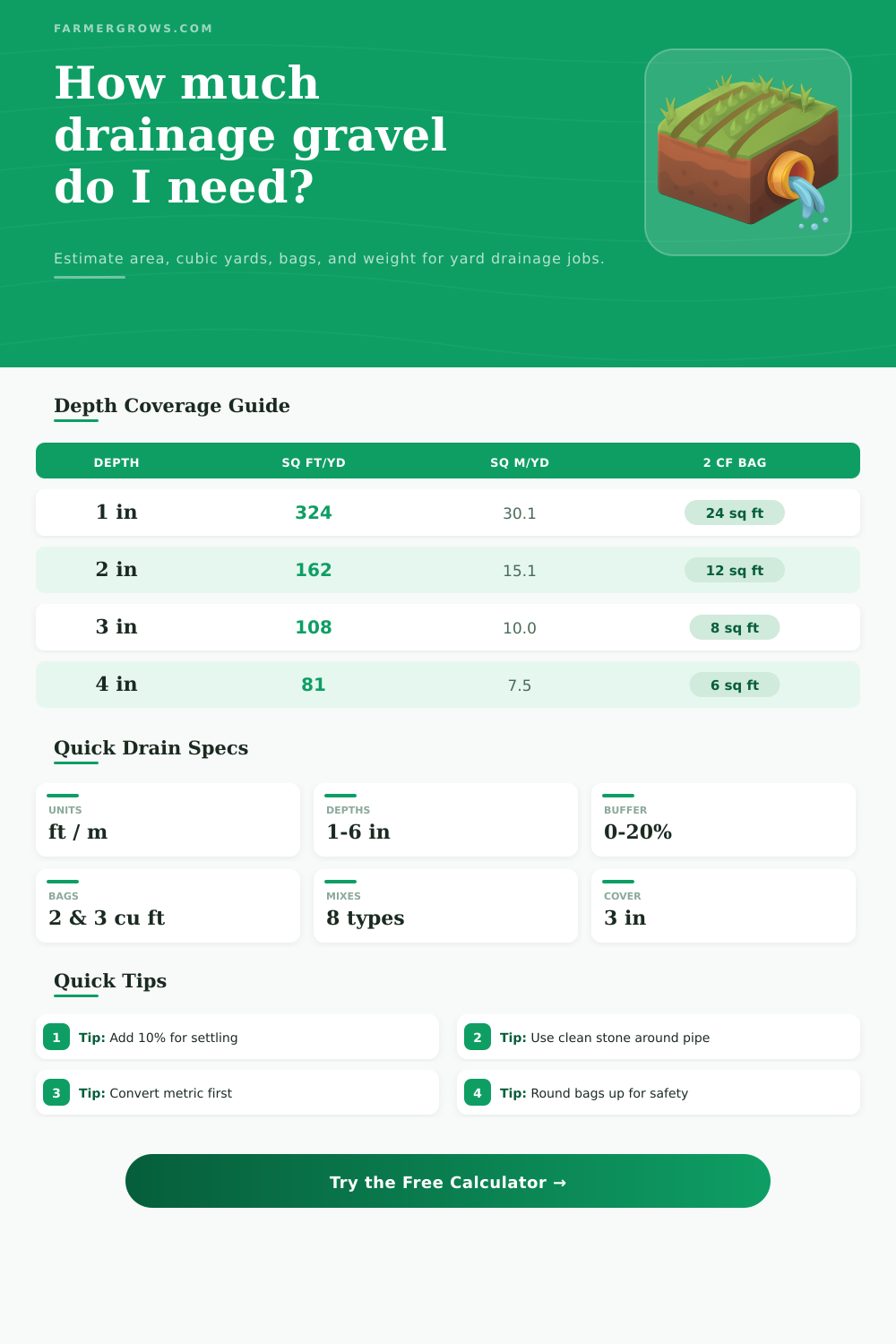
| Depth | Sq ft per yd | Sq m per yd | 2 cf bag |
|---|---|---|---|
| 1 in | 324 | 30.1 | 24 sq ft |
| 2 in | 162 | 15.1 | 12 sq ft |
| 3 in | 108 | 10.0 | 8 sq ft |
| 4 in | 81 | 7.5 | 6 sq ft |
| 6 in | 54 | 5.0 | 4 sq ft |
| Bag type | Volume | Bags per yd | 3 in cover |
|---|---|---|---|
| 2 cu ft bag | 2 cu ft | 13.5 | 8 sq ft |
| 3 cu ft bag | 3 cu ft | 9.0 | 12 sq ft |
| Bulk yard | 27 cu ft | 1.0 | 108 sq ft |
| Half yard | 13.5 cu ft | 2.0 | 54 sq ft |
| Drainage project | Typical area | 3 in yards | 2 cu ft bags |
|---|---|---|---|
| House perimeter strip | 24 x 4 ft | 0.98 | 14 |
| Downspout run | 30 x 3 ft | 0.92 | 13 |
| Window well pad | 8 x 6 ft | 0.33 | 5 |
| Low spot basin | 12 ft dia | 0.98 | 14 |
| Material | Low lb/yd | High lb/yd | Best use |
|---|---|---|---|
| Washed drain rock | 2450 | 2950 | French drains |
| 3/4 in crushed stone | 2600 | 3100 | Firm trench fill |
| Pea gravel | 2400 | 2900 | Bedding layer |
| Coarse sand | 2600 | 3200 | Filter and backfill |
Use clean, washed stone around perforated pipe so fines do not clog the drain.
Add 10% to 20% for compaction, uneven trench bottoms, and cleanup waste.
Poor drainage in the yard can cause a variety of problems for a homeowner. For instance, poor drainage can lead to the ground turning into mud, or it can lead to water leaking into the basement or creating cracks in the foundation. In each of these instances, digging trenches, laying pipe, and adding gravel is one method of fixing the drainage problem.
In order to lay the gravel in the trench created by the homeowner, the individual must purchase the correct amounts of gravel to accomplish the drainage project. If the individual buys too little gravel for the trench, then they will have to make extra trips to purchase the remaining amount of gravel required to fill the trench. However, buying too much gravel will lead to having extra gravel that must sit in the driveways.
How Much Gravel Do You Need for a Yard Drain
A French drain is a type of drainage system that allows the water to flow away from an area prior to allowing the water to pool. A French drain consists of a perforated pipe that is covered in fabric and is buried in gravel. The gravel allow water to enter the pipe, yet the fabric of the pipe prevents the soil from entering the pipe.
The depth of the gravel is also important; shallow gravel beds will allow water to move more slowly through the drainage system, but deeper gravel beds can handle more water. In most cases, you will require three to four inches of gravel around the pipe. Additionally, the gardener will cover the gravel with soil to allow the grass to grow.
Options for gravel include the use of either washed drain rock or pea gravel. Using washed drain rock is one of the best options because washed drain rock does not contain fines that will pack against the gravel; fines tend to pack against gravel and make the gravel unable to remain open. Additionally, pea gravel is another option for the gravel, but pea gravel may shift underfoot.
The shape of the drainage system will also impact the amount of gravel that is required for the drainage system. For instance, trenches that are straight and run along the foundation may contain less gravel than those that are curved or triangular in shape. For example, a puddle that is twelve feet in diameter may require nearly one yard of gravel if the gravel is four inches deep.
In addition to purchasing enough gravel for the system, there should of an overage of gravel purchased for the drainage system. Ten to twenty percent more gravel should be purchased than is calculated for the project; trenches may not be flat when dug, and gravel will settle within the trench by five to ten percent of the amount of gravel initially added to the trench. The weight of the gravel for the drainage system is another consideration prior to purchasing gravel.
One cubic yard of crushed stone weighs approximately three thousand pounds. The weight of gravel is important to consider in that if the area in which the drainage system will be built does not permit the heavy trucks that may be required to transport the gravel to the project site, then a wheelbarrow will be required to move the gravel. The stone that is used in the drainage bed should weigh more than two thousand pounds per yard of gravel because heavy stone will compact without becoming spongy.
For small drainage projects, you can purchase bags of gravel. Bags of gravel that are two cubic feet in size will cover eight square feet of area if the depth of the gravel is three inches. Additionally, one cubic yard of gravel will cover one hundred eight square feet of area if the depth of the gravel is three inches because there are twenty-seven cubic feet in one cubic yard.
There are various mistakes that can be made when installing a drainage system. For instance, adding too much soil to the trench too early in the drainage system installation will prevent water from passing through the gravel. Another mistake is to lay the pipe too deep into the ground without providing a slope for the pipe.
Providing a slope allows the water to be drained away from the area using the force of gravity. A slope of one inch of drop for every ten feet of pipe is the recommended slope. Providing cleanouts at the end of the drainage pipe will allow the debris to be flushed out of the pipe once a year.
Additionally, placing a fabric sock around the drainage pipe will prevent sand from entering the pipe and potentially causing the gravel to get clog. The type of soil in the yard will also impact the creation of a drainage system. For instance, clay soil is difficult to drainage; clay soil tends to swell when wet.
In these cases, the depth of the trench may have to be doubled or sand layers may have to be added to the trench. To test the soil in the yard, simply dig a hole in the ground and fill the hole with water. If the water drains at a rate of slower than one inch per hour, then the soil in that location is difficult to drain.
By installing a drainage system in the yard, the homeowner will prevent erosion and help to protect the foundation of the home. Additionally, the drainage system can prevent the neighbors water from entering the yard. Finally, in many areas, a permit is required for drainage systems near the foundation or near the street.