
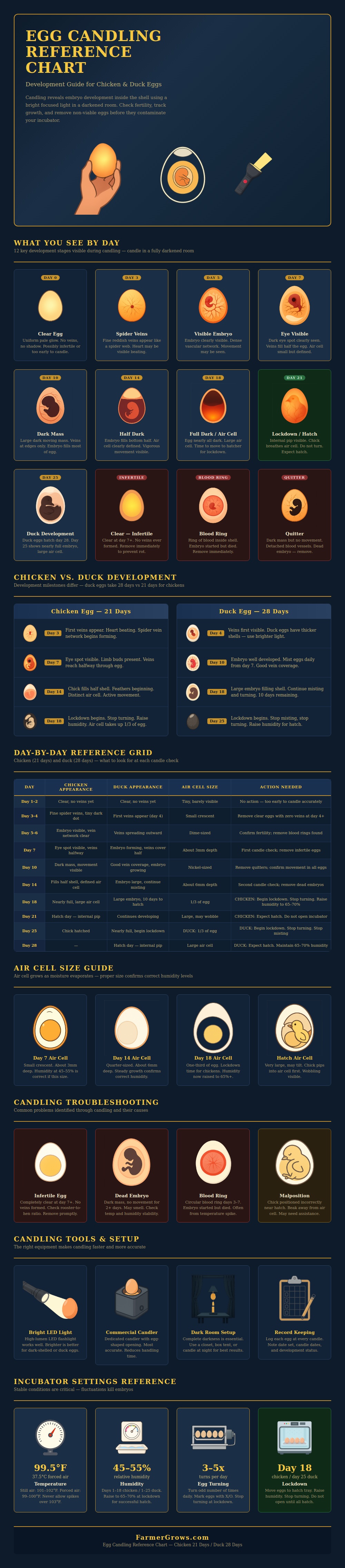
Candling are a process that allows for the inspection of the interior of an egg using bright light. Candling allows for the person to observe the growth of an embryo within the eggshells. To candle an egg, the person holds the egg against a bright light source in a darkened room.
The eggshell become translucent when the egg is held against the light, allowing the person to view the contents of the shell. The purpose for candling eggs is to allow the person to identify which egg are fertile and which eggs are instead becoming rotten and infertile. Should an infertile egg begin to rot within the incubator, that rotten egg may impact the health of the other egg within the incubator.
How to Candle Eggs and Check Embryo Growth
Thus, the person should remove the infertile eggs from the incubator. The embryo within the egg change over time due to the growth of the embryo. At three days of incubation, the person can see small red line that appear within the eggshell, which are the first blood vessel of the embryo.
At five days of incubation, the embryo has developed into a small shape that appears to move within the blood vessels within the eggshell. By seven days of incubation, the embryo has developed an eye spot and more blood vessel that fill more of the eggshell. By ten days of incubation, the embryo has developed into a dark mass that fills a large portion of the eggshell.
Finally, at fourteen days of incubation, the bottom of the eggshell appear dark, and the air pocket within the egg become visible. An air pocket form within the eggshell. The size of the air pocket allows for information to be obtained regarding the moisture levels within the incubator.
Initially, the air pocket is a small crescent shape within the egg. However, as the embryo consumes the moisture within the egg, the air pocket expand in size. If the air cell is too small, it may indicate that the humidity within the incubator is too high for the embryo, and the embryo may drown.
However, if the air cell is too large, this may indicate that the humidity in the incubator is too low, and the embryo may become dehydrated. Thus, observing the size of the air cell will allow the incubator to maintain the proper humidity for the embryo. There are different types of egg failure that can be identified through candling.
For instance, if the egg remains clear after one week of incubation, the person determines the egg to be infertile. Another instance of failure is if the egg feature a dark ring of blood within the interior of the eggshell; these are known as blood rings. Blood rings indicate that the embryo has died within the eggshell.
Additionally, if the embryo features a dark mass within the egg that does not exhibit any movement within the eggshell, then the embryo has experienced a stall in its developmental process; it should be removed from the incubator. By removing these failed eggs from the incubator, the bacteria that may develop within those eggs will not impact the healthy eggs. Each species of bird require different lengths of incubation to allow for embryonic development.
For instance, chicken eggs require twenty-one days of incubation to hatch the chick, but duck eggs require twenty-eight days of incubation. Additionally, duck eggs are thicker than chicken eggs, so a brighter light is required to candle duck eggs. Additionally, the blood vessels within duck eggs develop later than chicken blood vessels, and the lockdown period for duck eggs occurs around day twenty-five.
Thus, each species of bird requires a different length of incubation; there is no one set schedule for all types of eggs. In order to candle the eggs, the person will use a flashlight or a candler in the dark. Additionally, the person is to hold the egg in their hand against the light and rotate slowly to allow for even inspection of the egg.
Any eggs that are candled should be marked with an “X” or an “O” to indicate to the incubator manager that the egg has been candled. Additionally, candling should be logged each time it is performed. During incubation, the temperature of the incubator should be maintained at ninety-nine-point-five degrees Fahrenheit, and the humidity should be between forty-five and fifty-five percent until the lockdown period.
Additionally, the person should turn the eggs three to five times each day; an odd number of candler rotations each day to ensure that the embryo does not become sleep on its side. There are a few common mistake regarding incubation. For instance, candling the eggs too early; when candled too early, the fresh eggs may be confused with dead eggs.
Additionally, any leaks of light into the room may interfere with candling. Furthermore, the fluctuations in temperature within the incubator may result in the formation of blood rings within the eggs, or the embryos may stall in their developmental process. Thus, any person incubating eggs should maintain a steady temperature and humidity within the incubator.
Additionally, there may be malpositioning of the embryo; the beak of the embryo may be pointing in the wrong direction. However, unless the embryo is stalled in its development, the beak should not be redirected.