Salt Spreader Calculator
Estimate salt settings, load, coverage, and calibration targets for winter spreaders with a clean starting point.
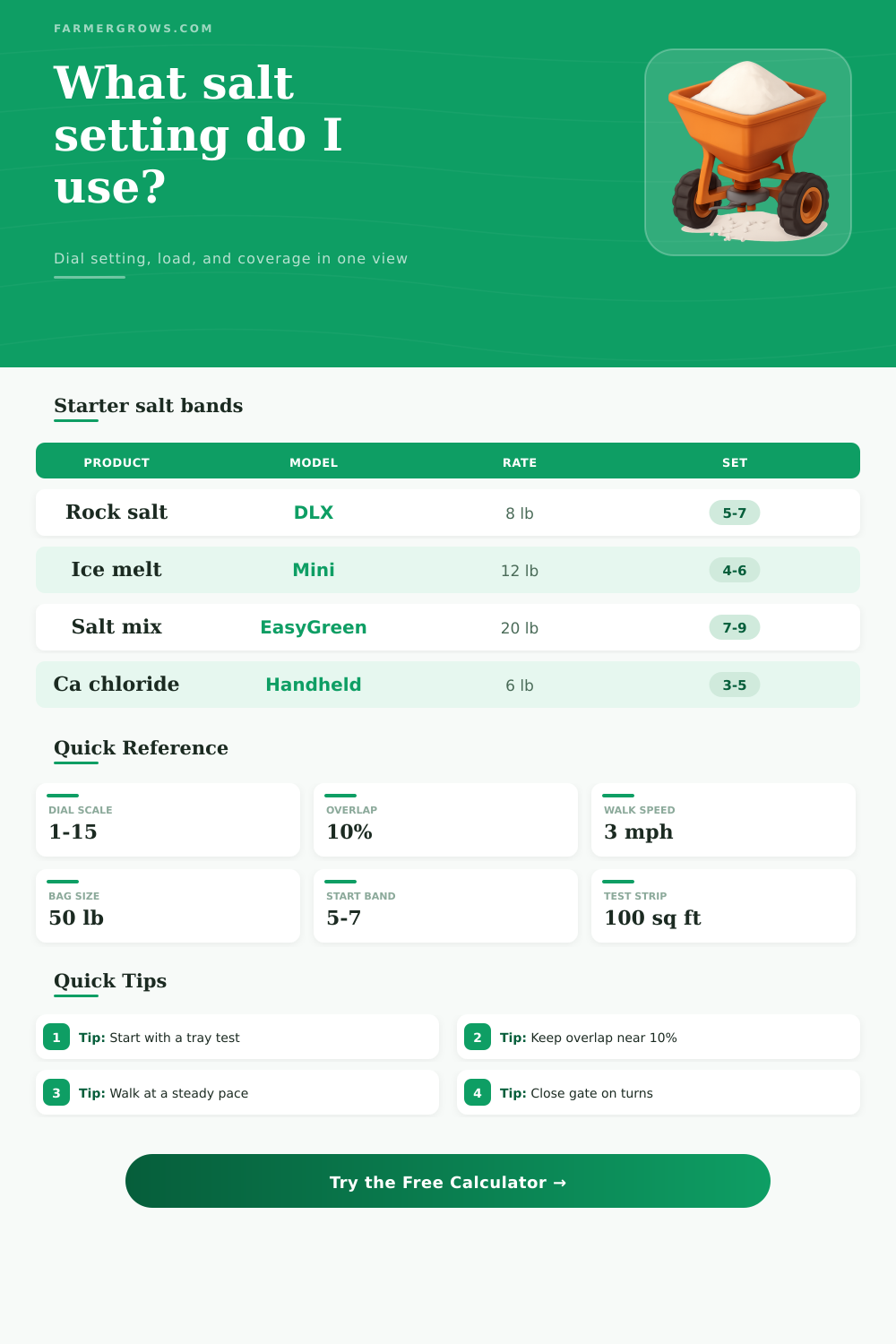
| Product | Model | Rate | Start |
|---|---|---|---|
| Rock salt | DLX | 8 lb | 5-7 |
| Ice melt | Mini | 12 lb | 4-6 |
| Salt mix | EasyGreen | 20 lb | 7-9 |
| Calcium chloride | Handheld | 6 lb | 3-5 |
| Rate | 50 lb bag | 25 kg bag | Use |
|---|---|---|---|
| 8 lb | 6250 | 3080 | Rock salt |
| 10 lb | 5000 | 2469 | Light ice |
| 12 lb | 4167 | 2057 | Ice melt |
| 20 lb | 2500 | 1235 | Salt mix |
| Strip | Target load | Use | Action |
|---|---|---|---|
| 100 sq ft | 0.8 lb | Quick check | One pass |
| 250 sq ft | 2.0 lb | Small walk | Weigh out |
| 500 sq ft | 4.0 lb | Driveway | Check band |
| 1000 sq ft | 8.0 lb | Full test | Set dial |
| Job | Area | Rate | Bags |
|---|---|---|---|
| Entry walk | 1500 | 8 lb | 0.2 |
| Driveway | 5000 | 8 lb | 0.8 |
| Sidewalk | 8000 | 10 lb | 1.6 |
| Parking lot | 43560 | 8 lb | 7.0 |
Run a short tray test on concrete or tarp, then nudge the dial up or down until the spread matches the target rate.
Keep your walking speed steady, overlap about 10 percent, and close the gate before turning at the edge of the driveway.
To use a spreader correctly, a person must understand how the spreader distribute granules. The spreader will distribute granules based on the opening of the spreader gate, the walking speed of a person, and the flow of the material that come out of the spreader. Because different materials will have different rates of flowing out of a spreader, the spreader dial must be adjusted for each type of material.
Rock salt is a dense material that will tumble in a specific way when poured into a spreader. Ice melt is a flaky material that will cling to the spreader more then rock salt. If a person walks too fast with the spreader, the coverage of the rock salt will be thin.
How to Use a Salt Spreader Correctly
If passes is overlapped incorrectly, the salt will create streaks or mounds on the ground. To use a spreader correctly, a person must also determine the target rate for the de-icer. The target rate is the amount of pounds of de-icer that are required for every thousand square feet of area that needs to be treated.
The target rate for salt is important to know because it reflects the amount of salt that is required for ice below the freezing point to melt. For instance, if the ice that need to be treated is packed with snow, more salt is required than if the snow is fresh. Eight pounds of rock salt per thousand square feet are the standard rate for treating a driveway.
The type of spreader also affects the amount of salt that should be applied with the spreader. A compact spreader will throw less salt in a specific area than a rotary spreader that has a wide opening. The walking speed of a person is a variable that will affect the even application of salt from the spreader.
A person should walk at a steady speed with the spreader. Walking too fast can reduce the amount of salt that come out of the spreader by fifteen percent or more. In this case, a person will have to adjust the dial of the spreader to compensate for walking too quick.
Walking slowly will result in the spreader distributing more salt to a specific area. A person will also have to consider the width of the spreaders band. A person should overlap each pass by ten percent to ensure that each area is covered in salt.
To use a spreader correctly, a person must first calculate the total area of the surface that will be treated with salt. To calculate the area of a rectangular surface, multiply the length of the surface by the width of the spreader. If the surface to be treated is in the form of a triangle, the individual must multiply the base of that triangle by its height, then divide that number by two to determine the total area in square footage.
Once the area in square footage is known, the total weight of salt that is needed to treat that area can be calculated by using the target rate. For instance, if the area to be treated is 5,000 square feet in area and the target rate is 8 pounds of salt for every thousand square feet of treatment area, then the total amount of salt that is required will be 40 pounds of salt. Since most bags of salt contains 50 pounds of salt, one bag will be required to treat the 5,000-square-foot driveway.
A tray test can be used to ensure that the spreader dial is correctly set to the amount of salt that will be applied to the treatment area. Using a scoop, a person can scoop a measured amount of salt (such as two pound). Using the spreader at a normal rate, the salt can be spread over a small area.
After spreading the salt, the salt that landed on the treated area can be weighed. If the weight is too light, the spreader dial should be increased; if the weight is too heavy, the spreader dial should be decreased. Tray tests can be performed on concretes or tarps, since the tarps permit the salt granules to be swept up for reuse.
The type of product that is used will affect the setting of the spreader dial. Rock salt is a dense product that is relatively inexpensive. However, it may become tracked into indoor areas if not rinsed away.
Ice melt products are lighter in weight than rock salt but begin to work quickly when the temperatures are relatively cold. Ice melt products are more expensive than rock salt. Calcium chloride products work by drawing moisture from the air.
However, it is potentially corrosive to treated concrete if too much is used. Finally, salt mixes that contain sand for traction will require a higher setting on the spreader dial because the sand creates a thick consistency to the mixture. Environmental factor will also impact the way in which the spreader is used.
For instance, if the area to be treated has alot of wind, lighter products will be blown away from the treatment area. Rock salt can be less affected by the wind. If the area contains fresh snow, it may conceal ice under the snow.
Using the salt in these cases may result in insufficient salt being placed on ice. Additionally, salt will run off the treatment area into the environment. Careful application methods must be utilized to minimize the salt that runs off the treated areas.
Using precise application methods will ensure that the area is made safe from ice without creating excessive salt runoff from the treated area.