
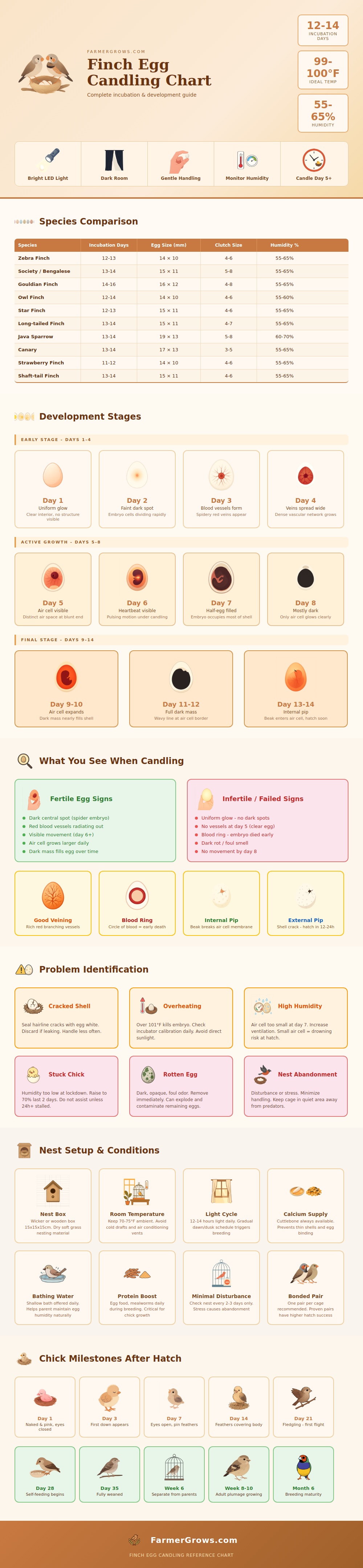
To candole an egg means to hold the egg up to a bright light in the dark room to see the embryo inside the egg shell. Candling allow for individuals to see the embryo develop from a small speck in the egg to a fully formed bird embryo. Furthermore, candling can help individuals to determine if the eggs is fertile or infertile, as well as if the embryo has died.
Finch eggs require warmth and moisture level to be maintained for the embryo to develop proper. If the temperature in which the eggs are incubated is too high, the high temperature will cook the embryo. If the temperature is too low, the embryo’s development will stall.
How to Candle and Care for Finch Eggs
Humidity is also important to maintain at the proper levels; if the humidity levels are too low, the embryo may become stuck in a membrane within the egg. Too much of humidity levels will cause the air cell within the egg to remain small, which can prevent the chick from properly exiting the egg when its ready. Day five is when you will first notice the sign of life within the fertilized egg during candling.
At five days old, you can see a dark spot within the egg with thin red lines emanating from the center of the spot; these is blood vessels that are building a life support system for the chicken embryo. By day six, the embryo has developed a heartbeat that you can see pulsing within the egg during candling. Furthermore, by day six, the embryo has filled most of the egg, leaving only a bright air cell at one end of the egg.
If the air cell is not expanding and the blood vessels has disappeared from the egg, the embryo has died; in this case, you should remove the embryo from the clutch so that it does not affect the development of the healthy egg in the clutch. The length of time to incubate finch eggs varies depending on the species of finch. For example, zebra finches require approximately twelve or thirteen days to incubate, whereas Gouldian finches take between fourteen and sixteen days.
Additionally, egg size within each species vary, which means that each species has a different amount of room for the embryo to turn within the shell. Larger eggs require more humidity to allow for the development of the necessary air cell within the shell for the embryo to successfully hatch. In caring for the eggs, it is important to be careful about handling them.
If you handle an egg to often, its internal temperature can become chilled. Additionally, if you handle eggs to rough when placing them into the incubator, the shell may crack. Eggs dont need to be candled every day; they should only be canded every three or four days.
If you candle eggs on day seven and see no blood vessels within the egg, then it is infertile. If there is a blood ring within the shell, the embryo has developed within the egg but has died. You should remove these eggs from incubation to protect the healthy eggs within the clutch.
Temperature and humidity should be maintained within the incubator. If the incubator is set to the appropriate temperature to incubate the eggs, it may rise in temperature if the incubator is filled with the eggs. Therefore, you must check the incubator daily to ensure that the temperature remains steady within the incubator.
Additionally, you should place the incubator away from windows and vents in the room where you’re going to place the incubator. If the air cell within the egg is too small, such as when candling the egg on day seven, then you should increase the ventilation levels within the incubator. The final stage of incubation is when the chick will pip into the air cell within the egg.
Internal pipping is when the chick’s beak tip becomes visible within the air cell. External pipping is when the chick begins to crack the shell of the egg. External pipping usually takes place within twelve to twenty-four hours after internal pipping has occurred.
It is recommended that humans do not assist the chick in the hatching process unless there has been no progress in pipping for a full day. After the chicks has hatched from their shells, they will be naked and blind. After they hatch, the chicks will grow soft down feathers by day three, open their eyes around day seven, and have their first set of feathers by two weeks of age.
After they hatch, the parent birds will feed their chicks for approximately two weeks after they hatch, after which the parents will continue to care for and feed the chicks until the chicks learn to eat seed. At six weeks of age, you should of separate the juvenile birds from their parents to allow the parent birds to rest and for the older chicks to not compete with the young eggs within the nest.