🌿 Fern Watering Calculator
Find exactly how much water your ferns need — by fern type, season, soil, and climate conditions
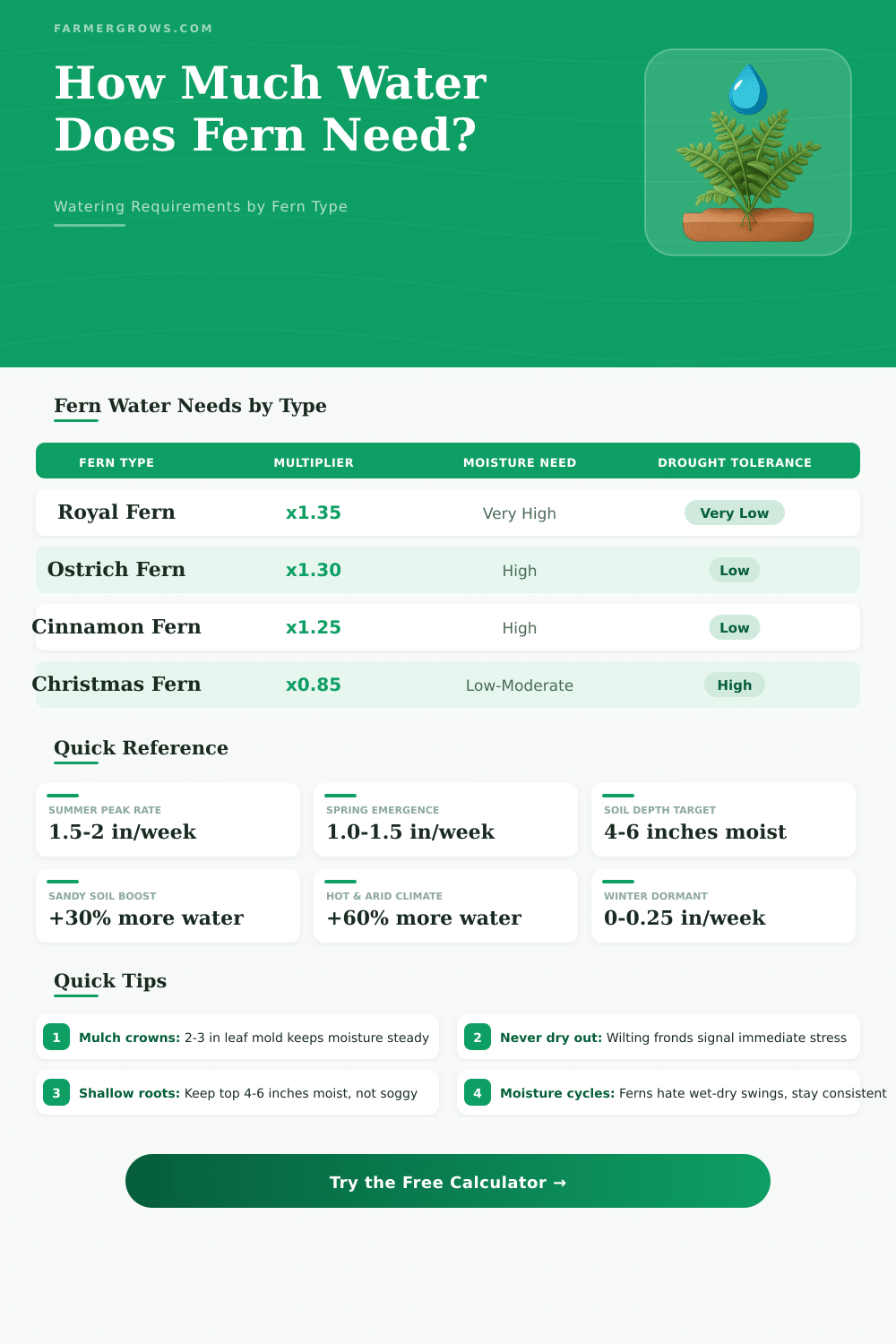
| Fern Type | Water Multiplier | Moisture Need | Drought Tolerance | Notes |
|---|---|---|---|---|
| Royal Fern | ×1.35 | Very High | Very Low | Streamside/boggy; most moisture-demanding |
| Ostrich Fern | ×1.30 | High | Low | Consistently moist soil; streamside plant |
| Cinnamon Fern | ×1.25 | High | Low | Wet to moist; boggy areas ideal |
| Sensitive Fern | ×1.20 | High | Low | Wet areas; wilts quickly when dry |
| Lady Fern | ×1.15 | Moderate–High | Low | Moist woodlands; sensitive to drought |
| Japanese Painted Fern | ×1.00 | Moderate | Moderate | Baseline moisture; adapts well |
| Autumn Fern | ×0.90 | Moderate | Good | More tolerant once established; evergreen |
| Wood Fern | ×0.90 | Moderate | Good | Adaptable; moderate moisture; evergreen |
| Christmas Fern | ×0.85 | Low–Moderate | High | Most drought tolerant; evergreen |
| Season | Water / Week | Frequency | Notes |
|---|---|---|---|
| Spring Emergence (Mar–May) | 1.0–1.5 in (2.5–3.8 cm) | 2–3x per week | New fronds unfurling; keep consistently moist |
| Active Summer Growth (Jun–Jul) | 1.5–2.0 in (3.8–5.1 cm) | Daily or near-daily | Peak demand; critical in heat |
| Mid-Summer Maintenance (Jul–Aug) | 1.0–1.5 in (2.5–3.8 cm) | 2–3x per week | Established plants; watch in dry spells |
| Late Summer / Fall (Aug–Oct) | 0.75–1.0 in (1.9–2.5 cm) | 2x per week | Slowing growth; reduce gradually |
| Fall Die-Back (Oct–Nov) | 0.5 in (1.3 cm) | Once a week or less | Herbaceous ferns dying back; minimal need |
| Winter Dormant (Dec–Feb) | 0–0.25 in (0–0.6 cm) | Only if very dry | Dormant (herbaceous) or minimal (evergreen) |
| Soil Type | Multiplier | Drainage | Notes |
|---|---|---|---|
| Sandy | ×1.30 | Fast | Water more frequently; poor retention |
| Loam | ×1.00 | Moderate | Baseline; ideal for most garden ferns |
| Clay | ×0.85 | Slow | Risk of waterlogging; water less often |
| Rich Woodland / Amended | ×1.05 | Moderate | Good moisture retention; slightly more than loam |
| Climate | Multiplier | Evaporation | Notes |
|---|---|---|---|
| Cool & Rainy | ×0.65 | Very Low | Rainfall covers most needs; supplement only if dry |
| Mild | ×1.00 | Moderate | Baseline; typical temperate conditions |
| Warm & Dry | ×1.35 | High | Significantly more water; mulch essential |
| Hot & Arid | ×1.60 | Very High | Maximum supplemental water; ferns struggle here |
Ferns have roots that go not very deep, so they easily dry outside. For those plants the Water schedule is between the main issues that one must control well. They like lightweight bright ground full of organic materials, and the soil must stay always wet so that the plant benefits.
The trouble lies in that, how much Water to shed and with what frequency.
How to Water Your Ferns
Ferns need balance between the waterings. They want wet soil, neither too dry nor entirely wet. In warm or dry settings they need more Water.
Indoor ferns in jars usually need Water two to three times per week. In winter one can Water every one to three days, while in summer maybe every day. Those plants truly thirst and for those that risk over-watering, Fern plants answer well.
When the upper layer of the soil feels dry, comes the moment to Water again. The ground never leave entirely dry. On the other hand, it should not stay too muddy or soaked.
Some species of ferns do not need always wet soil, but moast do. The soil of ferns always should feel at least a bit wet, what sets them apart from many other house plants.
Use pots with drain holes to help observe how much Water the Fern truly gets. It also protects against over-watering. When Fern does not seem healthy, probably it suffers from either too little or too much Water.
The secret is to find which of those problems happens. One way that works is to dip the jar in a Water bowl for a moment, later remove it and leave to drain. Ferns come from shady and rainy forests, hence they need much Water, but no dry spells.
Water at room temperature answers best. It protects against shifts in temperature that stress the plant. Especially the Boston ferns need much Water and never dry outside.
They come from tropical areas, where the ground stays always wet.
Humidity plays a role too. Misting the leaves now and then is helpful, but a plate with wet pebbles works more to raise the humidity. Simply lay the pebbles or stones on a dish, set the jar up and shed Water, so that the pebbles stay wet.
Double potting forms another option. Take a second tin a bit bigger then that of the Fern and fill it with Water-drinking moss. Many ferns have tender leaves with big surface for the volume and less good ways to keep Water than grasses, so they quickly lose humidity and favor wet places.
Ferns need more care than most house plants. Even so, if the whole upper part curls, then removing the leaves helps to clean and allowrecovery, what commonly works. They can bounce back from a truly bad state.