Fence Post Calculator
Estimate line posts, corner and end posts, gate posts, brace members, post length, concrete, gravel, and waste for farm, garden, orchard, and livestock fence layouts.
Use this as a planning takeoff before digging. Final post size and bracing should match soil strength, frost depth, livestock pressure, wire tension, gate width, and local code.
Fence Material Takeoff
Includes line spacing, perimeter or run count, gate openings, slope allowance, brace style, post length, concrete, gravel, and waste.
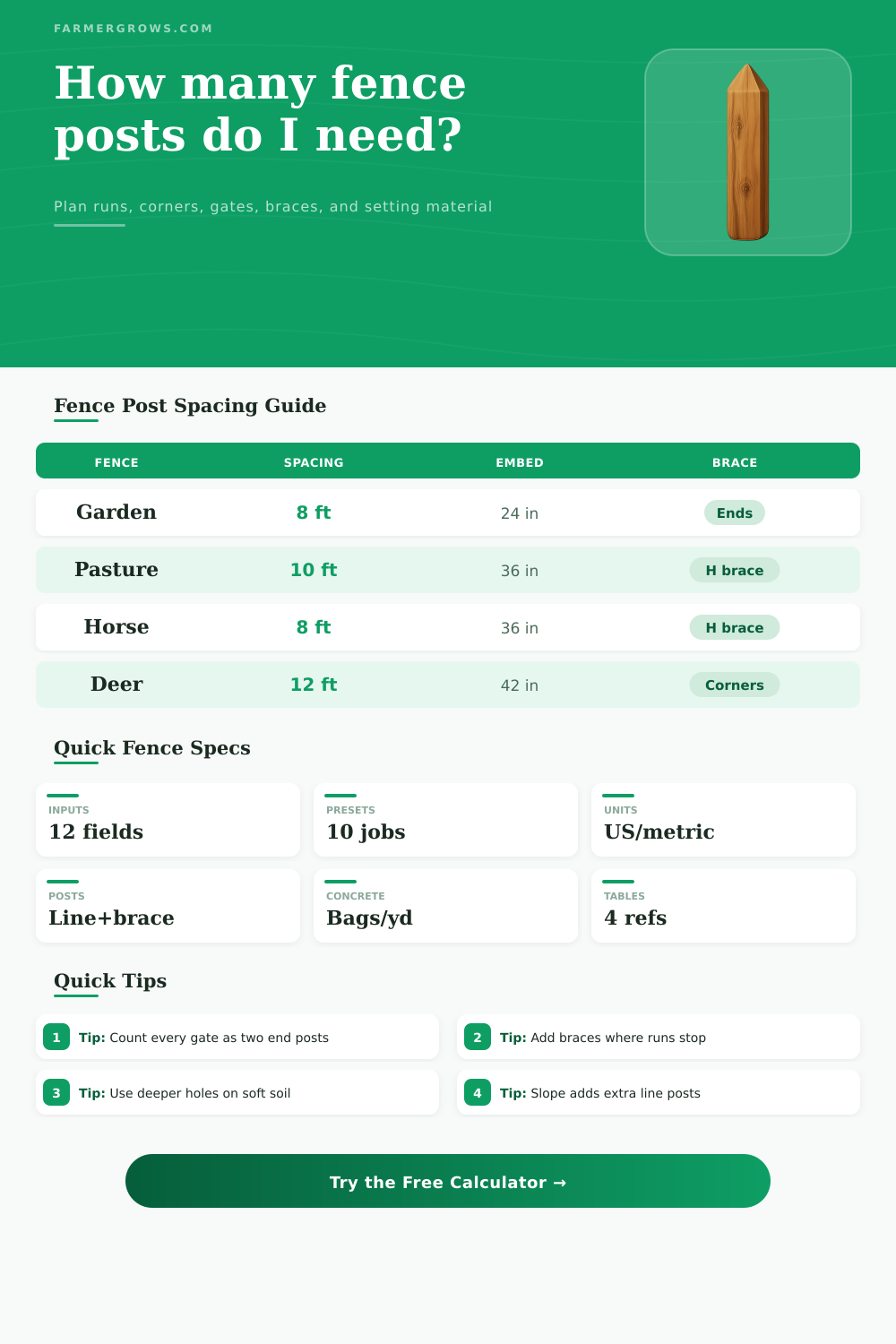
| Fence use | Typical line spacing | Common embedment | Structural post note |
|---|---|---|---|
| Garden welded wire | 6 to 8 ft | 24 to 30 in | Brace corners and gate openings on loose soil |
| Woven wire pasture | 8 to 12 ft | 30 to 42 in | H braces at ends, corners, and gates |
| High tensile electric | 12 to 30 ft | 36 to 48 in | Strong brace assemblies are more important than many line posts |
| Board or rail fence | 8 ft | 30 to 42 in | Rails often control spacing more than wire tension |
| Deer or orchard fence | 10 to 14 ft | 36 to 48 in | Tall corners need deeper setting and wind allowance |
| Hole size | Depth | Concrete per post | 80 lb bags | Gravel for 4 in base |
|---|---|---|---|---|
| 8 in diameter | 24 in | 0.70 cu ft | 1.2 bags | 0.12 cu ft |
| 10 in diameter | 30 in | 1.36 cu ft | 2.3 bags | 0.18 cu ft |
| 12 in diameter | 36 in | 2.35 cu ft | 4.0 bags | 0.26 cu ft |
| 14 in diameter | 42 in | 3.56 cu ft | 6.0 bags | 0.36 cu ft |
| 16 in diameter | 48 in | 5.09 cu ft | 8.6 bags | 0.47 cu ft |
| Brace style | Extra posts per point | Rails per point | Best use |
|---|---|---|---|
| No extra brace | 0 | 0 | Light garden fence, temporary fence, or driven line only |
| Single diagonal brace | 1 | 1 diagonal | Short low-tension runs and small gates |
| H brace | 1 | 1 horizontal rail | Most woven wire corners, ends, and gate openings |
| Double H brace | 2 | 2 horizontal rails | Long high-tension runs, corners, and wide gates |
| Layout example | Total length | Spacing | Base post count | Takeoff reminder |
|---|---|---|---|---|
| 100 x 100 ft garden | 400 ft | 8 ft | 52 posts | Add gate posts and corner braces after line spacing |
| One acre square | 835 ft | 10 ft | 88 posts | Four corners plus one gate often need bracing |
| 660 ft cross fence | 660 ft | 12 ft | 57 posts | Open ends count as structural posts |
| 200 ft board run | 200 ft | 8 ft | 27 posts | Rail length may force exact bay spacing |
| 1,200 ft high tensile | 1,200 ft | 20 ft | 63 posts | Use strong terminal posts at each strain point |
Before ordering posts: Walk the fence line and mark every gate, jog, corner, end, low spot, and steep grade. Those spots drive structural post count more than the straight runs.
Before setting posts: Confirm frost depth, drainage, and soil firmness. Concrete can help gate and brace posts, but a gravel base and tamped backfill may drain better in wet areas.
When you plan a fence, you need to take into consideration that fence posts is experiencing a form of pressure. Fence posts at the corners of the fence will experience more pressure than fence posts that is included in a straight line of fencing. Additionally, fence posts at a gate will experience different material than fence posts that people use along the line of the fence.
Therefore, fence posts must be considered in regard to the areas in which they will experience the most pressure and strength, fence posts must be placed in these areas so that the fence will remain stable overall. Many people will begin planning their fence by measuring the length of the area that they would like to fence in. Such measurements is essential to the building of the fence, but are not the only measurements that are required to be made.
How to Plan and Put Fence Posts
Additionally, the shape of the fence will impact the number of fence posts that is required to build the fence. For example, a straight line of fence will have fewer fence posts then a rectangular fence of the same length. Additionally, a rectangular fence will have more fence posts than a straight line fence due to the number of corners that is present on a rectangle.
Each corner will require a brace assembly to the fence, and each gate will require specific post. These measurements can be made using a calculator, which will allow the individual to determine the number of fence posts that will be required for the fence if any additional gates or corners are added to the fence. The spacing of fence posts will impact both the appearance of the fence and the amount of labor that are required to place each fence post.
For example, if the fence posts are to be closer together, the fence will both appear well and be stiffer. However, the closer the fence posts are to each other, the more labor that will be required to dig the holes for each fence post, and to place each fence post into its hole. However, if the fence posts are placed further apart, less labor will be required in the digging of the fence posts.
However, if the fence posts are too far apart from each other, the fence may sag between each post. Additionally, the type of soil in which the fence is to be built, as well as the slope of the land, will impact the placement of the fence posts. For example, if the land is to be relatively steep, the fence posts will need to be placed further into the fence to step the fence along the slope of the land.
Another consideration for building a fence is the placement of the gate. Gates will remove the length of fence that would be required to line the fence posts, but will require two gate posts that is of a larger diameter than standard fence posts. These additional fence posts are required to allow for the placement of the gate, and to ensure that the gate will not sag into the ground.
Additionally, if the gate is to be established at a corner of the fence, the number of braces that must be built into the fence will increase. If these variables are not considered when establishing a gate, the gate can lead to the fence sag in those areas of the fence. Another consideration in the building of a fence is the depth of the hole in which each fence post will be buried.
Each fence post must be buried deep enough into the ground to prevent the fence post from rotating if the fence wire is stretched. However, if the fence is built to be very tall above the ground but the fence posts are buried relatively shallow into the ground, the fence posts may shift if another animal leans on the fence. Additionally, the fence posts must be set into a setting material, such as concrete or soil and gravel.
The fence posts at the corners of the fence may require the use of concrete to allow for the necessary strength for the fence posts. However, the gravel and soil may be used to allow water to naturaly drain away from the fence posts. It is important to include a waste allowance for fence posts.
A waste allowance of 10% of the total number of fence posts that are to be built is typically sufficient. The 10% waste allowance for fence posts can account for any fence posts that may be miscut during the building of the fence, or any additional fence posts that may be required due to changes to the fence line. A higher percentage waste allowance may be required if the land that is to be fenced in is very uneven, or if long lengths of fence posts are to be cut at the job site where the fence is to be built.
Finally, using a planning tool can be of great benefit to the individual that is to build the fence. A planning tool will force the individual to consider each of the variable for the fence prior to the arrival of the fence posts. Once the individual has the number of fence posts that will be required for the fence, they can begin to consider in which areas of the fence the fence posts will experience the most stress.
By considering the stress that will be placed upon each of the fence posts, the individual can ensure that the fence will hold up over time, and will not require repairs after the winter season.