Fence Material Calculator
Compare wood, vinyl, chain link, wire, and panel fence material lists from perimeter, height, spacing, gates, terrain, waste, concrete, and hardware assumptions.
Choose a starting point for a yard, garden, paddock, pasture, pen, orchard, or utility run. Each preset fills the material type, length, height, post spacing, gates, waste, and terrain.
Fence Material Estimate
The cards round up to whole posts, panels, rolls, rails, bags, and hardware kits so the takeoff is ready for planning.
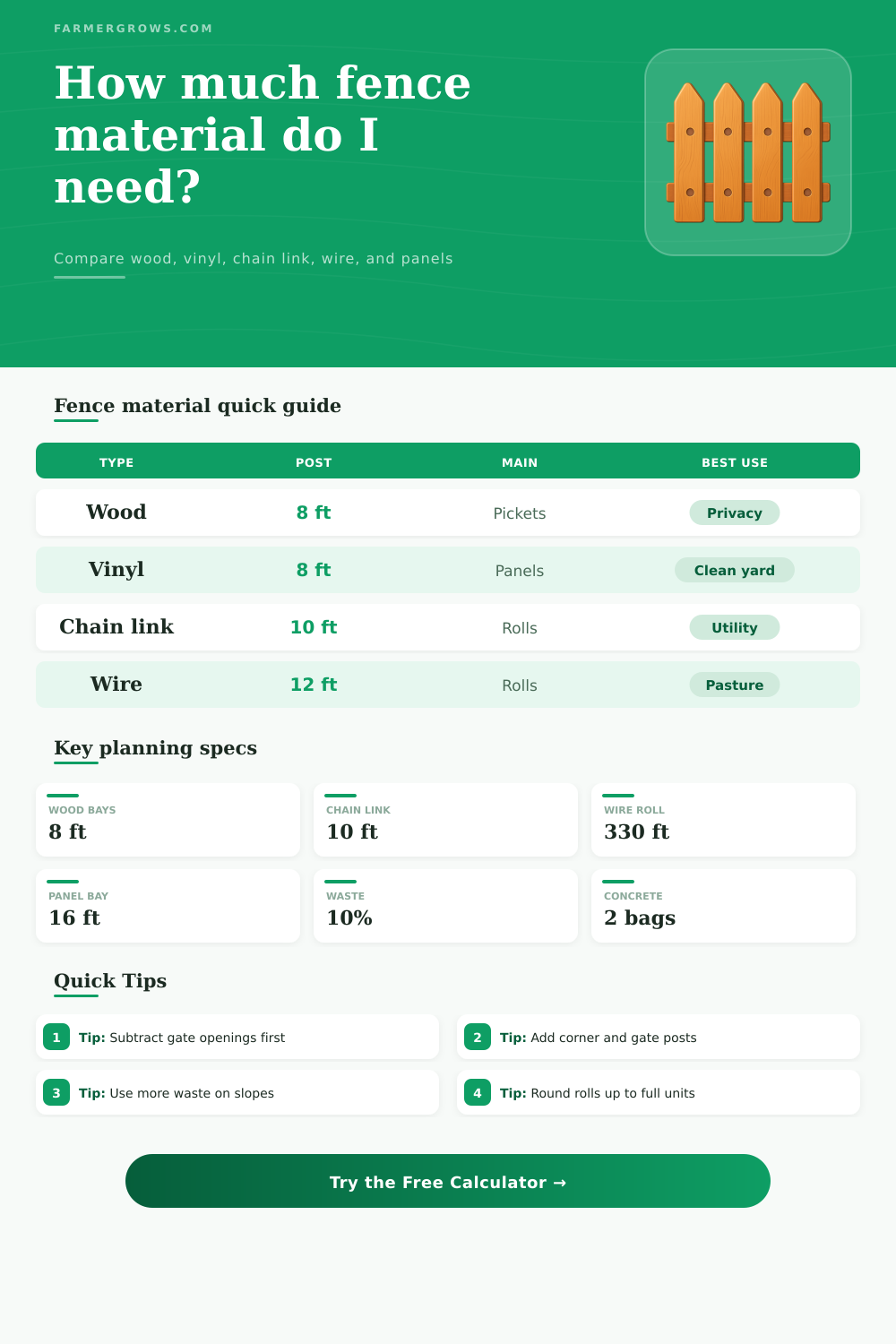
| Material | Main unit | Common spacing | Support material |
|---|---|---|---|
| Wood privacy or picket | Pickets or boards | 6-8 ft posts | 2-3 rails per bay |
| Vinyl panel fence | 6-8 ft panels | Panel width | Panel rails and brackets |
| Chain link fence | Fabric rolls | 8-10 ft line posts | Top rail, ties, tension wire |
| Woven or field wire | 100-330 ft rolls | 10-16 ft posts | Brace wire and staples |
| Livestock panel fence | Rigid panels | Panel width | Panel clips or staples |
| Fence use | Typical spacing | Height band | Notes |
|---|---|---|---|
| Wood privacy yard | 6-8 ft | 5-8 ft | Use closer spacing on windy or uneven lines. |
| Vinyl yard boundary | 6-8 ft | 3-6 ft | Match spacing to the actual panel width. |
| Chain link utility | 8-10 ft | 4-8 ft | Add terminal posts at ends, corners, and gates. |
| Woven wire pasture | 10-16 ft | 4-8 ft | Brace corners and long pulls before stretching. |
| Livestock panels | 8-16 ft | 4-6 ft | Place posts at each panel joint or overlap. |
| Item | Calculator count | Typical allowance | Planning note |
|---|---|---|---|
| Gate opening | Gate count x width | Subtract from run | Panels or fabric should not cover the opening. |
| Gate posts | 2 per gate | Added to post total | Use stronger posts for wide or heavy gates. |
| Concrete bags | Posts x bags per post | 1-3 bags each | More may be needed for tall fences or loose soil. |
| Gate hardware | 1 set per gate | Hinge and latch set | Chain link gates may also need bands and caps. |
| Line hardware | 1 kit per bay | Clips, ties, staples | Material type changes the actual fasteners. |
| Fence component | Common unit | Calculator input | Round-up rule |
|---|---|---|---|
| Wood pickets | 3.5-5.5 in width | Board width plus gap | Round up to whole pickets. |
| Vinyl panels | 6 or 8 ft panels | Panel width | Round up after waste and terrain. |
| Chain link fabric | 50 ft rolls | Roll length | Round up to whole rolls. |
| Woven field wire | 100-330 ft rolls | Roll length | Round up and keep extra for corners. |
| Cattle panels | 16 ft panels | Panel width | Round up to whole rigid panels. |
| Scenario | Perimeter | Material focus | Usual details |
|---|---|---|---|
| Small garden enclosure | 100-160 ft | Wire or panel | One walk gate and closer corners. |
| Backyard privacy line | 160-300 ft | Wood or vinyl | Rails, pickets or panels, and trim waste. |
| Dog run or utility run | 80-220 ft | Chain link | Fabric rolls, top rail, ties, and gate set. |
| Horse or goat paddock | 300-900 ft | Wire fence | Long rolls, braces, and wider gate openings. |
| Livestock panel pen | 64-240 ft | Rigid panels | Panel joints drive the post count. |
Planning a fence requires a systematic approach because fence projects involve many different variable that can affect the total amount of material that a person will have to purchase. Many people feels that fencing a property is a simple task; however, planning a fence is actualy a complicated task because the length of the fence, the types of fencing material that will be used, the number of gates, and the condition of the ground all play a role in determining the total amount of fencing materials that will be needed. It is crucial for fence planners to account for all of these variables to ensure that there will be enough materials to complete the fence installation.
The type of fencing material that will be used will change the components of the fence that will have to be purchased. For example, if you use wood pickets, the fence will need rail and enough space between each picket. Alternatively, if vinyl fence panels are to be used, the width of each panel will impact where the fence posts are placed and how many fence brackets a person will purchase for the fence.
How to Plan a Fence and Count Materials
Chain link fencing is another fencing material that may be selected for utility fence. However, chain link fencing will require fabric, top rail, and tension wire to be purchased as well as terminal fence posts at the corners and gates of the fence as the posts can take more weight. Additionally, woven wire fencing is often used for pasture area as the rolls of woven wire allow the fence to span further distance than individual fence panels.
However, fence posts and brace set will still be required at the corners of a woven wire fence. Lastly, livestock panels are another fencing material often used for pastures as the panels is rigid and require less labor to set up. The panels, however, require a post at every joint of the fence to prevent the panels from sagging in the pasture.
A fence calculator can make it easier for a planner to account for the mathematical requirements of the fence by inputting variables such as the layout of the fence, fencing material, fence height, spacing between panels, the number of gates to be included in the fence, and the terrain on which the fence will be erected. Each of these variables has a specific meaning and will impact the mathematical equation used in the fence calculator. For instance, post spacing is the distance between each fence post and will play a major role in determining whether or not the fence can withstand the force of the wind or the weight of the livestock.
Additionally, the total length of the fence will have to be adjusted to account for the space that will be occupied by the gates as the fence panels will not be required to cover that space. However, extra fence posts will have to be purchased for each gate as the posts for the gates will need to accommodate the gate hardware. Finally, the amount of fencing panels will have to be adjusted to account for potential waste in the fence panels as well as any alterations to the terrain on which the fence will be erected.
The volume of concrete that is required to set each fence post will depend upon the type of fence post and the type of soil in which each post will be set. For example, a single bag of concrete may be enough to set a fence post for a light fence in soil that is packed. However, the volume of concrete that is required for a corner or gate post may be more if the soil is loose.
This variable can be adjusted in the fence calculator as the terrain setting for the fence will increase the amount of concrete that will be allotted for each fence post to prevent the individual from running short of the amount of concrete that is required for the fence installation. Many individuals may focus on the fencing material as the first component of building a fence. However, individuals should focus on the fence hardware as the second component of building a fence.
Additionally, individuals should focus on the hardware prior to the purchase of the visible fencing materials. This is because kits for fence hardware must be purchased for every section of the fence. If the hardware is not accounted for in the purchase of fencing materials, individuals may have to make multiple trips to the store after the fence posts have been set into the ground.
The reference tables included in the page list the hardware that is required for each type of fence. In addition to the fencing materials, there are a number of external constraints and variables for fencing plans. For instance, local setbacks for buildings may prevent the fence from being built in certain areas.
Additionally, the location of buried utilities may also impact the location of fence posts. Furthermore, the agreements between neighbors for fencing materials may also impact the fence plan. The type of livestock that will use the fence will also impact the fence plan.
For instance, the weight of a horse will differ from that of a dog. Additionally, deer may require a fence that is more higher than other fence types. The height of the fence for deer will impact the number of fence posts and bracing material for the fence.
Additionally, the type of soil in which the fence posts are to be erected will impact the depth of each fence post. The depth of the fence posts will impact the amount of concrete for each fence post. In planning a fence, there are a number of steps that an individual should take.
The first of these steps is to measure the actual line of the fence that is to be built. After the length of the fence is measured, the width of each gate can be subtracted from the total length of the fence to account for the area that the gates will occupy. Following the fence length adjustment, the individual can determine the fencing material that will be used for the fence as well as the terrain on which the fence will be erected.
Finally, the fence calculation will provide the individual with a starting count of the amount of fence materials that will be required for fence installation.