
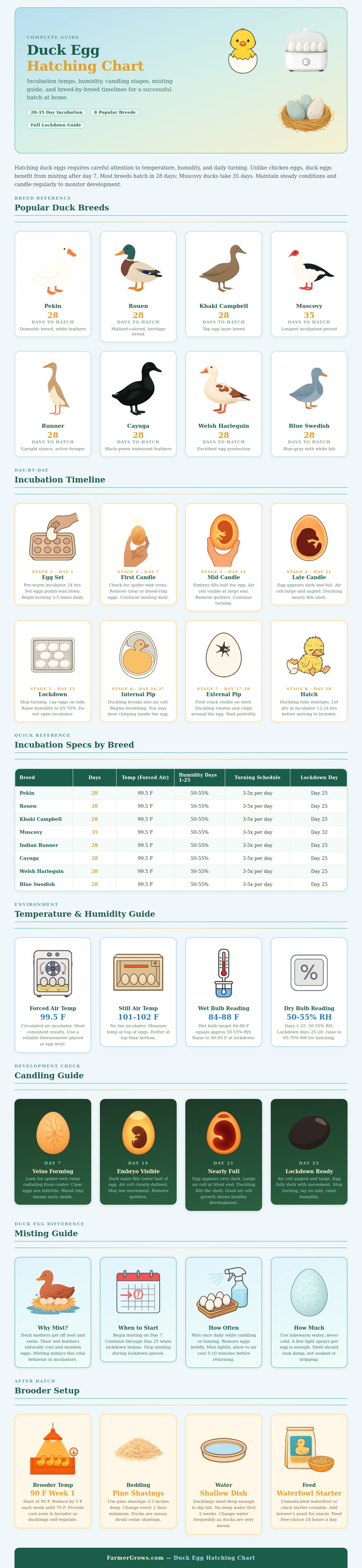
To hatch duck egg, there are specific procedure to follow since duck eggs has different biological requirement to chickens eggs. Duck eggs are larger with tougher shells than chicken eggs, so the humidity and the temperature of the duck eggs has to be more careful managed during the incubation process. Ducklings require more moisture than chicks because their mother duck will wet the egg while laying on a pond.
If the duck eggs do not have enough moisture, the membrane within the eggs can dry out and become leathery which will cause the ducklings to get stuck within the shells. The incubation period for most duck breed is twenty-eight days. However, some breed may take longer to incubate.
How to Hatch Duck Eggs
Before placing the duck eggs into the incubator, allow the incubator to pre-warm for twenty-four hours. You should place the duck eggs into the incubator with the pointed end of the egg facing downward. The eggs should be turned three to five times every day to prevent the embryo from becoming attach to the inner shell of the egg.
If the embryo becomes attached to the inner shell of the duck egg, the embryo will not develop correct which will prevent the duck egg from hatching. Duck eggs can be candled which is a process that check the development of the embryo within the egg. On day seven of incubation, you can candle the duck eggs by holding each egg against a light in a dark room.
A viable duck egg will exhibit vein within the egg, however if the egg is not viable, there may be a blood ring within the egg or there may be no development within the egg at all. You should discard any eggs that are not viable as they may emit odor that could negatively impact the other duck eggs within the incubator. However, candling should not be performed too frequent as the embryos within the eggs may get stressed out from the candling process which could also cause fluctuation in the incubator’s temperature.
The level of humidity within the incubator is another important aspect of the hatching process. During the first two week of incubation, the humidity should be set between fifty and fifty-five percent. You should mist the duck eggs with lukewarm water once per day.
The water should be sprayed onto the eggs until the shells begin to glisten, however, you should not spray the eggs with so much water that water drip from the eggs. Increasing the moisture in the incubator will prevent the membrane from drying out, which is necessary for a successful hatch from the duck eggs. The temperature in the incubator must be maintained throughout the incubation process.
If you use a forced air incubator, the temperature should be kept at 99.5 degrees Fahrenheit. For still air incubators, the temperature need to be set at between 101 and 102 degrees Fahrenheit. Still air incubators tend to lose heat, so a higher temperature is required to ensure that the eggs receive sufficient heat to perform the incubation process.
After the incubation process is approximately 25 days for standard duck breed or 32 days for breeds with longer incubation periods, you must enter the lockdown phase of incubation. During the lockdown period, you must stop turning the egg, lay the duck eggs on their side, and increase the humidity to between 65 and 70 percent. During lockdown, you should not open the incubator.
By opening the incubator during the lockdown phase, you can cause the humidity and the temperature within the incubator to drop. This can lead to the death of the duckling after it begin to move into the air cell within the shell containing the duckling. This process is known as pipping.
You must not attempt to help the duckling emerge from the shell. If you attempt to extract the duckling from the shell, it will die. After the duckling emerges from the shell, leave it within the humid incubator for twelve to twenty-four hours to dry out the duckling complete.
When the ducklings have hatched from the incubator, place them in a brooder. During the first week of the ducklings lives, the brooder should be maintained at 90 degrees Fahrenheit. After the first week, decrease the brooder temperature by five degree each week.
Use two to three inches of pine shaving in the brooder because ducklings create alot of moisture. Place shallow water dish in the brooder so that the ducklings can dip their bill into the water but not get drowned in the water. Add waterfowl starter crumble to the brooder containing niacin, which is a necessary nutrient for ducklings.
Finally, clean the brooder frequently because ducklings create wet environment within the brooder that need to be clean regularly.