💧 Drainage Area Calculator
Estimate gravel footprint, trench volume, bag count, and material weight for swales, French drains, and drainage beds.
Use the shape tool for a pad, basin, or trench footprint. The calculator converts metric or imperial entries, then adds your chosen overage for settling and compaction.
💧 Drainage Results
Estimate the gravel footprint and material demand for your drainage layout.
Calculation Breakdown
| Depth | Sq ft per yd3 | M2 per m3 | Best use |
|---|---|---|---|
| 1 in | 324 | 39.0 | Thin top layer |
| 2 in | 162 | 19.5 | Shallow fill |
| 3 in | 108 | 13.0 | Common trench top |
| 4 in | 81 | 9.8 | Deeper bedding |
| 6 in | 54 | 6.5 | Heavy drainage bed |
| Package | Volume | Per yard | Coverage at 3 in |
|---|---|---|---|
| 2 cu ft bag | 2 cu ft | 13.5 bags | 24 sq ft |
| 3 cu ft bag | 3 cu ft | 9 bags | 36 sq ft |
| 1 cu ft bag | 1 cu ft | 27 bags | 12 sq ft |
| Bulk yard | 27 cu ft | 1 yard | 324 sq ft |
| Project | Area | Cubic yards | 2 cu ft bags |
|---|---|---|---|
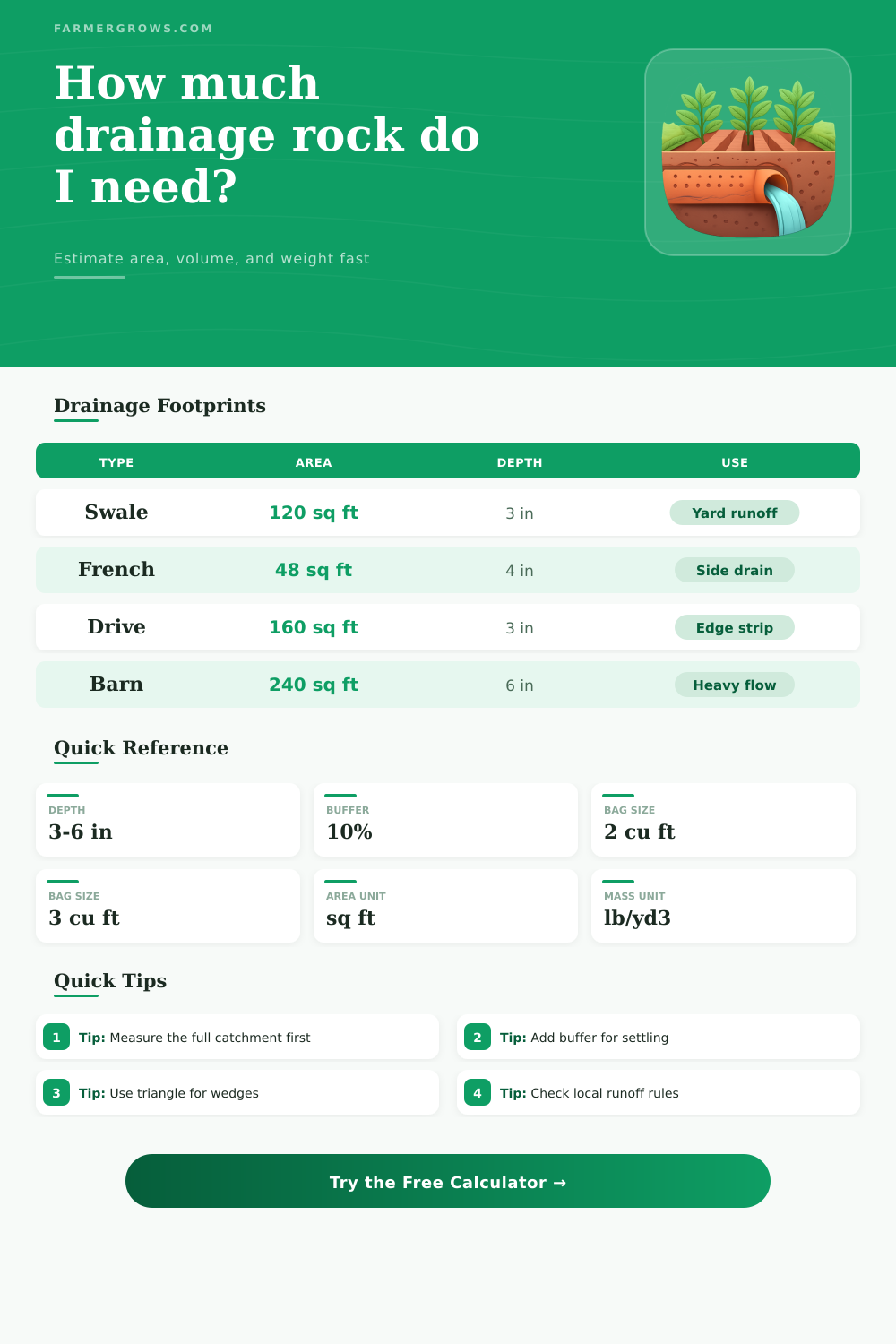
| Backyard swale | 120 sq ft | 0.37 yd3 | 6 bags |
| Shed drain bed | 60 sq ft | 0.19 yd3 | 3 bags |
| Driveway edge | 180 sq ft | 0.56 yd3 | 9 bags |
| Barn runoff line | 240 sq ft | 0.74 yd3 | 10 bags |
Rainwater runoff can damage a property due to the formation of ruts in the ground or the movement of rainwater toward the foundation of a building. If not managed correctly, rainwater can pool in the basement or it can wash out the driveway. A common fix for these drainage issue is to dig a trench and fill it with gravel.
However, unless you calculate the correct size of the drainage area for your location, a drainage system will fail. You have to understand the footprint of the area that you wish to drain and the thickness of the gravel layer that you will place in the trench to effective move the water away from the property. Drainage beds use gravel to create channels for the rainwater to move quick through the bed.
How to Size a Gravel Drainage Bed
Compacted soil prevents water from moving quickly through the soil and is not an effective material for drainage bed. A French drain includes a trench, fabric, a perforated pipe, and clean washed rock. The perforated pipe will siphon the rainwater underground and the gravel will handle any rainwater that overflow the pipe.
Swales are another type of drainage system but works on the surface of the ground. Swales require that the surface area and the depth of the drainage bed match the uphill catchment area that drain into the swale. If the drainage bed is too small for the catchment area, it will become clogged with sand and clay.
If the drainage bed is too big for the catchment area, you will waste money and time building the drainage bed larger then necessary. Measuring the catchment area is vital to building an efficient drainage bed. The catchment area is not the same as the drainage trench.
You must measure the area that will collect the rainwater, such as the roofline, the driveway, and the pasture area. Depending on where the drainage trench is located, you may find that the catchment area is a rectangle 12 feet by 10 feet. If the land slope downward, you may have to calculate the area of a triangle to find the total area that will contribute to the drainage trench.
If the drainage trench is located in a pasture, you could use the same method to calculate the area of a wedge shaped swale. If the drainage catch basin is located under gutters, you may have to calculate the area of a circle. Calculating the size of the catchment area correctly is vital to ensuring that the gravel layer can handle the volume of water from the catchment area.
The depth for the gravel layer depends on the intensity of the water that runs through the area. For light yard drainage, three inches of gravel is sufficient. Three inches of gravel allow one cubic yard of gravel to cover 108 square feet.
For heavy runoff from a barn or paddock, six inches of gravel is recommended. However, six inches allows only 54 square feet of coverage by one cubic yard of gravel. The gravel should allow water to pass through but not get clogged with sand or clay particle.
The type of gravel that you choose will also affect the weight of the gravel. For instance, washed drain rock weighs approximately 2,450 pounds per cubic yard, while river stone weighs approximately 3,000 pounds per cubic yard. Crushed stone locks together well and is good for building driveways.
However, pea gravel is helpful when building drainage beds because it move more easily under pipes. The weight of the material will also change, so when purchasing gravel in truckloads or bags, it is vital to account for these different weight. You must include a buffer to account for the settling that gravel will undergo over time.
Depending on the location of the gravel area, it will settle between five and twenty percent due to rain and footsteps. If you order gravel in bags, a two-cubic-foot bag of gravel will cover 24 square feet at a depth of three inches. However, the same bag will only cover 13.5 square feet at a depth of six inches.
One cubic yard of gravel will cover 324 square feet at a depth of one inch. However, you have to calculate how deep the gravel bed should be. Mathematical error are likely when people plan the drainage bed incorrectly.
When building a drainage swale for a lawn area, you must include a pitch of the swale to ensure the swale does not pond with the water from the yard. If water ponds in the swale, it means the drainage system is not performing correctly. A preset layout for drainage beds will make it easier to dig the trenches when you have to complete several drainage project.
Rectangular layouts work for greenhouses, while circular layouts work for orchards. Long, narrow layouts will work best for creating drainage beds along the lines of paddocks. Calculate the volume of gravel required for each project in cubic yards or meters.
Then round up the number of bags of gravel that would cover the project area. Also, calculate the weight of the gravel that will be needed based on the density of the gravel type. For example, a runoff area of 240 square feet from the barn will require 0.74 cubic yards of gravel.
This would be around ten two-cubic-foot bag of gravel at a weight between 1,600 and 2,000 pounds. There are tradeoffs for gravel of different size. Bags of gravel are best for small projects of 60 square feet or less.
Bulk gravel is better for building drainage beds for large projects like a 180-foot driveway strip. Lightweight gravel is helpful for drainage beds near a swimming pool. Coarse sand is helpful in drainage basins to filter the sand and clay particles.
Use coverage tables to determine how many square feet a yard of gravel will cover at a specific depth. For example, a depth of four inches of gravel will cover 81 square feet of ground with one yard of gravel. However, a depth of six inches will only cover 54 square feet.
Finally, during the planning phase for building a gravel drainage bed, account for the overages and the weight of gravel. Although a small amount of extra gravel may seem unimportant, the weight of the gravel will be significant. For example, use the weight ranges for gravel to account for the weight difference between wet and dry gravel.
However, if you take the footprint of the drainage bed and the depth of the gravel layer, account for how deep the gravel bed should be for the amount of water that will fall on the area, and include a buffer for the gravel settling over time, the drainage system will work for your benefit. It will keep your yard firm and your foundation dry.